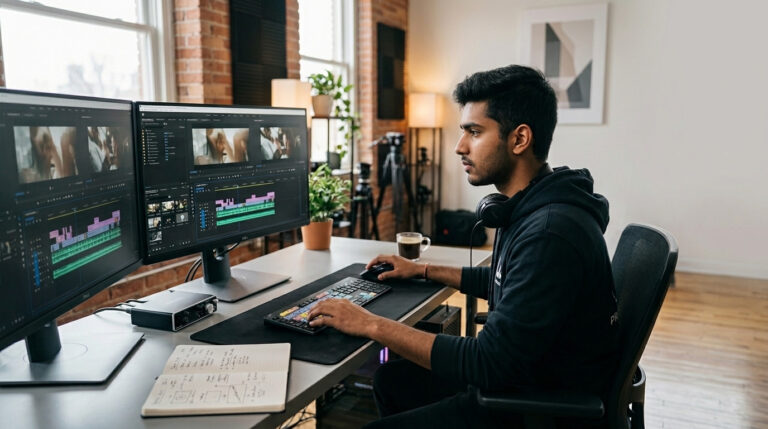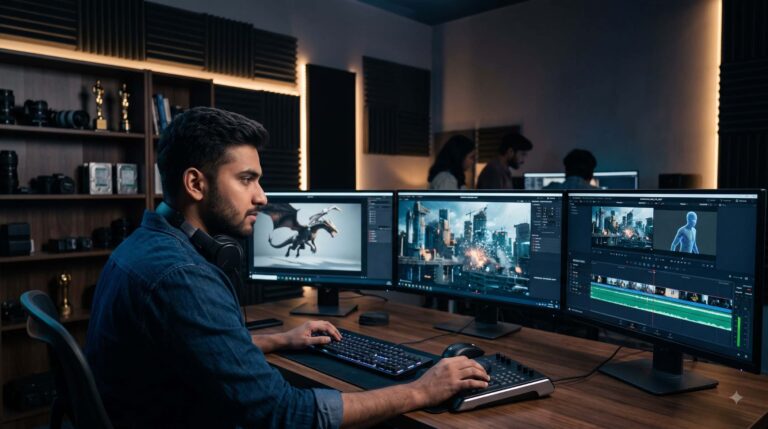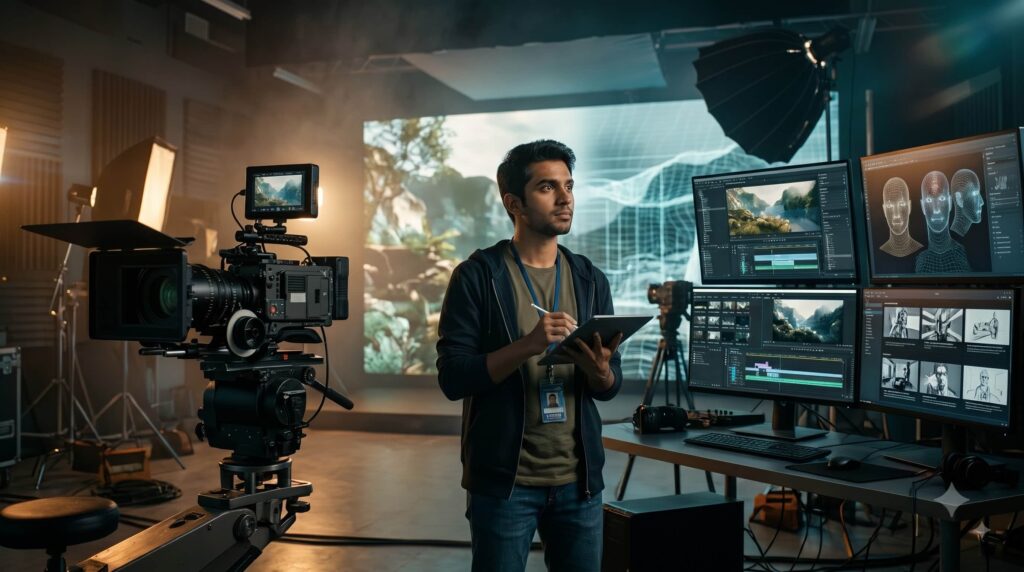
Students are concerned about how AI is changing the film industry. The actual truth is AI is making slow, repetitive film tasks much faster and cheaper, thus adding even more importance to human abilities such as storytelling, directing, and creative taste. The implementation of the AI in the film industry project is not an experiment anymore or just a new trend. In the film industry this technology is used in writing, filming, editing, dubbing, and marketing.
For students, it may seem both exciting and terrifying at the same time. The software you learn today may be outdated in two years. However, the essence of cinema remains the same. It is the story, visuals, and emotions that matter in the end.
In this guide, you will learn:
- implementation of AI in the film industry, step-by-step
- How AI is influencing Indian and Malayalam cinema
- Which film positions are in danger, and what positions are safe
- The AI technologies film students must learn
- How to get a successful film career in the AI world
What Does AI in the Film Industry Actually Mean?
AI for the film industry involves the use of advanced software that learns from vast amounts of data to provide assistance in various filmmaking operations such as screenwriting, pre-production, editing, VFX, sound design, dubbing and marketing. Here what AI does is identify patterns and uses them to make recommendations and generate images, video and audio content.
The majority of applications of AI for filmmaking belong to two relatively easy categories:
- Assistive AI: Assistive AI means the tools that will help you get your job done quicker. Examples: auto-transcription software in editing software, automatic color matching and quick background removal.
- Generative AI: Tools that generate something new based on text prompt or image input. Examples of generative tools are text-to-video generators, AI concept art and AI voice generation.
A simple analogy that may be used to comprehend it is the following. Assistive AI is like a super-fast personal assistant working quickly. Generative AI is like a junior artist who sketches concepts in seconds but needs a director to determine what is good and what is bad.
This is crucial because even though AI creates large amounts of content in a short period, choosing content that suits the narrative remains within the realm of human activity.
How Is AI Used in Movies Today?
Almost all aspects of film production are enhanced by AI today, from the first script writing to a trailer that one watches on Instagram. In the vast majority of cases, AI doesn’t make a complete movie. AI takes care of small and tedious activities, allowing the team to focus on creative decisions. Below is how AI in film production:
AI Scriptwriting and Story Development
There are several AI tools that assist writers in developing ideas, plots, and character backgrounds and breaking down a script into scenes, locations, and props. It is also used by producers to calculate budgeting and schedule filming.
Is AI able to create a movie script? Yes, but the screenplays might get too boring and predictable. It doesn’t have its own stories like humans do, think or imagine. An author who uses both AI and conducting research will get the best outcome.
Storyboarding and Previsualization
Just with a script, AI can create concept art and storyboards in minutes. Allowing filmmakers to present their ideas to producers without spending money on a complete art team.
- Fast location and costume concept art
- Quick storyboarding for defining camera angles
- Basic animation for visualizing scenes
AI in Film Production and Cinematography
Throughout the process, AI works with the camera and the production team to make the process the fast instead of replacing them.
- Virtual production: Big LED screens display digital backgrounds moving together with the camera, which allows actors to act within the scene.
- Smart camera tracking: AI can help match the movement of the camera and digital mechanisms.
- Planning tools: AI can recommend on the lightning arrangement, predict weather and handle call sheets.
AI Video Editing and AI Colour Grading
In post-production, the presence of AI can be experienced by the students. AI video editing capabilities can transcribe the dialogue, select the right takes, detect scene transitions and even create a basic cut. This helps save time from repetitive routines for editors.
AI colour grading tools can synchronise the colours of two scenes, correct skin tone and create a certain style throughout the entire movie. However, the final decision on the mood remains with the colourist.
AI in VFX and AI Visual Effects
AI in VFX has revolutionised some of the most exhausting processes in the VFX business. Rotoscoping involves cutting out objects frame by frame and took days earlier. Now AI can perform an early roto in minutes.
Popular AI visual effects techniques are as follows:
- Removal of wires, logos and other unwanted objects
- Sky replacement and background replacement
- De-aging and digital doubles creation
- Resolution upscaling of low-res footage
- Creation of brief clips using text-to-video technologies
Sound, Dubbing, and Localization
AI helps filmmakers remove unwanted noise, generate temporary tracks and even make voiceovers. In India, the largest application for AI in the film industry is dubbing. AI can perform translation and lip-syncing to make the film appear natural in Hindi, Tamil, Telugu, Kannada, and Malayalam languages.
Marketing and Distribution
In studio, AI technology is in editing trailers, testing posters, writing social media posts and analysing consumer preferences. AI technology is used by the streamers to choose films to be displayed on your homepage.
How is AI technology being utilised in Indian and Malayalam Films?
The use of AI in Indian Cinema has become more common when compared to other nations. It is widely used to make entire films, translate movies, and even for editing. The main reason for the adaptation is the low budget and the push from streamers.
What About Malayalam Cinema?
Malayalam movies are well known for excellent screenplays that are produced at low budgets. This makes AI helpful for small tasks that may not be so significant, like VFX cleaning, efficient editing, and dubbing in order to release a movie all over India. Monica is considered India’s first AI movie, and the Malayalam song, assisted by AI, was released in 2026 on YouTube.
This approach does not find support in everybody. Upon the release of an older Hindi movie with a modified ending due to AI technology, the people who worked on the original movie criticised the ethical side of the modification. For students, this case is a great example of using AI. Being able to apply AI is essential. However, knowing when not to use it is equally important.
Will AI Replace Filmmakers?
So, will AI replace filmmakers? No. AI will not replace good filmmakers, but it will replace many actions which were done before manually. Those who know how to tell a story, manage a team and take decisions creatively have an advantage.
This is a real trend, however, and college students shouldn’t overlook it. Fast Company mentioned that 41,000 jobs from films and television shows vanished in Los Angeles County within three years. AI is not the only cause of this trend; there were also strikes and cost-cutting.
| What AI does well | What humans still do best |
| Sorting and tagging footage | Deciding what the story is about |
| First-pass rotoscoping and clean-up | Directing actors and getting real emotion |
| Rough cuts and transcripts | Choosing rhythm, pace and tone in the edit |
| Matching colours between shots | Creating a unique visual style |
| Fast concept images | Understanding culture, humour and local life |
Can AI Replace Film Editors and VFX Artists?
More transformation is expected here rather than elimination. The editors will use less time on editing and matching clips and more on creating an engaging story. The VFX artists will spend more time designing and solving the problems. The editors and artists who are skilled in using AI tools will usually be faster.
Which Film Jobs Are Safe From AI?
These positions rely greatly on human opinion:
- Directors and creative producers
- Screenwriters with unique style
- Cinematographers responsible for lighting and mood creation
- Actors and performance coaches
- Editors and colourists
- VFX artists and art directors
- Production managers working with people
The jobs requiring taste, leadership and human interaction are difficult to replicate by AI.
Film Careers in the Age of AI
Film studios currently require individuals having experience in conventional filmmaking along with familiarity with AI technologies. According to a report by Semafor in September 2026, film executives are likely hiring individuals experienced with AI rather than training their current employees.
Is Filmmaking a Good Career after AI?
Yes, it is still a good career choice, but the real difference lies in the way one enters into filmmaking. There will be very few beginners hired for performing basic tasks and logging tasks.
New and Growing Roles
- Generative video artist: shots, concepts and visual ideas are created by the AI tools.
- AI-assisted editor: Fast work via AI, but owns the story and the edit.
- Virtual production technician: LED walls and real-time engines are controlled on set.
- Previs artist: fast visualisations for scenes before filming.
- Localisation and dubbing specialist: Oversees AI dubbing for multiple languages.
- AI content supervisor: Quality check, rights and consent control
Skills That Every Film Student Must Develop Today
- strong basics first: Arrangement, lighting, editing, colour grading and storytelling basics. AI can’t save a bad concept.
- Tool knowledge: Obtain at least one AI tool per step in your process.
- Prompt writing: Clear and specific prompts will produce much better results from AI.
- Storytelling skills: Your unique voice and cultural background can’t be replicated by AI.
- Team spirit and communication: A well built team is required for film.
- A proper portfolio: Showcase your own decisions and choices, not just AI-generated material.
What AI Tools Should Film Students Learn?
students will generally begin with a few AI tools for filmmakers covering writing, visual effects, editing and sound. In the initial state, you do not have to know all new apps. Choose one app per category, learn how to use it and check on upgrades from time to time. Here are some AI tools used by film students that you can use as a starting point:
| Stage | Tool examples | What it helps with |
| Script and research | ChatGPT, Claude, Gemini | Brainstorming, script notes, scene breakdowns |
| Concept art and storyboards | Midjourney, Adobe Firefly | Mood boards, locations, character looks |
| Video generation | Runway, Google Veo, OpenAI Sora | Short shots, test scenes, visual ideas |
| Editing | Adobe Premiere Pro, Descript | Transcripts, text-based editing, rough cuts |
| Colour and finishing | DaVinci Resolve | Colour matching, clean-up, upscaling |
| Voice and sound | ElevenLabs, Adobe Podcast | Voice-overs, dubbing tests, audio clean-up |
| Virtual production | Unreal Engine | Real-time backgrounds and previs |
Here are some useful pointers:
- In the beginning, the majority of tools will provide free versions or have student discounts, so try it out and know which tool is necessary.
- Technology changes fast, so know the principle behind the tools.
- Save copies of your original works; they will be the proof of your creativity.
AI Filmmaker in India
The first thing to do when learning how to become an AI filmmaker in India is to master regular filmmaking, then learn how to use AI for your work. There is no way around. The best AI filmmakers are good filmmakers first.
- Learn how it works: Attend a course in screenwriting/cinematography/editing/visual effects to learn the core of filmmaking.
- Mix AI gradually into your process: Introduce one AI tool into each stage of your workflow while working on small projects.
- Shoot short films: Produce 1-3-minute films, music videos, commercials with combination of live and AI footage.
- Take part in AI Film Festivals and competitions: India has its own film festivals dedicated to AI films.
- Establish an online presence: Promote your work through YouTube, Instagram and LinkedIn.
- Contribute to other projects: get to know some local production companies and try to contribute.
Ethical Guidelines for Films that Every Film Student Should Know
AI ethics are just another part of professionalism. Remember these principles at all times:
- Consent: Never reproduce the face or voice of an actual person without consent.
- Copyright: AI generated images and music should be avoided because of copyright.
- Transparency: Inform the client about the AI usage in your film.
- Attribution: humanly acknowledge everyone involved in making the film.
- Deepfakes: no manipulation using AI
Conclusion
AI and the future of films in the film industry can be summarised into the following key point: AI has changed the way in which films are produced but not the reasons why people choose to watch them. It has automated many tedious and repetitive tasks involved in the process of screenwriting, editing, special effects and dubbing. It has also increased the importance of such human skills as writing stories, directing and critical thinking.
The following steps should be noted:
- Develop strong filmmaking fundamentals first.
- Gradually learn how to use AI in filmmaking.
- Honour others’ creativity when using AI.
- Continue producing films with your own vision.
Students who follow these guidelines will never be replaced by AI but rather use it to create great stories on small budgets.
Start Your Film Career With Tiju’s Media School
Are you interested in being part of the world of cinema? Then Tiju’s Media School provides diploma courses that cover both traditional methods and modern techniques in filmmaking.
Frequently Asked Questions:
A: AI in filmmaking refers to advanced software trained on vast datasets that identifies patterns to assist in tasks across screenwriting, pre-production, filming, video editing, VFX, sound design, dubbing, and marketing. It mainly falls into two categories: Assistive AI (tools that speed up routine tasks like auto-transcription and background removal) and generative AI (tools that generate new content from prompts, such as concept art and video clips).
A: No. AI will not replace good filmmakers, though it will automate many manual, repetitive actions. Core creative decisions, such as deciding what a story is about, directing actors, shaping tone and rhythm, and understanding cultural nuance still require human taste, leadership, and emotional depth.
A: While AI can generate a screenplay, the output is typically predictable and lacks the lived experiences, original thoughts, and emotional depth that human writers bring. AI works best as a writing assistant for brainstorming, research, outlining, and scene breakdowns.
A: Roles that rely heavily on human judgement, emotional nuance, personal vision, and teamwork are the least vulnerable. These include:
Directors and creative producers
Screenwriters with distinct voices
Cinematographers responsible for lighting and mood
Actors and performance coaches
Editors, colourists, and art directors
Production managers overseeing human teams
A: In India, AI adoption is driven largely by low production budgets and streaming platforms. It is widely used to assist in full productions, edit archival footage, and power multilingual pan-India dubbing with lip-syncing across Hindi, Tamil, Telugu, Kannada, and Malayalam. In Malayalam cinema, where screenplays excel on lean budgets, AI helps with VFX clean-up, streamlined editing, and dubbing.
A: The integration of AI has introduced specialised technical and creative positions, including:
Generative Video Artist: Creates visual concepts, test shots, and assets using AI video tools.
AI-Assisted Editor: Uses automated workflows to cut faster while preserving narrative flow.
Virtual Production Technician: Operates real-time game engines and LED volumes on set.
Previs Artist: Rapidly generates pre-shoot scene visualisations.
Localisation & Dubbing Specialist: Manages multilingual AI translation and voice synchronisation.
AI Content Supervisor: Handles legal compliance, usage rights, and consent verification.
A: Students should learn one core tool per production stage:
Writing and Research: ChatGPT, Claude, Gemini
Concept Art & Storyboards: Midjourney, Adobe Firefly
Video Generation: Runway, Google Veo, OpenAI Sora
Editing and Transcription: Adobe Premiere Pro, Descript
Colour and Finishing: DaVinci Resolve
Sound and Voice: ElevenLabs, Adobe Podcast
Virtual Production: Unreal Engine
A: Key ethical standards include:
Consent: Never clone or reproduce an individual's face or voice without explicit permission.
Copyright: Exercise caution with AI-generated visuals and audio to avoid intellectual property infringement.
Transparency: Always disclose AI involvement to clients, audiences, and festival organizers.
Attribution: Give proper credit to every human contributor involved in the production.
No Deepfakes: Never use generative tech to deceive, falsify, or manipulate people.