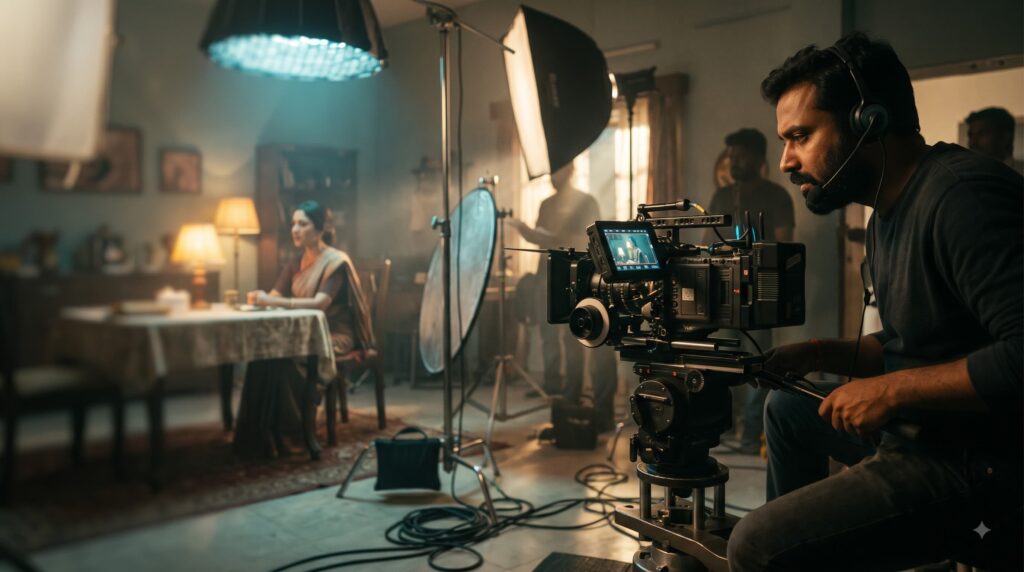
Mood is created by cinematographers through manipulation of five elements: lighting, colors, composition, camera movement, and lenses. They determine what kind of mood to set for the shot and then pick up the settings that will provide such a mood. For instance, when the room is lit using just one candle, it becomes very tense, but if you open the curtains and allow the warm afternoon sunlight into it, the mood changes.
Therefore, “How do cinematographers create mood?” The first question they ask for every shot is, ‘What should the audience feel?’ Then they answer it with a lamp, a colour, a lens, or a camera move. This is the heart of visual storytelling in film, and it is the first thing we teach in the Tiju’s Media School cinematography course.
What is mood in cinematography?
Mood in cinematography is how a scene feels to the viewer before any dialogue takes place. This is the tension that you feel when watching a scary hallway scene in a movie or the coziness you experience during an eating scene in a family setting. The creation of a mood is done using the camera, not the screenplay.
Tone versus mood in film production is usually confused. The former refers to the attitude that the movie creator has toward the story he or she is telling, while the latter refers to the feelings of the audience after viewing a certain scene. The job of the cinematographer director of photography (DP) is to convert the tone of the director into a mood that the viewer experiences.
The cinematography techniques for mood listed below are interlinked, and all are usually applied by the DP simultaneously.
Light and Dark: How is Mood Created Through Lighting in Film?
Mood is created through lighting by choosing to reveal or conceal certain elements from the viewer. Even bright lighting seems transparent. Deep shadow feels secretive. Among all the film lighting techniques, this is the one that shapes feeling most.
Hard light vs soft light
- Hard light comes from a small, direct source like the noon sun or a bare bulb. Sharp shadow edges, every line on a face visible. Harsh, dramatic, and confrontational. Film noir runs on it.
- Soft light comes from a big or diffused source, an overcast sky or a lamp bounced off a wall. Shadows fade gently. Most romance lighting is soft, and a bedsheet in front of a lamp is all the diffusion you need to get there.
Where the light comes from
The direction of light changes the emotion even when the brightness stays the same:
- Key light from the front looks flat and clean. Good for comedy, news and interviews.
- Light from the side, often called chiaroscuro, splits the face into a bright half and a dark half. It suggests a character with two sides, or someone hiding something.
- The backlight or rim lighting highlights the contours of the human form. Keeping the front dark creates a silhouette, and it evokes an aura of mystery or menace.
- Top lighting drops the eyes into shadow. You cannot read the character’s expression, so you do not trust them.
- Under lighting, from below the chin, is the classic horror lighting trick. Faces never look like that in real life, so the brain reads it as wrong.
High-key and low-key lighting
Lighting Ratio: Lighting ratio refers to the difference between the key light and the fill light used to soften shadows.
- High-key lighting has a low ratio. Everything is bright, shadows are weak, contrast is low. It feels happy and safe. Think of a wedding video or a TV comedy.
- Low-key lighting has a high ratio. Most of the frame sits in darkness. It feels tense and moody because the audience fills the dark with their own imagination. Thrillers and crime dramas live here.
What is low-key lighting used for? Suspense, secrecy, danger, grief. Any moment where the DP wants you wondering what is in the dark.
Motivated and natural light
Motivated lighting is where the source of light comes from something seen in the frame, be it a window, lamp, or even a phone screen. Such elements act as practical lights. Motivated lighting feels real, while unmotivated lighting looks staged. DPs from Kerala use natural lighting quite often. Monsoon clouds make up one large soft box, while the golden hour by the backwaters surpasses any man-made lamp.
How do cinematographers use shadows? As a subject in their own right. A shadow crossing a wall, or a doorway left black, tells the audience something is being held back.
Try this: sit a friend by a window in the evening. Shoot with the window in front of them, then beside, then behind. Three moods from one phone. It is the first exercise in the cinematography courses in Kerala at Tiju’s Media School.
Colour and Temperature: How Does Colour Create Mood in Film?
Colour sets a tone since the brain processes colour before anything else is processed. Warm colours feel closer while cool colours feel farther away. Colour in filmmaking begins with lighting on set and ends in the grading suite.
Colour temperature
All light sources have colours, measured in Kelvin. That measurement is what colour temperature in film refers to.
- Tungsten 3200K: household bulbs, candles, sunset. These give warm tones of orange and gold. Warmth reads as home, love, memory and comfort. Pushed too far, it reads as heat, sickness or decay.
- Daylight 5600K: midday sun, overcast sky, most LED panels. These give cool tones of blue and grey. Coolness reads as loneliness, distance, hospitals, technology and grief.
What does colour temperature do in film? It sets the emotional baseline before anything happens. A bedroom lit at 3200K feels like a place someone loves. The same bedroom lit at 5600K feels like a place someone left.
Mixing the two in one frame, say a warm lamp inside and blue evening light through the window, puts two feelings in one shot. The DP sets white balance to favour one side so the other reads as deliberately warm or cold.
Building a colour palette
A colour palette is the small set of colours a film allows itself. The DP plans it with the production designer during pre-production planning, and the colourist finishes it in colour grading. Basic colour theory gives three common approaches:
- Monochromatic: single colour but with variations of lightness and intensity. A blue film feels drowned in melancholy. An amber film feels frozen in the past.
- Complementary colours: two colours which are complementary to each other. Orange and teal combination of colours gives that energy and glow effect because of the contrast between warm skin and a cool background. That is why many action films adopt this colour scheme.
- Desaturated film: colour removed and film looks almost grey. It feels bleak or exhausted. War films and social films tend to be of this sort.
A LUT (lookup table) applies the palette to footage in one step during the grade. It cannot rescue a scene lit at the wrong temperature, though. Mood has to be right on set.
Malayalam cinema cinematography has a strong tradition here. Rain, green paddy, red earth and old wooden houses give Kerala DPs a palette most regions never get. Shooting that landscape well is a big part of any good diploma in cinematography in the state.
Try this: shoot one corner of your room under a warm bulb, then under window light only. Put the two stills side by side.
Composition and Spatial Design: Where You Put the Subject
Composition creates mood through where the subject sits and how much space surrounds them. The centre of a tidy, symmetrical frame reads as powerful, or trapped. Pushed into a corner with empty space all round reads as small and alone. “Cinematographic composition” tells the viewer where to look and how to feel after viewing it. Framing principles containing emotion
- Thirds rule: align the subject with one of the dividing lines of the frame. It gives an emotional and balanced sensation; therefore, it is considered the standard one.
- Centre framing: put the subject dead centre. It feels formal, confrontational or strange. Directors who love symmetry use it to make ordinary rooms feel unsettling.
- Leading lines: roads, corridors, railings and rivers pull the eye toward the subject. They add order and direction, or a sense of being pulled somewhere you do not want to go.
- Negative space: leave most of the frame empty. The subject looks isolated, vulnerable or overwhelmed by the world around them.
- Frame within a frame: shoot through a doorway, a window or between two people. The inner frame boxes the character in. It seems as though you are watching a person trapped or being spied upon.
- Depth: foreground, mid-ground, background
The flat picture seems like a photograph, while the layered one seems like a space. DPs think in foreground, midground, and background: a blurred shoulder up front, the actor in the middle, a lit doorway behind. Fog, rain and dust deepen this further, and the monsoon hands you all three.
Headroom, lead room and short siding
-
- Headroom is the space above the head. Too much shrinks the character; too little feels tight.
- Lead Room is the area before the face. With lead room in the picture, the feeling becomes calm.
- The Short Side reverses this idea. The character faces the near edge, while the background area is left blank.
Visual weight and blocking
Visual weight is how hard something pulls your eye. Bright things, faces and lone figures pull hardest. Blocking is where the actors stand. Two people far apart in a wide frame feel estranged; jam them into a tight two-shot and they feel intimate, or hostile.
The frame shape matters too. A wide 2.39:1 aspect ratio suits scale and landscape. A boxy 4:3 feels old, private or closed in. It gets decided in pre-production planning and shapes every frame after.
At Tiju’s Media School, composition gets taught on real streets around Mavelikara and Thiruvalla. Students frame one corner ten ways and compare. Testing instead of guessing is why many call it the best cinematography diploma in Kerala for people who learn by doing.
Camera Movement and Rhythm: How Does Camera Movement Affect Mood?
Camera movement affects mood by changing where the audience feels they are standing. Still camera, calm observer. Shaky camera, nervous participant. A slow glide can feel like a dream, or like being followed. Camera movement techniques are the nearest thing a DP has to a pulse.
Handheld vs smooth
- A static shot on a tripod feels stable and patient. Horror uses it a lot; you sit there waiting for something to move.
- Handheld adds drift and shake. Urgent, real, anxious. Documentaries and panic scenes.
- Steadicam, gimbal and dolly moves float. Elegant, dreamy, romantic. Yet a smooth camera trailing someone down a corridor feels like a hunter. Same move, opposite mood, depending on pacing and context.
The most useful moves and what they feel like
- Push-in: the camera moves toward a face. A realisation, a decision, a threat. Leaning in, basically.
- Pull-out: the camera backs away and the character shrinks into the space. Loss, loneliness, or a reveal of scale.
- Tracking shot: the camera travels beside a moving subject. Companionship or pursuit.
- Pan and tilt: turning left-right or up-down from one spot. A slow pan builds suspense; a whip pan is a jolt.
- Crane shot: the camera lifts above the scene. Grand, final, godlike. Lots of films end on one.
- POV shot: the camera becomes the character’s eyes.
Camera angles and power
- Low angle, looking up at a subject, makes them feel powerful or dangerous.
- High angle, looking down, makes them feel small, weak or trapped.
- Dutch angle, with the horizon tilted, tells the audience that something is wrong with the world or with the character’s mind.
Beginners over-move. Every shot glides, every scene has a drone, and it wears the viewer out. Good DPs move the camera when the feeling asks for it. In the Tiju’s Media School cinematography course, students shoot one short scene locked off, handheld and on a gimbal, then watch the three back to back. The lesson takes ten minutes and tends to stick.
Optics and Lens Character: How Do Lenses Affect the Mood of a Film?
Lenses impact moods in the way they manipulate space. With a wide-angle shot, distance is exaggerated; rooms expand and faces distort. With a telephoto shot, distance is compressed; everything is close and intimate. Lens selection in cinematography is not noticed by many viewers, yet it determines whether a scene is open, closed, realistic, or dream-like.
Focal length
The focal length of the lens is its numerical designation in millimeters, which controls how much space is captured and the sense of depth sensation.
- Wide-angle lens (around 14 mm to 24 mm) captures a large amount of space and distorts depth if one pushes it close to a face; the nose will be oversized. This distortion can be perceived as disturbing, comic, or drunken.
- Telephoto lens (from 85mm) focuses on a narrow part of the frame and compresses the depth. The background layers overlap. Flattering and intimate for faces. Used in a chase scene, it will make a runner seem stationary, useful in moments of panic.
- The 35 mm and 50 mm are close to what eyes see. Neutral, honest and the home of most drama.
Prime vs zoom, spherical vs anamorphic
- The prime lens only comes in one particular focal length. Increased sharpness and performs better in low light situations. It will force you to move around with your camera rather than turning the ring.
- There are several focal lengths in the zoom lens. Convenient in documentary shooting and hectic days.
- A spherical lens provides a nice, clear picture and creates a circular bokeh shape.
- An anamorphic lens compresses a wide image into the sensor. Creates an oval bokeh shape and horizontal lines in the lens flares. And people know that it looks like cinema, but don’t understand why.
Imperfection as mood
These days, lenses are almost too sharp, and that’s why DPs look for an old, 60s or 70s vintage lens. The imperfections add a sense of nostalgia through softness, lens flares, and glowing highlights. Modern lenses have an appearance of presence and clinical accuracy. It depends on mood, not quality.
How can you achieve a movie-like feel on a low budget? Always choose the lens before choosing the body. An aged body with a good prime will beat any brand new body with a kit zoom lens any day. This principle is what the students enrolled in “the best cinematography courses in Kerala” learn at the very beginning.
Sensors, Aperture and Depth of Field: How Does Depth of Field Affect Emotion?
Depth of field influences emotions through the decision about what portion of the surrounding world will be kept sharp. Shallow depth of field will blur the entire world other than the subject, thereby making the scene seem more private. Deep focus allows the entire world to remain sharp and thus making the character a part of the objective world rather than his subjective one. Depth of field in film can therefore be defined as the gap between thoughts and facts.
Aperture
Aperture is the opening at the back of the lens. This opening is measured using f/stops in photo lenses, while for cinema lenses, it is measured using T/stops.
Wide open (f/1.4 to f/2.8): a small area of the image is in focus while the rest becomes lost in soft color. This creates an intimate and/or a subjective mood in the scene.
Stopped down (f/5.6 to f/11): The majority of the frame is in focus. This creates a sense of objectivity or impartiality.
Focus as a storytelling tool
A focus pull occurs when focus is pulled from one element to another within the same frame: from face to cell phone, from the man in the foreground to the woman at the door. A focus pull creates a change in focus in the same way a cut does but without cutting.
Sensor size
Sensor size alters the characteristics of a lens. Since full-frame sensors are larger than Super 35, matching the framing would require a longer lens, resulting in shallow focus and a more circular appearance. That’s the look of large-format that Hollywood movies aspire to achieve. Smaller sensors keep more in focus, which is ideal for documentary filmmaking.
ISO is the sensitivity of the sensor. By pushing ISO, it becomes possible to shoot in darkness, although noise is produced. Some DPs choose to leave some noise on purpose, similar to how there used to be film grain in old films.
Film vs digital
The film vs digital question is really a mood question.
- Celluloid has grain, a soft roll-off in the highlights and a warm halo around bright lights. Nostalgic, textured, a little distant in time.
- Digital is clean, sharp and strong in low light. Immediate and present. It can be graded toward film, but its natural state is crisp.
Most students will shoot digital all their lives, so learning to make digital feel warm is a core skill. The still photography course inside the Tiju’s Media School diploma teaches aperture, ISO and depth of field on stills first. One frame teaches exposure faster than twenty-four.
Putting It Together: How Do Cinematographers Create Mood in a Scene?
Mood creation is achieved through the choice of a particular emotion and directing all the instruments to achieve that effect. When lighting, color, lensing, framing and motion direct toward a similar point, the viewer senses it. When one directs toward a contrary direction, viewers are left in confusion.
Here is a simple guide that shows how cinematographers create mood in film for six common feelings:
| Mood | Light | Colour | Lens and focus | Camera |
| Fear | low-key, under or top light, deep shadow | cool, desaturated | wide lens close to face, shallow focus | static then sudden move, Dutch angle |
| Romance | soft key, warm backlight, rim light | warm tones, golden hour | telephoto, wide aperture, soft bokeh | slow dolly, gentle push-in |
| Isolation | single practical, lots of dark | cool blue, monochromatic | wide lens, deep focus, negative space | slow pull-out, high angle |
| Tension | side light, high lighting ratio | mixed warm and cool | 50mm, tight framing, short siding | handheld, slow pan |
| Nostalgia | soft natural light, haze | warm, slightly desaturated | vintage lens, flare, halation | static or Steadicam, 4:3 frame |
| Power | hard key, strong contrast | rich, saturated | telephoto, centre framing, symmetry | low angle, crane |
Treat the table as a starting point. Genre conventions exist so DPs can follow them or break them on purpose. A horror scene lit like a romance is more disturbing than one lit like every other horror film.
The order of decisions
On a real production, the DP does not decide mood on the day. It happens in pre-production planning:
- Read the screenplay and give each scene a word as its required emotional state.
- Concur on this with the director.
- Draw up the shot list and rough storyboard based on these, and choose the lenses, aspect ratio, and palette that fit.
- Scout the locations during the time of day you will be shooting and notice where the light falls. Choose the camera last.
That last step surprises people. The camera is the least important choice on the list.
How Tiju’s Media School teaches this?
The Film Department of Tiju’s Academy, more popularly known as Tiju’s Media School, is the film department of the same academy, which is famous for training and coaching in areas such as OET, IELTS, PTE, NCLEX-RN, Prometric, DHA, MOH, HAAD, and German language coaching. There are four courses taught in the film department, namely Cinematography and Still Photography, Scriptwriting and Direction, Editing & Colour Grading and VFX & Motion Graphics.
What makes it one of the best cinematography courses in Kerala for beginners:
- Hands-on camera training from week one, on real cameras and lights.
- Small batches, so everyone gets time behind the camera and honest notes on their footage.
- Location shoots around Mavelikara and Thiruvalla, using Kerala’s light and rain as the classroom.
- Built for cinematography for beginners as much as for working videographers moving into film.
Are you confused about how you can learn cinematography in Kerala without shifting to Chennai or Mumbai? This is it.
Conclusion
The cinematographer sets up the mood by making five decisions in all shots. These decisions are about light, colour, position of the subject, movement of the camera, and the lens used. When these work together, the audience senses the mood without knowing what has made it feel that way. When they are at loggerheads with each other, the scene is boring even if the camera is costly.
Every one of those five can be practised with a phone, a lamp and a window. The exercises above come straight from the first weeks of the Tiju’s Media School cinematography course. Do them a few times and you start noticing light and framing in every film and every room. That is when you begin to think like a DP.
Ready to learn cinematography in Kerala?
Tiju’s Media School runs a Diploma in Cinematography and Still Photography with real cameras, real lights and real locations from day one. Small batches, honest feedback, and a Kerala landscape that does half the lighting for you. For anyone comparing cinematography courses in Kerala, it is the practical choice.
Frequently Asked Questions:
A: Cinematographers create mood by controlling five elements: lighting, colour, composition, camera movement and lens choice. They decide what the audience should feel in each shot, then pick the lamp, colour, lens or camera move that produces that feeling.
A: Mood in cinematography is how a scene feels to the viewer before any dialogue takes place, such as the tension of a dark hallway or the cosiness of a family meal. It is created with the camera, not the screenplay.
A: Tone is the filmmaker's attitude toward the story. Mood is what the audience feels during a specific scene. The cinematographer's job is to convert the director's tone into a mood the viewer experiences.
A: Lighting creates mood by revealing or concealing parts of the frame. Bright, even light feels open and safe. Deep shadow feels secretive. Hard light is harsh and dramatic, soft light is gentle and romantic, and under lighting is the classic horror trick.
A: Low-key lighting is used for suspense, secrecy, danger and grief. Most of the frame sits in darkness, so the audience fills the shadows with their own imagination. Thrillers and crime dramas rely on it.
A: Colour sets the emotional baseline before anything happens. Warm tones around 3200K read as home, love and comfort. Cool tones around 5600K read as loneliness, distance and grief. A chosen colour palette, finished in colour grading, keeps that feeling consistent.
A: A static camera feels calm and patient. Handheld feels urgent and anxious. Smooth Steadicam or dolly moves feel dreamy, or like a hunter when they follow someone slowly. Push-ins add intensity, pull-outs add loneliness, and low angles add power.
A: Wide-angle lenses exaggerate distance and distort faces, which feels uneasy or comic. Telephoto lenses compress space and feel intimate. Anamorphic and vintage lenses add flare and softness that read as cinematic or nostalgic.
A: Shallow depth of field blurs everything except the subject, making a moment feel private and subjective. Deep focus keeps the whole scene sharp, making the character feel part of an objective, wider world.
A: Choose the lens before the camera body. An older camera with a good prime lens looks more cinematic than a brand-new body with a kit zoom lens. Then control light, colour and framing with what you have.
A: Tiju's Media School, the film department of Tiju's Academy, runs a Diploma in Cinematography and Still Photography with hands-on camera training, small batches and location shoots around Mavelikara and Thiruvalla. It suits beginners and working videographers moving into film.