
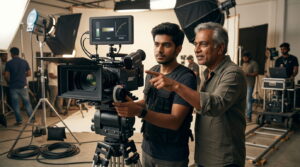
As you read this, you are most likely a big movie buff. Possibly, you’ve wasted days and nights watching video clips behind the scenes or have realized the lighting in all the movies that you’ve seen. Or maybe your friends once told you that you’ve got an eye for it. Well, whatever has led you to be here, let me tell you in all honesty that there isn’t an easy way to learn how to become a successful cinematographer. There’s always an alternative route, and once you know about it, things will definitely seem a little easier.
India currently churns out visual content like never before. Web series on OTT platforms, digital commercials, music videos, and indie short films, all of this is creating genuine demand for people who know how to work with a camera and light. For those who’ve had their eyes set on this industry, 2026 is actually the year when it might be worth your while.
I will help you understand how it actually works.
Step 1: Master Technical and Creative Skills
Understand the Camera and Lighting
Cinematography is not really about the camera. Not at its core. The camera is just a box that records whatever you put light on. The true artistry lies in one’s ability to understand lighting and its effect on the image. It is commonly believed that cinematography is made up of 70% lighting. While this may seem to be an overstatement at first glance, anyone who has ever shot anything will agree once they actually go out there and shoot something.
A harsh overhead light makes someone look tired or villainous. A soft side light on a face can make the same person look warm and vulnerable. Same actor. Same camera. Completely different emotion. That is the power of light and learning to control it is your first real priority.
Start with the exposure triangle. These include aperture, shutter speed, and ISO. Try understanding how each one affects your picture both functionally and visually. How would opening up the aperture affect a portrait shot? What does a slow shutter do to moving subjects? This is foundational knowledge, and every working director of photography carries it automatically.
Then spend proper time with lenses. A lens focal length guide is not just about how much you can see in the frame. A 50mm feels natural to the human eye. A 35mm gives you a slightly wider, more environmental feel. An 85mm on a close-up is flattering and intimate. The choice influences the way the audience relates to the subject. A good DP thinks in lenses.
Lighting setups
Three-point lighting is the first thing to learn and honestly, the thing you keep coming back to your whole career. Key light gives you shape. Fill light softens shadows. Backlight separates the subject from the background. Once you understand this triangle properly, you start seeing it everywhere in films, in photographs, in television commercials. And you start understanding when and why people break it.
Beyond lighting, spend real time with color theory. Warm colors feel safe, approachable, and nostalgic. Cool colors feel distant, tense, lonely. This is not just a post-production concern. It begins right there on set your lighting and its color temperature, colors within the set design, and how they communicate. A basic knowledge of color grading principles means that you have already begun contemplating the end result before you’ve even stepped foot inside the studio. That is a valuable habit to build early.
Watch films as a student. Not for the story, but you can watch them separately for that, but for how the story is being shown to you. Learn camera movement: when they use hand-held shots, why they opt for the crane, when they simply keep the camera motionless and leave the performance to the actor. All that is an important choice, and the more you understand it, the better you will become at making such choices. There are directors, like Alfonso Cuarón, and there are cinematographers in India, like Anil Mehta and Sanu John Varughese, who do great things in their frames.
Embrace 2026 Film Technology
The tools available to cinematographers have changed a lot even in the last three or four years. Virtual production with LED volume stages is moving out of big Hollywood productions and into mid-budget films globally, including in India. It changes how you think about lighting on set because the screen itself becomes a light source. Understanding how to work with that is becoming a relevant skill faster than most people expected.
Drone operation is also something the modern DP needs to understand. Gimbal vs dolly is a real conversation you will have on sets regularly. A dolly gives you precise, controlled, weighted movement that feels very cinematic. A gimbal gives you freedom and a slightly more organic, floating quality. Knowing when each one serves the scene is part of your growing visual vocabulary.
One honest word of caution on drones. A lot of student reels are almost entirely drone shots because they look impressive quickly and they are easier to execute than properly lit interior scenes. But any working director watching your reel is looking for something specific: can this person light a human face emotionally? Can they put a camera in the right place for the right reason? Drone footage does not answer that question. Make sure your reel does.
Step 2: Build a Cinematography Portfolio
Nobody is sitting through a twelve-minute showreel. Not in 2026. Attention spans are short, and people watching your reel are usually already looking at fifteen other reels the same week. Make sure that yours is less than 90 seconds, preferably around 60 if possible. There should be a reason behind each and every shot.
How to build a cinematography portfolio that actually means something to working directors starts with shooting narrative work. Short films are the best option. Even micro-budget ones where you are all doing three jobs each. The point is to get footage that shows you can serve a story with images, not just capture beautiful scenery.
Reach out to student directors and indie filmmakers. They need camera people. You need footage. Shoot music videos if you get the chance; the Malayalam and Tamil music video industry is genuinely active and gives you a lot of creative latitude with lighting and style. Spec commercials are worth doing too: pick a brand you like, build a simple concept around it, and shoot it like it is a real job. This illustrates a kind of commercial sense that can help you later on in landing advertising jobs that pay handsomely in India.
When making your reel, think of it as one complete story rather than separate clips. Color grading basics matter here too. A reel that conveys a sense of cohesion through a particular feeling conveyed through colors comes off much more professionally than one in which each clip appears entirely different from the previous one. This indicates that you consider the entire visual experience of your work, from conception to delivery.
Cull mercilessly. Work from eight months ago that does not represent your current ability should come out.
Step 3: Network and Start Working on Set
There is no classroom version of what a real set teaches you. That’s how it really is. No matter what you have learned about cinematography from reading books, you will still be completely unprepared to step onto a professional movie set. That feeling goes away once you have put in enough hours. But you have to put in the hours.
The traditional path, and it still works in 2026, is to start at the bottom of the camera department. Getting work as a Production Assistant or a 2nd AC on a short film or low-budget feature is not a step backward. It is the beginning of real education. As a 2nd AC, you are building camera setups, managing equipment, and marking focus positions. You are learning how a set functions, how quickly decisions have to be made, how problems get solved without stopping the shoot.
Assistant camera operator jobs are where most of the best DPs in the industry started. Working as a 1st AC puts you right next to the DP every day. You see every lens choice they make, every lighting decision, every conversation they have with the director about how a scene should look. That proximity is irreplaceable.
Film festivals are worth attending even if it feels like it is not directly connected to the work. MAMI in Mumbai and IFFI in Goa are the main ones, but regional festivals in Kerala are genuinely valuable. The Kerala film culture is sophisticated and the short film screenings at these events bring together the kind of independent directors who are actively looking for good camera people to collaborate with. Show up, watch films, talk to people. A conversation at a festival screening has led to more first DP jobs than any amount of online networking.
Join the WhatsApp groups and Facebook communities where Malayalam and South Indian film crew members share information. How to become a cinematographer in India as a practical matter often comes down to who knows you and whether they trust you. The importance of showing up and being known as a person that does good work and is easy to deal with grows over time beyond almost any other factor.
Step 4: Freelance Cinematographer
The move from assisting to shooting your own projects is rarely one big moment. It usually happens gradually. Someone needs a shooter for a corporate video and the usual person is unavailable. A friend making a short film trusts you enough to hand you the camera. You take the job, you deliver properly, and that becomes the next thing on your reel.
Getting hired as a freelance cinematographer in the early stages is about building a reputation one job at a time. Take the corporate interviews. Take the real estate walk-throughs. Take the YouTube content work. Take the no-budget short film where you will be building the lights yourself. Each of these teaches you something specific and useful that you genuinely cannot learn another way. And each one creates a reference: a director or producer who will tell the next person that you show up, you work hard, and the footage looks good.
Learn to price yourself properly. Know what a day rate looks like in your specific market. Invoice cleanly. Deliver files on time and in the format you agreed upon. These things sound basic, but they are genuinely what separates people who get called back from people who do not.
Here is something that does not get said enough about this career. Visual storytelling is a collaborative process. The DP and the director work together for days, sometimes at extremely uncomfortable places, and always amid pressure. Directors choose people they trust and are comfortable with. Your technical skill matters. Your eye matters. But so does whether you are calm when the shoot is going badly, whether you take direction without getting defensive, whether you are actually invested in the project succeeding or just doing a job. The best DPs are creative partners, not just camera operators.
Should You Study Cinematography Abroad?
The honest answer is that you do not strictly need a degree to build a real cinematography career. Many of the best working DPs in India learned entirely through assisting and on-set experience. But formal education at a strong institution gives you access to things that are genuinely hard to replicate on your own, professional equipment from the beginning, structured feedback on your work, and a peer network that stays with you for your whole career.
The best film schools for cinematography at an international level include the American Film Institute in the USA, the Vancouver Film School in Canada, and the National Film and Television School in the UK. The level of equipment at these schools is at a full professional cinema standard. The individuals you study with have successful careers in the same field in the coming years. The networking that you do in two years of the school would actually influence how your life is for the coming twenty years.
Cinematography courses after 12th within India are also worth serious consideration. FTII Pune is the most respected name in the country. SRFTI in Kolkata is excellent. There are strong private options in Mumbai and increasingly in Kerala, where the local film industry provides real context for what you are learning. When evaluating any program, look at how much of the course is actual shooting versus classroom theory. A good film school gets cameras in your hands early and keeps them there.
Tiju’s Academy: The Best Place to Start in Kerala
If you are based in Kerala and want a focused, practical foundation in cinematography, Tiju’s Academy is built specifically for that. This is not a general media program. Everything here is oriented toward getting you camera-ready and industry-ready in the Malayalam film and production space.
At Tiju’s Academy, we offer a dedicated best cinematography diploma in Kerala that covers camera operation from the ground up, lighting setups, three-point lighting in real studio and location environments, lens work, color grading basics, composition, and visual storytelling as a practical discipline, not just a theory lecture.
Every student builds a showreel throughout the course. Faculty work individually with each student across multiple real projects so that when you finish, you leave with work that genuinely represents your ability. You do not graduate here with a certificate and no reel. That combination is what actually gets you hired.
We keep batch sizes small on purpose. Cinematography is a hands-on craft. You cannot learn camera movement techniques or lighting setups three-point lighting properly, when you are one of fifty students watching from the back of a room. You need to be the one holding the light meter and making the call.
Our industry connections are specifically within the Malayalam film and OTT production ecosystem. We know where assistant camera operator jobs open up in Kerala and we actively help students get into those opportunities. For many of our graduates, the transition from course to first real job has happened while they were still completing their programme.
Whether you want to shoot the next major Malayalam web series, build a career in commercial and advertising cinematography, or eventually take your portfolio to an international film school application, Tiju’s Academy gives you the specific foundation to make that realistic.
Planning to study cinematography? Join Tiju’s Academy today. Talk to us about the next batch, what the program covers, and what our graduates are doing now.