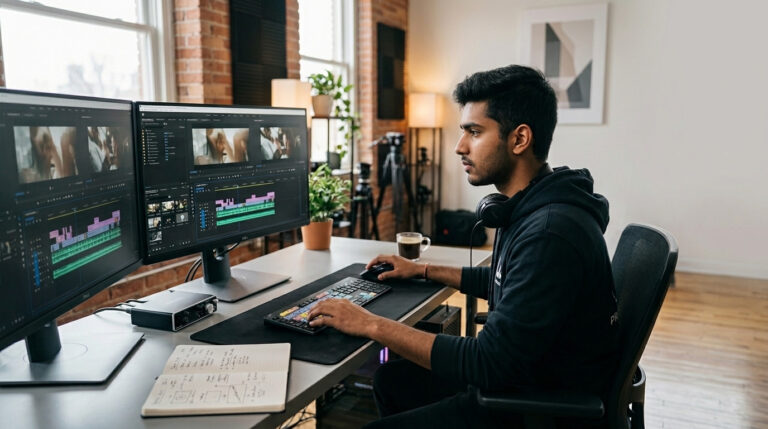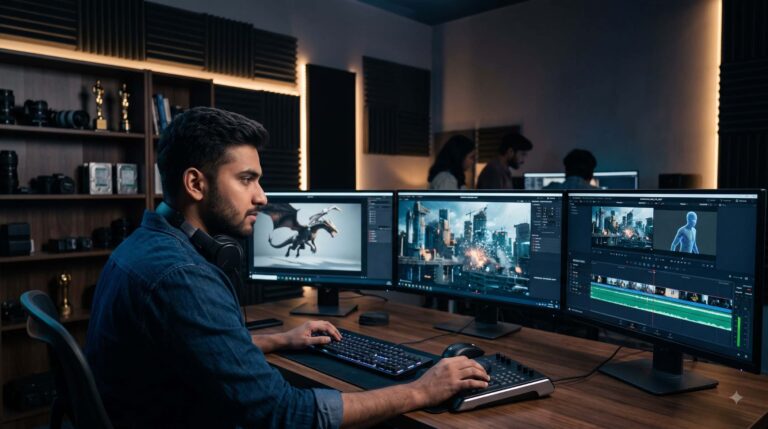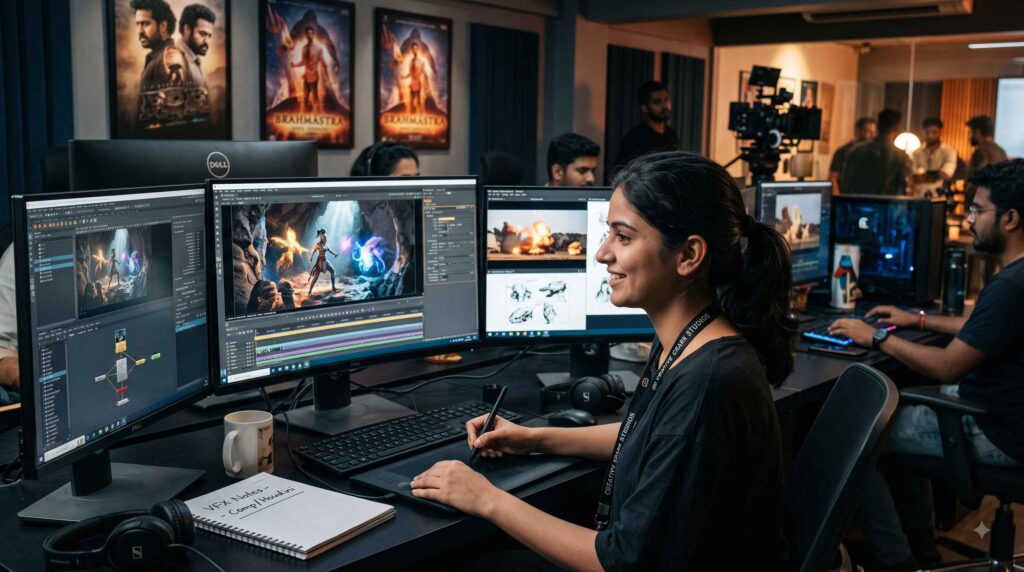
What it takes to be a VFX artist in India? is one of the most asked questions by creative youngsters today, and the truth is that this career path is closer to becoming reality than what many may think.
You do not have to be a graduate from a film school, nor do you have to struggle for years. What you need is the software knowledge, a specific portfolio, and an entry point into the industry. Here is a guide on what it means to be a VFX artist, skills needed, portfolio creation, positions, and salaries in 2026.
At Tiju’s Media School, we run one of the most practical VFX filmmaking courses in Kerala, and this guide reflects the same industry approach we teach in class. Be it just out of curiosity or prepared to get into it, this article gives you an excellent starting point.
We will first talk about the actual nature of the job.
What Is It That a VFX Artist Actually Does?
A VFX artist works with visual effects that cannot be captured by a camera in the normal way, somewhere between capturing the raw video footage and producing the final polished version of the shot. Simply put, VFX artists either create or correct certain visuals that would not otherwise have been possible by just using a camera, from a tiny object being cut out of the scene to a complete computer-generated creature.
This is generally what their daily activities include:
- Rotoscoping, which basically entails isolating a character or an object frame by frame for editing purposes
- Compositing, blending all the different visual layers into one seamless final image
- 3D integration, placing digital objects or characters convincingly into real footage
- CGI work, building fully digital elements like creatures, vehicles, or environments
- Green screen and chroma key cleanup, removing the background and replacing it with a new scene
VFX artists today work across the film industry, OTT and streaming platforms, advertising, and the gaming industry. This is a big shift from a decade ago, when VFX work was mostly limited to big-budget films. Now nearly every kind of visual content uses some level of visual effects or motion graphics.
Beginner Level VFX Skills (Required VFX Skills in General)
To be a VFX artist requires a combination of technical skills using certain software tools and some basics of artistry, but people usually learn only the software part and skip the other half. Both are equally important.
Skills to develop:
- Familiarity with basic VFX software such as Nuke, After Effects, Houdini, Maya, Blender, etc.
- Layers, masking, and rendering skills
- Basic knowledge of texturing and lighting for 3D scenes
- Familiarity with the general VFX pipeline, so you know how your work fits with everyone else’s
Artistic and foundational skills to build:
- Good sense of lighting, shadows, colors, and perspective
- Ability to be patient, as the creation of one shot may take several hours
- Observational skills, so that digital objects match live shots
Soft skills that matter more than people expect:
- Managing deadlines under pressure
- Taking feedback well and revising work quickly
- The ability to flow well within a pipeline because an artist’s work is used by the other artist
- The best way to answer the question of how to start a career in VFX is to select one piece of software and master one aspect of work and only after that expand your skills. Learning too many things at once discourages beginners.
VFX Portfolio Tips That Work
Studios don’t care about the certificates that you have but about the work done, and this is why your showreel is the most important thing that you have as a novice. One good two-minute showreel can give you more than just knowing software tools.
Here are VFX portfolio tips that actually work:
- Keep it short. Aim for 60 to 90 seconds maximum. Recruiters see many reels daily, and they never spend much time on lengthy ones.
- Start with your strongest footage. The first 10 seconds determine whether the viewer will continue to watch or move on.
- Use breakdowns of before-and-after. This demonstrates your individual approach and shows how you achieved certain results.
- Be specific, not general. A showreel that showcases your skills in one or two particular aspects (like compositing or rotoscope) is better than an average reel of everything.
- Update regularly. Add new, better footage to your portfolio regularly, as your skills get better and cut old footage from the reel.
A well-focused and sincere showreel is more valuable than a fancy reel with tutorials and other people’s footage. Studios know how to distinguish between the two.
Career Path in the VFX: Different Types of VFX Artist Roles
It is important to understand that the work of VFX is far from being one profession; it’s a chain of different specialists’ jobs, and usually, when people start in this industry, they decide on just one specialization. Knowing the career map in advance allows you to determine what type of VFX artist role to start with.
Here are the most widespread types of VFX artist roles that you will come across:
-
- Roto/Prep Artist: isolates elements frame by frame and is the most popular starting point for freshers
- Tracking/Matchmove Artist: syncs the movement of the camera, making digital elements match the real footage
- Compositor: combines all layers, footage, CGI and effects into one complete image
- 3D Modeler: creates objects, characters and environments in a digital environment
- Texturing Artist: applies textures on 3D models such as skin, clothes or metal
- Lighting Artist: applies lighting to 3D scenes matching the real footage
- FX Artist: responsible for creating simulation of elements like fire, smoke, water, etc.
- Matte Painter: responsible for creation of digital backgrounds and extension of environments in shots
The highest position in the VFX industry is VFX supervisor, supervising the whole process pipeline and achieving such a position after many years of practical experience. In case your area of interest is compositing, then it usually begins with learning roto and tracking, because that gives an understanding of how footage works.
Difference Between VFX and Animation
One of the most frequent inquiries for novices is what the difference between VFX and animation is. The reason is that these two disciplines have a lot in common when it comes to using the same software and having similar skills, but they are very different when it comes to the job itself. Visual effects specialists deal mostly with live-action footage and make additions or merge digital content with it. Animators create whole scenes, characters, and movements, sometimes even without real footage at all.
As a rule, many studios disregard this distinction, and professionals tend to switch from one field to another throughout their career. If you are good at 3D modeling and CGI, you will be able to do both VFX and animation. You should choose the one that would be more interesting to you: VFX if you like working with real footage, and animation if you like creating worlds from nothing.
Entry Level vs. Senior Positions: What These Positions Actually Do
Entry-level artists do specialized jobs in an extremely controlled environment, whereas senior artists have ownership of a shot or sequence and are responsible for directing others. Understanding this distinction will allow you to manage expectations about your first job.
Entry level:
- Roto, prep, and basic tracking work
- Working closely under a lead or senior artist
- Learning studio discipline and pipeline structure
Mid-level:
- Independent compositing or 3D work
- Handling full shots with much less supervision
- Starting to specialize in one clear skill area
Senior or lead:
- Supervising entire shots or sequences
- Client-facing reviews and creative decision-making
- Mentoring junior artists and reviewing their work
Entry level VFX jobs in India generally begin in roto or basic compositing, so do not be put off if your initial job seems to have limited scope. This is the conventional route that everyone follows, even those who are now doing major projects internationally.
Why VFX Is a Popular Career in 2026?
The field of visual effects is flourishing because of the immense amount of content being produced on OTT platforms, in games and advertising, and visual effects have become integral as opposed to the occasional and highly priced element they once were.
Here’s why it is growing:
- OTT platforms are creating more content than ever before, and the majority of the content involves the use of visual effects or motion graphics in some way or form
- The Indian gaming industry is expanding at a rapid rate and requires constant production of visual artists
- The availability and power of software tools have increased, reducing the cost of entry for fresh talent
- VFX Production Houses that are present all over India, like those in the flourishing Kerala film industry (also known as Mollywood) of Kerala, are churning out more VFX-intensive content than ever before
Thus, the answer to “is VFX a good career in India 2026?” would be a definitive yes, but only if you acquire the necessary skillset yourself rather than merely gaining a certificate. The demand is definitely increasing, particularly among compositors, FX artists, and supervisors.
Similarly, jobs in VFX in Kerala have increased in line with the increasing production of films and advertisements from Kerala. Most of the students here learn on the job while interning at production houses or studios before landing full-time jobs. A lot of the professionals also opt to be freelance VFX artists, taking up projects offered by various studios in India and even abroad.
VFX Artist Salary in India
The pay scale of VFX depends highly upon your skill level, specialization, and the city/studio you work in, and so it is better to have ranges rather than a single figure in mind. The pay scale mentioned here is an approximation and can be changed as per the employer and project.
Following is a realistic breakup of “VFX artist salary in India” till 2026:
- Fresher: about ₹2.5 to 4.5 lakh annually, that is around ₹15,000 to 30,000 per month. Jobs related to rotoscoping and prep fall under the lower bracket.
- Mid-level: 1 to 4 years of experience, around ₹4 to 8 lakh annually, based on specialization and city.
- Senior/specialist: experienced compositors, FX artists, and lighting artists get around ₹8 to 20 lakh annually or even higher. FX artist salary is generally on the higher end of this bracket.
- VFX Supervisor/top-tier jobs: above ₹20 lakhs per annum, particularly in the cities of Mumbai, Bangalore, or Hyderabad and working for international production houses.
The VFX artist salary for fresher in India can differ widely depending on the source and city. Salaries for studios depend greatly on skills and a well-crafted portfolio and not necessarily on the certificate. It is possible to earn much more as a freelance VFX artist dealing with foreign clients, due to the fact that overseas pay is higher than local pay.
How Tiju’s Media School Helps You Start Your VFX Career?
Reading about the industry is one thing. Building real, job-ready skills needs hands-on training with industry-standard tools, and that is exactly what our media school focuses on. Tiju’s Media School VFX and Motion Graphics Course is built to take you from the basics to a strong, employable portfolio.
Here is what the course covers:
- Foundational design concepts before moving into advanced work
- Hands-on training in compositing and 3D integration techniques
- Practical work on motion graphics for film, TV, advertising, and digital media
- A curriculum specifically designed to help you build a strong, employable portfolio by the end of the course
We are home to a wider set of film schools in Kerala-style programs under one roof, including diplomas in editing and color grading, cinematography, and scriptwriting and direction. This way, the students of VFX will learn along with editors, cinematographers, and directors, similar to the way production teams function. Our editing laboratories include dedicated VFX labs, and therefore students gain exposure to professional facilities right from the beginning.
This blend of hands-on education and departmental exposure is why we have earned our place among the best film institute in Kerala choices for media aspirants. If VFX and film and media courses in Kerala interest you, our team can walk you through the course structure, software covered, and portfolio outcomes.
Get information about our Diploma in VFX and Motion Graphics and also look at our other related Diplomas in Editing and Color Grading and Cinematography.
Conclusion
The idea of becoming a VFX artist in India is a feasible one if approached in the proper way. Master one or two programs well and don’t try to cover everything; make sure your demo reel is concise and true to your abilities, choose an entry point in either roto or compositing, and be patient as you move up from the entry level into the higher levels of creativity and seniority.
It’s true that the industry is developing thanks to streaming, gaming, and advertising. That is the real path behind how to become a VFX artist in India, skill first, portfolio second, and steady growth after that.
There is no need for you to do this on your own. Proper training, using industry-standard software, combined with a portfolio-based education, will help you transform into an industry-ready professional in the shortest possible time.
Want to begin your VFX journey now?
Check out the VFX and Motion Graphics course at Tiju’s Media School, or connect with us on WhatsApp to know more about our courses, fees, and portfolio-based outcomes. Our Media School is located in Kerala, offering practical training to make you industry-ready.
Frequently Asked Questions:
A: A VFX artist creates or corrects visuals that cannot be captured by a camera alone. The work includes rotoscoping, compositing, 3D integration, and building CGI elements for films, streaming shows, advertising, and games, turning raw footage into a finished, polished shot.
A: You need technical skills in software like Nuke, After Effects, Houdini, Maya, or Blender, along with layers, masking, and rendering knowledge. Equally important are artistic skills like a sense of light and color, patience, and observation, plus soft skills like handling feedback and deadlines.
A: The best approach is to pick one software tool and master one skill area, such as roto or compositing, before expanding further. Trying to learn everything at once tends to slow beginners down. Building a focused, honest showreel is the fastest way to get noticed.
A: VFX artists mainly work with real, live-action footage and add or blend digital elements into it. Animators build entire scenes, characters, and movement from scratch, often without any real footage. Many artists move between both fields once they are skilled in 3D modeling and CGI.
A: Freshers typically earn around ₹2.5 to 4.5 lakh per year, or roughly ₹15,000 to 30,000 per month, with roto and prep roles at the lower end. Mid-level artists earn ₹4 to 8 lakh, while senior compositors, FX artists, and supervisors can earn ₹8 to 20 lakh or more.
A: Common roles include Roto or Prep Artist, Tracking or Matchmove Artist, Compositor, 3D Modeler, Texturing Artist, Lighting Artist, FX Artist, and Matte Painter. Above these sits the VFX Supervisor, who oversees the entire pipeline after years of hands-on experience.
A: No formal degree is required. Studios care more about your skills and portfolio than your certificates, and a strong, focused showreel demonstrating real hands-on work matters far more than qualifications alone.
A: A strong showreel is short, around 60 to 90 seconds, with your best shot first. It should include before-and-after breakdowns and show depth in one or two skills rather than a shallow mix of everything and should be updated regularly as your skills improve.
A: Yes. Demand is rising because of growth in OTT platforms, gaming, and advertising, all of which now use visual effects regularly. Compositors, FX artists, and supervisors are especially in demand, and production hubs like Kerala's film industry are producing more VFX-heavy content than before.
A: Tiju's Media School offers a Diploma in VFX and Motion Graphics with hands-on training in compositing, 3D integration, and portfolio building. Students train alongside editors, cinematographers, and directors, with access to dedicated VFX labs and professional-grade facilities from day one.