
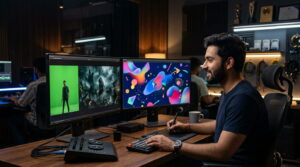
Those who have enjoyed seeing a superhero soar through a destroyed city one minute, only to have a bouncy animated logo appear on the screen moments later, after the ad break, must be familiar with both of the camps in this discussion that is to come. The VFX vs motion graphics dilemma regularly comes up among students who are passionate about screens, stories, and design, yet uncertain about what really suits their talents. It sounds almost the same, uses identical software, and the industry loves putting them in the same category.
At Tiju’s Academy, we have spent years helping students in Kerala and beyond figure out exactly where they belong in this world. And now, to set things straight for good, at the end of this essay, you’ll not only learn the theory but also figure out which one suits your future career path best.
Let’s get to the short explanation first
This is the one line that will tell you how visual effects differ from motion graphics: VFX creates illusions of the impossible within filmed videos, while motion graphics creates moving graphics. VFX integrates fantasy elements into reality. Motion graphics add movement to graphic designs. Now let’s actually understand “what is motion graphics and VFX,” because the details are where the interesting choices live.
What is VFX?
VFX, standing for visual effects, is the craft of producing and modifying images that cannot be filmed on a regular film set. Whenever the director requires a dragon, spaceship, flood or even a whole other planet, VFX specialists do just that. Here comes the catch: the term “integration” the effect must blend in nicely with the live action footage.
The lion’s share of current VFX is made up of computer-generated imagery (CGI) three-dimensional creatures and objects produced on computer systems. But VFX is much broader than CGI alone. It also includes compositing and green screen keying, where filmed elements are layered together and backgrounds are swapped out. This includes set extension, digital matte painting, fire/smoke particle effects, motion tracking, and various clean-up effects, such as getting rid of wires or other distracting elements in a shot.
Just imagine some of the spectacular scenes in movies like Avatar, Interstellar, or any Marvel movie. Most of that did not really exist in real life. It was built, tracked, lit, and blended by VFX teams during the post-production pipeline. This is why VFX Film Making Courses can be quite technically challenging after all, you’re trying to trick the human eye, and it is quite tricky to trick.
At Tiju’s Academy, we treat VFX as a filmmaking skill and then a software skill because the best VFX artists know why the shot looks good before ever touching the nodes.
What is Motion Graphics?
However, motion graphics is where graphic design learns to move. Motion graphics are the animated opening credits, the tutorial video explaining how a certain app works, the lower third name card on a TV channel, the animated chart that brings dull numbers to life, and the catchy social media ad that grabs you right when you swipe past it.
The soul of motion graphics is kinetic typography text that dances around and conveys emotions using the principles of timing and rhythm. With the addition of shapes, icons, illustrations, transitions and some graphic design sensibility, we get an art form whose purpose is not realism but effective communication of information.
Motion graphics do not try to fool its viewer into thinking that something is real. On the contrary, it admits that it is designed and its main goal is to capture attention and deliver information in a short time and in a beautiful manner. This is why it rules digital marketing and tutorials, brand identities, YouTube openings and business presentations.
Motion design vs visual effects is the difference of goals.
Motion design vs VFX: the core differences
Let’s lay out the real, practical distinctions so the contrast is unmistakable.
- Purpose. VFX exists to serve a story by making impossible things believable. Motion graphics exist to communicate a message or brand with visual polish.
- Source material. VFX always relies on footage that involves real people, real cameras, and real sets requiring improvements. Motion graphics are usually created out of design elements, although they may include footage.
- Realism. VFX strives for photorealism; a seam that exposes the illusion means failure. Motion graphics appreciate its graphical appearance; it should appear designed.
- Complexity of the pipeline. Visual effects involve heavy modeling, simulation, and rendering, thus it requires more resources. Motion graphics, on the other hand, is lighter and faster, although 3D motion graphics is catching up in terms of resources.
- Places where you can find it. Visual effects are found in movies, TV shows, and expensive commercials. Motion graphics are found in advertisements, social media videos, UI animations, broadcast packages, and corporate videos.
It is important to understand the difference between visual effects and motion graphics because it will affect your expertise and eventually decide where you will be employed.
VFX vs animation vs motion graphics: don’t confuse the three
It is common for students to expand the question to include VFX vs. animation vs. motion graphics, and this expansion is quite natural because all three share common features.
Animation is a wider term that covers all of them, the art of creating moving sequences of frames or digital models that may be hand-drawn, computer animated, or filmed using some other method of creating such an effect. Animation is a separate discipline, and no connection with “reality” exists here.
Motion graphics is, actually, a specific subset of animation, the art of animation of graphical elements and typography.
VFX uses the techniques of animation and CGI but relies on real footage. The key characteristic of VFX is its connection with reality.
So the clean way to remember it: animation creates movement, motion graphics design movement to communicate, and VFX blends movement into reality. Three cousins, one family, very different day jobs.
The tools of the trade
This is where the confusion between the two occurs due to software overlap.
After Effects, developed by Adobe, is the standard tool for motion graphics work and is used with Premiere Pro for editing and Illustrator for creating assets. It is the sandbox where kinetic typography, animated logos, and explainers get created. Become adept at both Adobe After Effects and Premiere Pro and you will be able to do most of the motion graphics work out there.
For VFX, the software load becomes more extensive. Compositing might happen in After Effects for lighter shots, but serious work often moves into Nuke or DaVinci Resolve Fusion for node-based compositing and finishing. When CGI enters the picture, artists reach for 3D packages and 3D modeling and Blender have become a favorite entry point because Blender is powerful, professional-grade, and completely free. Add tracking software, simulation tools, and a proper render setup, and you have a full VFX workstation.
Here’s the truth we tell all students: technology evolves, but the core remains the same. It is for that very reason that our Diploma in VFX and Motion Graphics covers not only the software but the principles behind designing, timing, coloring, and storytelling.
Which one should you choose?
It’s not really a question of “which is better,” only which is best suited to the way you think.
Select VFX if movies are your passion, you enjoy solving problems, have great attention to detail, and the excitement of making people jump out of their seats from seeing something that doesn’t even exist!
If you love designing, branding, rhythmic animation and quick communication, select motion graphics.
And here’s a secret from the industry: you don’t strictly have to choose. Many of the most employable creators are hybrids who understand both. A motion designer who grasps compositing, or a VFX artist who can whip up a clean animated title, is enormously valuable in today’s studios and agencies. That hybrid strength is exactly why we built a combined pathway rather than forcing students into one narrow lane.
Why the industry needs both right now
The need has never been greater. More content is being produced by streaming services, companies are spending huge amounts of money for videos, and social media thrives on short and animated videos. While VFX creates the visual magic that we seek in cinema, motion graphics creates the educational and marketing content required by each company.
For an Indian student, and more specifically a student from Kerala, this can actually be an opportunity. The local film industry and advertising industry is booming, remote working has created opportunities for global companies, and good artists are few and far between. A solid VFX and Motion Graphics course in Kerala can be the launchpad into film, television, advertising, gaming, and digital content creation.
Learn it right at Tiju’s Academy
This is where we get to talk about home. Tiju’s Academy has built a reputation as the best VFX institute in Kerala by focusing on one thing above all: turning passionate beginners into industry-ready professionals.
We believe we are the best VFX course in Kerala, not because we say so, but because of how we teach. Our curriculum is hands-on from day one. Students don’t just watch tutorials, they build real projects, work through the full post-production pipeline, and finish with a portfolio that studios actually want to see. As a dedicated VFX Training Institute in Kerala, we keep our batches focused and our mentorship personal, because we know creative skills grow best with real feedback.
Our flagship program, the Tiju’s Academy Diploma in VFX and Motion Graphics, is designed to cover the entire journey. You’ll start with design and animation fundamentals, move through kinetic typography and motion graphics in After Effects, and progress into compositing and green screen keying, CGI basics, 3D modeling and Blender, and finishing in DaVinci Resolve Fusion. By the end, you won’t just understand VFX vs motion graphics in theory, you’ll be able to do both.
We designed the best Diploma in VFX and Motion Graphics course in Kerala to be practical, affordable, and career-focused. Whether your dream is to work on feature films, produce explainer videos for the digital marketing world, or join a leading animation studio, Tiju’s Media School Courses gives you the technical skills, creative confidence, and industry connections to get there.
We provide dedicated placement support, mentorship from working professionals, and an environment where creativity is genuinely encouraged. That combination is why so many students searching for the best VFX institute in Kerala end up choosing us and why so many of them go on to build the careers they imagined.
Conclusion
So, VFX vs motion graphics, what is the difference? VFX makes the impossible look real inside live-action footage; motion graphics make design move to communicate ideas with style. One immerses, the other informs. Both are creative, in-demand, and rewarding, and the smartest artists learn to move fluently between them.
The best next step isn’t picking a side from a distance, it’s getting your hands on the tools with proper guidance. If you’re ready to turn your curiosity into a real, employable skill, the Tiju’s Academy Diploma in VFX and Motion Graphics is built exactly for that. Come learn where the illusion is engineered and the design comes alive.
Your screen career starts here. Let’s build it together.