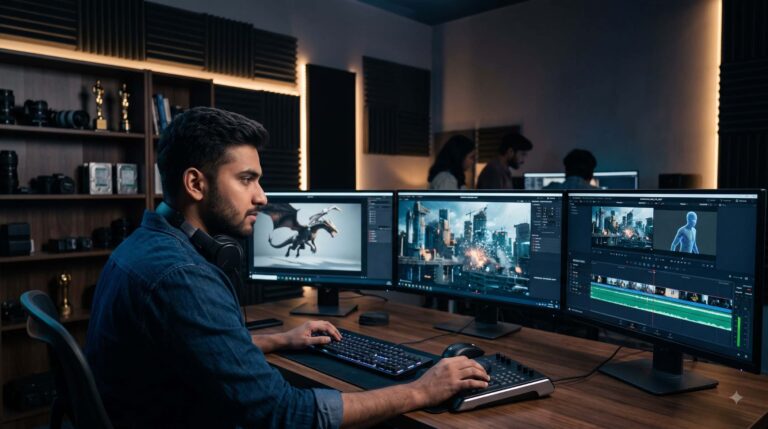
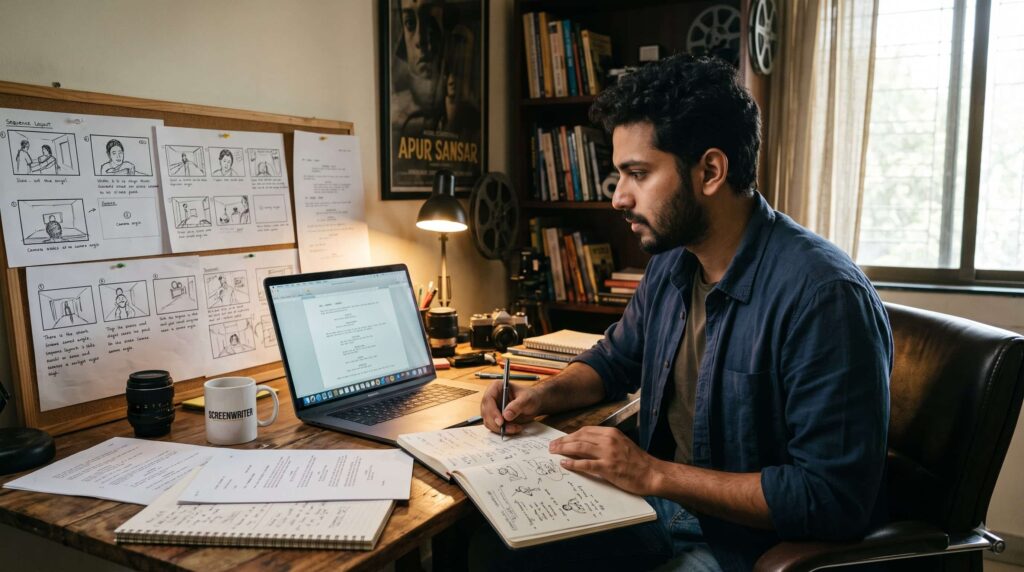
Short film scripts that stand out tend to do one thing well. It revolves around a single concept, has something at stake for a single character, and doesn’t go on long enough for the reader to start counting pages. This is a realistic response to the question of how to write a short film script. The format isn’t difficult to master and will take a few hours at most. The problem lies in finding the right concept to work within ten pages and be memorable enough to be recalled by the reader the next day.
This guide will cover format, length, structure, dialogue, characters, and two sample pages that you can use directly in your writing.
What is a short film?
A short film can be described as one whose duration is less than 40 minutes, including its credits. That is what is considered by the Academy Awards, and it is also the same case for other festivals.
However, the shorts that have been successful across the world tend to be:
- 3 to 5 minutes for online and YouTube short film work
- 8 to 12 minutes for the festival circuit
- 15 to 20 minutes for good graduation or portfolio work.
Film programmers at film festivals like Clermont-Ferrand, Sundance, and IFFK watch hundreds of films in a week. A film that is ten minutes long receives better attention than one which is twenty-five minutes long. Film length is a crucial consideration rather than a mere technicality.
What is the length of a short film script?
The length of a short film script ranges from 5 to 15 pages. The rationale for the figure lies in this simple truth. A page in a well-formatted screenplay translates to one minute of film length.
So the equation for pages per minute of a short film script goes like this:
| Runtime you want | Pages to write |
| 5 minutes | About 5 pages |
| 10 minutes | About 10 pages |
| 15 minutes | About 15 pages |
The number of pages is dependent on whether or not your format is correct. A page that contains a lot of content written densely will have more pages than the one with spaced action lines. Dialogue heavy pages run faster. Action heavy pages run slower.
One more thing worth knowing early. Shorts are not sold the way features are. Is it hard to sell a short film script? Yes, because almost nobody buys them. A short is a calling card. It exists to prove you can tell a story, so a producer trusts you with a bigger one.
Why short films matter for new filmmakers?
Short films are the most economical way of understanding the whole process of filmmaking, right from the idea generation to its exhibition. You write it, cast it, film it, edit it, and witness your audience reacting to it. Very few other formats let a beginner do all of that in a few months.
They also give you things you cannot get from theory:
- A finished piece for your showreel and portfolio
- Something to submit through FilmFreeway to a short film festival or screenplay competition
- Proof of your director’s vision that you can show at an interview or in a pitch deck
- Real experience with a shot list, a storyboard and a production budget
- Feedback from strangers, which is far more useful than feedback from friends
Understanding the basics of script writing
Before structure and character, get the mechanics right. Script readers can spot a badly formatted script from across the room, and many stop reading on page one.
Screenplay format for short film scripts
Screenplay format for short film work is identical to feature format. There is no separate short film layout.
Every screenplay is built from six elements:
- Scene heading (slugline) in capitals, telling us INT. or EXT., the location, and DAY or NIGHT
- Action lines in present tense, describing only what a camera can see or a mic can hear
- Character cue in capitals, centred, above the dialogue
- Parenthetical in brackets under the name, used sparingly for a small delivery note
- Dialogue block in a narrow column under the cue
- Transitions like CUT TO or FADE IN, used rarely in a spec script
The technical scriptwriting rules are fixed:
- Courier 12-point font, always
- 1.5-inch left margin, 1-inch right margin
- A clean title page with your title, your name and one contact detail
- V.O. for a voice we hear over the action, O.S. for a voice from off-screen
- No camera directions in a spec script, since shot division belongs in the shooting script
If you want to know how to format a screenplay without memorising margins, use software. Good screenwriting software for beginners includes Celtx, WriterDuet, Fade In and StudioBinder, all of which have free tiers. Arc Studio and Final Draft are paid and worth it later. A free short film script template in Google Docs also works fine if you are just starting.
What font is used in a screenplay? Courier or Courier New at 12 point. That specific font is what makes the one-page-per-minute rule hold.
Short film script structure
Short film script structure follows the same shape as a feature, just compressed. Do short films need a three-act structure? Not strictly, but almost every short that works has the same underlying beats:
- Setup: who the person is and what their normal looks like, in one or two scenes
- Inciting incident: the thing that breaks normal, ideally on page one or two
- Rising action: pressure builds and the stakes get personal
- Turning point or midpoint: the character learns something that changes the plan
- Climax: the moment where they choose
- Resolution or denouement: one short beat, often a single image
In a three-act structure short film, act one might be one page. Act three might be half a page. That is normal. Structure for a short film story appreciates a quick introduction since you do not have the luxury of twenty minutes to prepare the audience.
Test: When you can’t identify exactly what time your character decides something, then your structure is still incomplete.
Steps for Writing a Short Film Script
Here is the process most working writers use. How do you start writing a short film script? Not with a plot. Start with a moment.
Step 1: Find one image or one moment of change
Skip short film idea development that begins with a whole world or a franchise. A woman discovers an old letter at a rented house. A young boy tells his father that he accidentally broke the window in a lie. That’s enough for ten pages.
Step 2: Write the logline
What is your method of writing the logline for your short film? The logline should be written in one sentence that includes the four parts: character, objective, obstacles, and stakes.
For example: Night nurse must conceal her mistake from the patient’s chart before the supervisor comes around because she needs her job to feed her entire family. And if you cannot write such a sentence, there’s still something wrong with your premise.
Step 3: Create beat sheet
Write 8–12 beats on one page. Do not include scenes and dialogue, only action. It’s your outline, and it’s easier to correct it here rather than on the ninth page.
Step 4: Write the first draft quickly
No editing while you write. Aim to get ten pages done in a couple of sittings. The first draft is going to be terrible, and that is why we call it a first draft.
Step 5: Read it aloud
Preferably, do a table reading with three other people. Clumsy sentences always show up when you make someone say them.
Step 6: Rewrite and revise
Chop off the first two lines of every scene and the last line of most scenes. Scripts almost always start scenes too early and end them too late.
Step 7: Get coverage
Send it to someone who does not like you enough to lie. A teacher, a mentor, or a paid script reader.
Can I write a short film script with no experience? Yes. The format is public, the software is free, and the only real requirement is finishing a draft. Most people who never write a script simply never finish the first one.
Expanding your scriptwriting skills
- Story arcs and plot points
A plot point is any event that turns the story in a new direction. A character arc is the internal version of the same thing. In a short, you usually only have room for one real arc and two or three plot points.
Keep the setup and payoff close together. If you plant a detail on page two, pay it off by page nine. A twist ending only lands if the clue was already there.
- Writing dialogue for short films
In essence, dialogue for a short film should be written with less than is required. Dialogue will work when the words written on paper are not what the character means. That gap is subtext.
Practical rules:
- How much dialogue should a short film have? Less than half of what you first wrote. Cut every line that repeats information the audience already has
- Avoid on-the-nose lines like “I am angry because you left.” Let the behaviour carry it
- Give each character a different rhythm, so you could remove the names and still tell them apart
- Never use dialogue for exposition that an image could handle
- Interruptions, unfinished sentences and silence all read as real speech
- Character development in screenwriting
Character development in screenwriting comes down to the gap between what a character wants and what they need. The want drives the plot. The need drives the ending.
Your main character needs to have a goal, an obstacle and a threat looming over him/her. Your antagonist need not necessarily be a villain; he could be anybody who is coming in the way of your protagonist in fulfilling his/her goals.
One paragraph per character.
Questions:
What is his/her goal?
What is he/she afraid of?
What would he/she never admit publicly?
- Visual storytelling in screenwriting
Visual storytelling in screenwriting means putting the meaning into things we can see. The movie is a visual story, and “show, don’t tell” isn’t just a phrase, it’s how the medium works properly.
- Use something besides “she was nervous” try: she wipes her palms on her jeans twice
- Consider mise-en-scène, what’s in the shot and what isn’t
- Blocking counts as writing. Where a character stands in a room says something
- Pacing lives in scene length. Short scenes accelerate, long scenes slow things down
- Write for the budget you have. A single location, limited cast and practical locations are creative constraints, not compromises
Common mistakes in short film scripts
What are common mistakes in short film scripts? These are the ones that appear again and again in student drafts:
- Too many locations, which makes the script unshootable on a small budget
- A first page that sets up mood instead of a problem
- On-the-nose dialogue where characters announce their feelings
- Camera directions in a spec script
- A twist that was never set up, so it reads as a cheat
- No ending, just a fade out on an unresolved mood
- Writing a feature idea in ten pages, so nothing gets room to breathe
- Wrong font, wrong margins, no title page
What makes a short film script stand out? A specific voice, one clear idea, and a final image that makes the audience rethink the scene before it.
Getting your short film script noticed
A finished script sitting in a folder does nothing. Getting noticed is a separate job from writing, and most new writers skip it.
- Get coverage before you submit: A paid script reader or a working writer will tell you in two pages what your friends will not say in six months
- Enter screenplay competitions: Short screenplay categories exist at most major contests, and a placement gives you something concrete to put in an email to a producer
- Use Film Freeway once the film is shot: Build a submission list of 15 to 20 festivals, mixing large ones with regional ones like IFFK, where your odds are better
- Put the film where people watch; A YouTube short film with a real thumbnail and a clear title will be seen by more people than a festival rejection ever would
Writing a short film script in Malayalam
In case of Short film script writing in Malayalam, the format is exactly the same as the English format. In Malayalam short film script format, slugline, action, and transition are done in English, but dialogue is in the Malayalam language only. This is the common procedure in the entire industry, and this makes the script readable to people doing the shot listing and script breakdown.
Where to learn scriptwriting properly
Reading about format gets you to a first draft. Getting notes on that draft, then shooting it with a real crew, is what turns a writer into a filmmaker.
Tiju’s Media School runs a four-month diploma in scriptwriting and direction in Kerala, built around 80 percent practical work. Students write a screenplay for a 5 to 6 minute short in the first semester, sit through in-class script readings and feedback, and finish the course with a complete ten minute short film and a professional showreel.
The scriptwriting course in Kerala at Tiju’s covers film grammar, the three-act structure, dialogue and subtext, script breakdown, shot division, and directing performance. Students also watch and discuss close to 100 classic films across the course. The film direction course in Kerala side of the programme includes blocking, working with actors, pre-production planning, and pitching.
Tiju’s Media School also runs cinematography courses in Kerala, along with editing and color grading and VFX and motion graphics. While searching for filmmaking courses, which result in not only a certificate but an actual portfolio as well, one should consider how many hours are dedicated to shooting in the program.
Frequently Asked Questions:
A: About 10 pages. One correctly formatted page equals roughly one minute of screen time, which is the short film script pages per minute rule. The rule only holds if your margins and font are correct.
A: Short film script length is usually 5 to 15 pages. For festivals, 8 to 12 pages works best. A ten minute film gets a fairer viewing from programmers than a twenty five minute one.
A: Start with one image or one moment of change, not a plot. Good short film idea development stays small. A woman finds an old letter. A boy lies about a broken window. That is enough for ten pages.
A: Courier or Courier New at 12 point, always. Combined with a 1.5-inch left margin, this font is what makes the one page per minute rule work. It is a fixed part of screenplay format for short film scripts.
A: Not strictly, but almost every short that works follows the same beats. In a three-act structure short film, act one might be one page and act three half a page. That compression is normal.
A: Write one sentence with four parts: the character, the goal, the obstacle and the stakes. If you cannot write that sentence, the premise is not clear enough yet. Fix it before you write page one.
A: Yes, because almost nobody buys shorts. A short film is a calling card, not a product. It exists to prove you can tell a story so a producer trusts you with something bigger.
A: Yes, because almost nobody buys shorts. A short film is a calling card, not a product. It exists to prove you can tell a story so a producer trusts you with something bigger.
A: Tiju's Media School runs a four-month diploma in scriptwriting and direction, built around 80 percent practical work. The script writing course in Kerala ends with a complete ten-minute short film and a professional showreel.