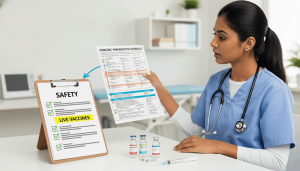
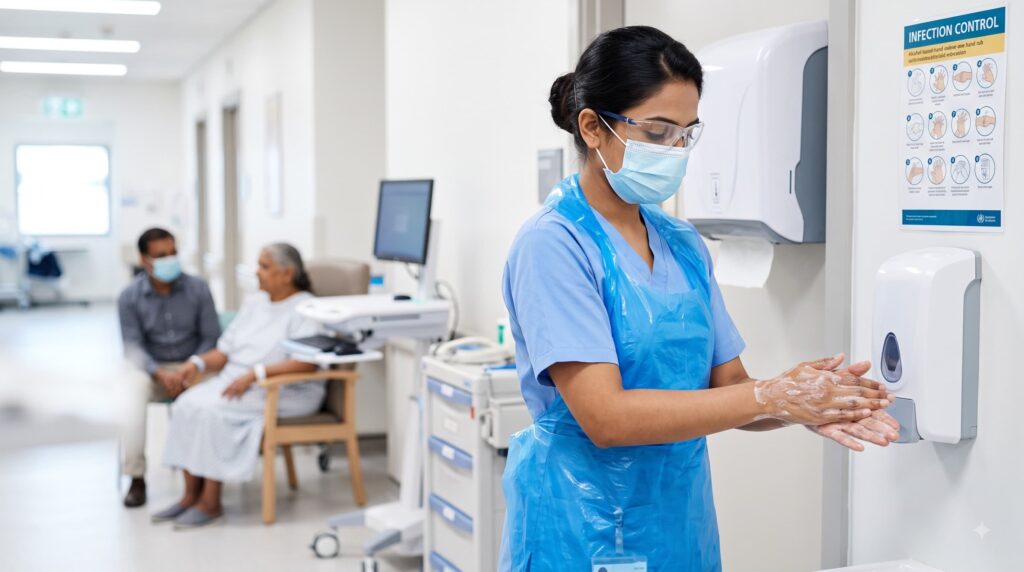
Infection control and isolation precautions for NCLEX can be divided into four distinct levels, which include standard precautions that apply to all patients; contact precautions for disease transmission by contact; droplet precautions for large respiratory particles; and airborne precautions for small airborne particles. The fifth level called protective isolation or neutropenic isolation acts opposite to these and protects the patient from you. You just need to be aware that certain diseases fall under each category, and then you will also know what type of PPE will be required for that disease.
Below is a brief explanation:
- Standard Precautions are always applicable to all patients.
- Contact Precautions need gown and gloves. MRSA, C.diff, scabies, and lice.
- Droplet precautions require a mask up to 3 feet. Examples include flu, mumps, and pertussis.
- Airborne precautions require an N95 mask along with a negative pressure environment (AIIR). Examples include TB, measles, and chicken pox.
- Neutropenic precautions protect the patient. No fresh flowers, no raw food, no sick visitors.
The National Council of State Boards of Nursing tests this content on almost every exam form because it maps directly to safety and infection control. That is also why our faculty at Tiju’s Academy NCLEX RN training puts this chapter early in the schedule rather than saving it for revision week.
Standard Precautions NCLEX RN: The Baseline for Every Patient
Standard precautions NCLEX RN questions test one idea: you treat every patient as if their blood and body fluids could infect you. Diagnosis does not matter. Presumed infection status does not matter.
What standard precautions include:
- Hand hygiene: Hand hygiene with either soap and water or alcohol-based hand gel before and after contact with the patient. In case your hands appear dirty or the patient is on C. diff enteric precautions, you should use soap and water. Alcohol does not kill C. diff spores.
- Gloves: Wear them when there is any possibility of exposure to blood, body fluids, or non-intact skin or mucous membranes.
- Mask, eye protection, and gown: Only in case of possible splashes or sprays. Procedures such as suctioning, wound irrigation, and childbirth often necessitate their use.
- Safe injection practice: Always avoid recapping needles with two hands. Dispose of sharps directly into a puncture-proof container.
- Respiratory hygiene: Tissues, covering coughs, and masks for coughing patients in the waiting area.
Hand hygiene deserves extra attention. On a priority question, if washing your hands is one of the options and nothing in the stem is life-threatening, it is usually the answer. The exam treats it as the single biggest step in breaking the chain of infection, and so does every audit team on a real ward.
A classic trap on the exam is the patient with HIV or Hepatitis B and C. Students panic and pick isolation. Standard bloodborne precautions are enough unless a second infection needs transmission-based precautions on top. Over-isolation of the patient is a wrong solution, and the guidelines of the Centers for Disease Control (CDC) prove it.
NCLEX Airborne Droplet Contact Precautions: Sorting the Three Tiers
Most students lose marks not because they forget the PPE, but because they put the disease in the wrong bucket. NCLEX airborne droplet contact precautions questions are really pathogen-sorting questions in disguise. Particle size decides everything.
Airborne Precautions: My Chicken Hez TB
For airborne precautions, we need to take care of microorganisms that are less than 5 microns in size because they remain suspended in the air for hours and travel throughout the room.
Use the mnemonic My Chicken Hez TB:
- Measles (Rubeola)
- Chicken pox (varicella): In addition to this, contact precautions are needed until all lesions have crusted over.
- Herpes zoster (shingles), when disseminated or in an immunocompromised patient.
- TB, pulmonary TB, or laryngeal TB
COVID-19 comes under this category during aerosol-generating procedures such as intubation
Room and PPE rules:
- Room: Airborne Infection Isolation Room with negative air pressure and six to twelve air changes per hour. Keep the door closed all the time.
- Personal Protective Equipment (PPE): fit-tested N95 mask or powered air-purifying respirator (PAPR). Put on before entering the room.
- Transportation: Leave the patient inside the room as much as possible. When transporting him/her for imaging studies, cover the patient’s face with a surgical mask and not the N95 mask. This detail gets tested constantly.
Droplet Precautions: SPIDERMAN
Droplet precautions involve the heavier particles that are more than 5 micrometers. They cover a distance of 3 to 6 feet during coughing, sneezing, or speaking and eventually reach the ground. No special ventilation needed.
Use the mnemonic SPIDERMAN:
- S for sepsis, scarlet fever, streptococcal pharyngitis
- P for parvovirus, pneumonia, pertussis
- I for influenza
- D for pharyngeal diphtheria
- E for epiglottitis
- R for rubella
- M for mumps, meningitis, mycoplasma
- AN for adenovirus
Room and PPE rules:
- Room: A private room should be preferred. When beds are short, patients should be cohorted with someone with the same active infection. The door may remain open.
- PPE: A surgical mask once you are within 3 feet of the patient. Many hospitals simply mask at the doorway.
- Transport: Mask the patient before they leave the room.
Contact Precautions: CHIPS
Contact precautions deal with infections that spread through contact of the skin to skin or contact of the infected area. This includes the bed rail, call bell, and your stethoscope.
Use the mnemonic CHIPS:
- C for C.diff and cutaneous diphtheria
- H for herpes simplex
- I for impetigo
- P for pediculosis, meaning lice
- S for scabies and staphylococcus, including MRSA and VRE
Room and PPE rules:
- Room: Private room preferred, or cohort with the same organism.
- PPE: Gown and gloves before entering the room, not once you have reached the bedside.
- Equipment: Use the stethoscope and blood pressure cuffs for this particular room only or go disposable.
- The C. diff rule: Soap and water for hand hygiene. Bleach-based wipes for surfaces. Alcohol gel fails against spores.
These three tiers make up the bulk of tested content, and in our classroom sessions we run them side by side in a single comparison grid so students stop mixing up the mask types. The above grid forms part of our C3 Loop (Concept to Connect to Clinical) approach that we adopt throughout the syllabus.
Neutropenic Precautions NCLEX Questions: Protecting the Patient
Neutropenic precautions NCLEX items flip the logic. Here the patient is the vulnerable one, usually because of chemotherapy, a stem cell transplant, or an absolute neutrophil count under 500. You are the risk.
What protective isolation looks like:
- Private room with positive air pressure and HEPA filtration
- No fresh flowers, pot plants, and standing water in the room
- No raw fruits, raw veggies, eggs that are not cooked well, and un-pasteurized milk
- Visitors not allowed if having coughing, colds, rash, or any vaccine taken recently
- Strict hand hygiene from staff and family before entering
- Daily bathing, oral care with a soft brush, and no rectal temperatures or suppositories
Watch the air pressure direction. Negative pressure keeps germs inside for TB. Positive pressure keeps germs out for the neutropenic patient. Exam writers love that contrast, and it appears often in Next Gen case studies where a leukemia patient shares a unit with a suspected TB admission.
Donning and Doffing PPE: NCLEX Order
The donning and doffing PPE NCLEX order shows up mainly as drag-and-drop ordered response questions, and those are all-or-nothing. Partial credit does not exist on that item type.
The logic is simple. You put PPE on from the body outward, and you take it off starting with whatever is dirtiest.
Donning, or putting on:
| Step | Item |
| 1 | Gown |
| 2 | Mask or respirator |
| 3 | Goggles or face shield |
| 4 | Gloves, pulled over the gown cuffs |
Doffing, or taking off:
| Step | Item |
| 1 | Gloves, the most contaminated item |
| 2 | Goggles or face shield |
| 3 | Gown |
| 4 | Mask or respirator, removed outside the room |
Two details that decide the mark:
- Perform hand hygiene right after removing gloves and again after all PPE is off.
- The respirator comes off outside the room for airborne isolation. If you remove it inside, you breathe the contaminated air.
An easy memory hook: doffing runs close to alphabetical order. Gloves, goggles, gown, mask.
NCLEX Infection Control Mnemonics: One-Page Revision Table
Keep this list by your side during the last week before you take your examination. Most NCLEX infection control mnemonics do not work well on their own because students cannot remember which room goes with which letter in time.
| Precaution | Mnemonic | Room Setup | PPE for Nurse | Mask for Patient |
| Standard | None needed | Any room | Gloves, plus gown & mask only if splashes are likely | None |
| Contact | CHIPS | Private or cohort | Gown & gloves on entry | None |
| Droplet | SPIDERMAN | Private preferred, door open | Surgical mask within 3 feet | Surgical mask during transport |
| Airborne | My Chicken Hez TB | AIIR, negative pressure, door closed | N95 or PAPR before entry | Surgical mask during transport |
| Neutropenic | None needed | Positive pressure, HEPA filtered | Standard PPE, strict hand hygiene | Patient masks when leaving room |
A fast way to see how much you know is to cover the last three columns, say a disease name out loud, then say the room and mask before you check. If you hesitate for more than three seconds, that disease needs more revision.
How These Questions Show Up on the Next Gen NCLEX?
Older exam forms asked you to name the precaution. The current format asks you to act on it. A case study begins with a nurse’s note, followed by some vital signs and a report of a chest X-ray, and finally presents you with what measures you would take before going into the room.
What that means for your prep:
- Expect matrix and highlight items where you tick correct actions and leave wrong ones blank. Wrong ticks lose you marks, so guessing hurts.
- Expect the patient’s status to change between question 3 and question 4. A suspected pneumonia becomes suspected TB, and the precaution has to change with it.
- Expect delegation questions. You will be asked if the nursing assistant should bring the food tray to an airborne isolation room or whether the family should visit a neutropenic patient after he/she has received a flu vaccination.
- Prepare for patient education questions. Questions regarding patient education like teaching a patient suffering from TB about covering coughs, finishing the complete course of drugs, and attending follow-up sputum tests are equally common.
- The fix is repetition with feedback. Always read the rationale, even if you have answered the question correctly, because the rationale often provides explanations about why the second-best choice is not correct.
Common Mistakes That Cost Marks
Reading the rules is one thing. Applying them under time pressure is another. These are the errors we see most often in our mock exams:
- Choosing an N95 for the patient during transport instead of a surgical mask
- Using alcohol rub for a C. diff patient
- Forgetting that chickenpox needs both airborne and contact precautions
- Leaving the door open on a negative pressure room
- Applying full isolation to a stable HIV patient who only needs standard precautions
- Removing the respirator before leaving an airborne isolation room
- Confusing positive and negative pressure rooms
How Tiju’s Academy Trains You for This Chapter?
We are widely rated the best NCLEX RN coaching centre in Kerala, and infection control is a good example of why. Rather than handing you a list to memorize, our trainers walk you through the reasoning that the exam actually rewards.
What our students get:
- High-yield lessons built around what genuinely appears on the exam, using our HYQ Matrix (High-Yield Question Matrix)
- NCLEX-style practice questions with a detailed rationale for every option, right and wrong, through the Pulse Practice System
- Next Gen NCLEX case studies and clinical judgment drills in the CJ Forge (Clinical Judgment Forge)
- Full NCLEX-RN content review with a structured syllabus, not scattered notes
- A guided study roadmap through PathMap Blueprint, so you always know what to study next
- Test-taking strategy sessions under ExamCore Training and Apex Application
- Readiness assessments and simulated exams before you book your date
- Daily live sessions plus recorded sessions you can rewatch any time
- Instructor support and peer community through MentorSync
- Flexible self-paced learning with FlexiTrack 365, plus a repeat-access option
Students who cannot travel join our NCLEX coaching online batches and get the same live faculty, the same question bank, and the same mentor support. Whether you attend our NCLEX RN training centre in Kerala in person or sit in on NCLEX online coaching from another state or the Gulf, the content and the trainers are identical. Our NCLEX RN coaching online batches also suit working nurses on rotating shifts, since every class is recorded.
This is important when considering foreign-educated nurses and Indian nurses who have decided to join the US healthcare system. The vocabulary and protocol are different than those you learned in your own country, and our faculty teaches the US version.
Start Preparing With Us
Infection control is high-yield, but it is one chapter out of many. The Next Generation NCLEX will ask you to apply these rules inside unfolding case studies where the patient’s condition changes halfway through, and a single PPE sequence error can pull down a whole item set.
That is exactly the kind of question our trainers drill in class. If you are looking for NCLEX coaching in Kerala that focuses on clinical judgment rather than rote learning, come talk to us. Our team has guided nurses from across Kerala and the Gulf into US hospitals, and we would be glad to add you to that list.
Explore our NCLEX Coaching Programs at Tiju’s Academy and start your preparation this week.
Frequently Asked Questions:
A: Infection control and isolation precautions for NCLEX fall into four levels: standard precautions for all patients, contact precautions for spread by touch, droplet precautions for large respiratory particles, and airborne precautions for small particles. A fifth level, neutropenic isolation, protects the patient from you.
A: Wear a fit-tested N95 respirator mask or a PAPR put on before entering the room. The patient stays in an airborne infection isolation room with negative air pressure, six to twelve air changes per hour, and the door closed at all times.
A: Use the mnemonic SPIDERMAN: sepsis and scarlet fever, parvovirus and pneumonia and pertussis, influenza, pharyngeal diphtheria, epiglottitis, rubella, mumps and meningitis and mycoplasma, and adenovirus. These need a private room and a surgical mask within 3 feet.
A: The donning and doffing PPE NCLEX order is gown, mask, goggles, then gloves when putting PPE on. Remove it in the reverse risk order: gloves first, then goggles, gown, and the mask or respirator outside the room.
A: Chickenpox and disseminated herpes zoster need airborne plus contact precautions. Contact precautions continue until every lesion has crusted over. COVID-19 also moves into airborne precautions during aerosol-generating procedures such as intubation.
A: Alcohol does not kill C. diff spores. For C. diff enteric precautions, wash your hands with soap and water and clean surfaces with bleach-based wipes. Use soap and water any time your hands are visibly soiled.
A: Neutropenic precautions NCLEX items reverse the usual logic, since the patient is the vulnerable one. Use a private room with positive air pressure and HEPA filtration, allow no fresh flowers, raw food, or sick visitors, and keep hand hygiene strict.