
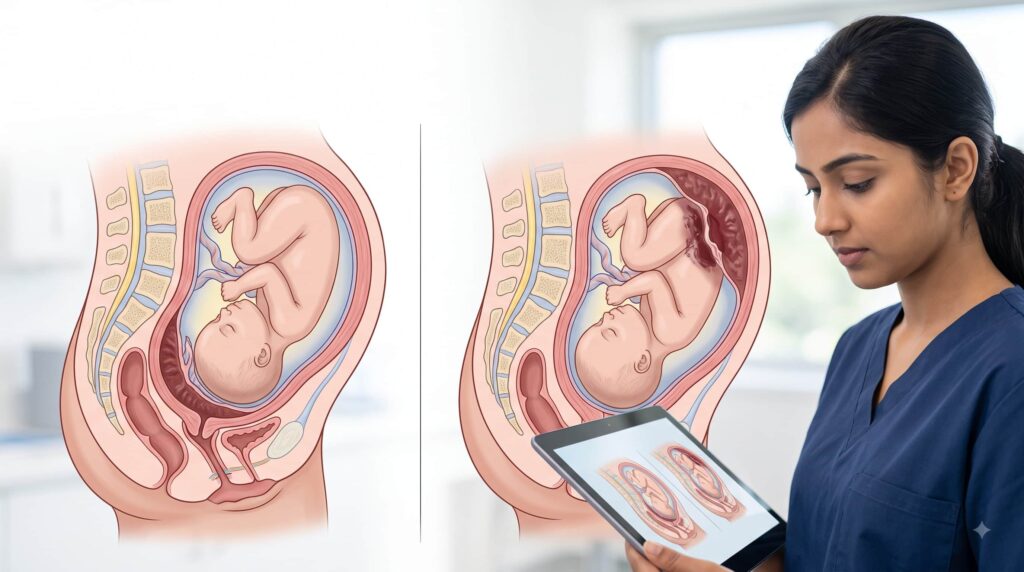
It is simple to differentiate placenta previa and abruptio placentae. Placenta previa happens when there is an abnormal location of the placenta within the uterus, where the placenta is situated in such a way that it obstructs the cervix. Abruptio placentae involves a normal location of the placenta but its premature separation from the uterine wall. Previa usually brings painless, bright red bleeding. Abruption usually hurts, and the blood is often dark red. Sometimes the blood stays hidden inside.
Both are big causes of antepartum haemorrhage (APH). That’s bleeding after 20 weeks of pregnancy and before the baby is born. Both can put the mother and baby in danger. Therefore, if you are a nursing student, you will frequently come across “placenta previa vs. abruptio placentae” in your lectures, wards, and NCLEX examinations.
What Is the Placenta, and Why Does It Matter?
The placenta develops inside the uterus only during pregnancy, connecting the mother and child through the umbilical cord. You can regard the placenta as the lifeline of the baby.
It usually attaches itself to the top portion of the uterine wall. It keeps away from the cervix, which is the opening of the womb. The small opening inside the cervix is referred to as the internal os.
Here are some of the things that the placenta does each day:
- Transfers oxygen and nutrients from the mother to the fetus (oxygen and nutrient exchange)
- Takes away the baby’s waste
- Makes hormones that keep the pregnancy going
- Protects the baby from harm
The placenta is richly supplied with blood vessels. Hence, if it is misplaced or separates prematurely, there may be serious bleeding. This explains why placental abnormalities are so life-threatening.
What Is Placenta Previa?
What is placenta previa? It is the location of the placenta in the lower uterine segment covering the internal os completely or partially. The term ‘previa’ means ‘going before.’ Essentially, the placenta occupies a position in front of the child’s head, blocking its delivery.
When the lower segment of the uterus stretches at late stages of pregnancy, the placenta can start bleeding.
Types of Placenta Previa
Typically, four categories of placenta previa can be found in medical textbooks:
- Complete (total) placenta previa: the placenta covers the entire internal os.
- Partial placenta previa: it partially covers the internal os.
- Marginal placenta previa: the placental margin touches the internal os margin.
- Low-lying placenta: it is situated in the lower part of the uterus but does not cover the internal os.
It is very confusing for students to distinguish between “complete,” “partial,” and “marginal placenta previa.” Just bear in mind that it goes from “fully covering” to “touching.” Actually, there are several new classifications that reduce this problem and use only two definitions: “placenta previa” and “low-lying placenta” (“placenta edge within 2 cm from the internal os”).
And here is something good, placenta that is considered to be low in early pregnancy often migrates further. This is why a repeated ultrasound examination is performed later.
Causes and Risk Factors of Placenta Previa
Nobody knows the exact cause every time. But these causes and risk factors of placenta previa are common:
- A previous caesarean section or other surgery on the womb
- Placenta previa in an earlier pregnancy
- Multiparity (many past pregnancies)
- Advanced maternal age, usually 35 or above
- Twins or more
- Smoking
- IVF pregnancy
Another fact that you need to be aware of. If a woman has both a history of C-section and previa, she will be at risk of developing placenta accreta spectrum. It is a condition where the placenta attaches deeply into the uterine wall and may bleed heavily during birth.
Placenta Previa Symptoms
- The main placenta previa symptoms include:
- Painless bright red bleeding, often out of nowhere
- A soft non-tender uterus
- Bleeding that stops and then comes back
- Abnormal fetal presentation, like a breech or sideways baby
- A normal fetal heartbeat in most cases, unless the bleeding is heavy
Doctors confirm it with an ultrasound. A transvaginal ultrasound gives the best view and is safe when done gently by a trained person.
Why Is a Vaginal Exam Not Allowed?
This one comes up in exams all the time: why vaginal examination is contraindicated in placenta previa. The answer is easy. A finger exam can disturb the placenta lying over the cervix. That can start sudden, heavy bleeding. So no finger exam until an ultrasound rules out previa.
What Is Abruptio Placentae?
What is abruptio placentae? Here’s a simple placental abruption definition. It’s the premature separation of the placenta from the womb wall before the baby is born. The placenta was in the normal spot. It just came off too soon.
In this case, blood accumulates between the placenta and the uterus. The baby suffers oxygen deficiency, and the woman may bleed severely.
Concealed vs. Revealed Placental Abruption
People often ask about concealed vs. revealed placental abruption. There are three types:
- Revealed hemorrhage: The blood comes out, so you can see it.
- Concealed hemorrhage: The blood stays trapped behind the placenta. You may see little or no bleeding.
- Mixed: Some blood comes out and some stays inside.
Concealed bleeding is the scary one. The mother can go into shock while the pad looks almost clean.
Grades of Placental Abruption
The grades of placental abruption show how bad it is:
- Grade 0: No signs. It’s only found after birth.
- Grade 1: Mild. A little bleeding, some tenderness. Mother and baby are fine.
- Grade 2: Moderate. More pain and signs of fetal distress, but the mother isn’t in shock.
- Grade 3: Severe. Heavy bleeding, shock, and often the baby doesn’t survive.
Causes of Placental Abruption
Common causes of placental abruption include:
- Hypertension and preeclampsia
- Abdominal trauma, like a fall or a road accident
- Smoking
- Cocaine use
- Abruption in an earlier pregnancy
- Water breaking too early
- A sudden gush of amniotic fluid
- Older age of the mother
Placental Abruption Symptoms
Watch for these placental abruption symptoms:
- Severe abdominal or back pain
- Dark red bleeding, or sometimes none at all
- Uterine tenderness
- A rigid or board-like uterus in bad cases
- Strong, frequent uterine contractions
- An abnormal fetal heart rate
- Signs of shock that look worse than the bleeding you can see
Why the hard belly? The board-like uterus in placental abruption happens because trapped blood irritates the uterine muscle, and it tightens up.
Abruptio placentae can result in hypovolemic shock, DIC, which is a major clotting disorder, and a Couvelaire uterus, where there is bleeding inside the uterine wall. Early delivery and stillbirth may also result.
Comparison Table: Placenta Previa vs. Placental Abruption
The following is the comparison of placenta previa and abruptio placentae in tabular format. Keep this placenta previa vs abruptio placentae chart handy for nursing students.
| Point | Placenta Previa | Abruptio Placentae |
| What happens | Placenta sits low, near or over the cervix | Normal placenta comes off too early |
| Pain | Usually none | Usually painful |
| Blood colour | Bright red | Often dark red |
| Can you see the blood? | Yes, usually | Maybe, maybe not |
| Mother’s state | Matches the blood you see | Can be worse than the blood you see |
| Womb | Soft, not tender | Tender, may be hard |
| Baby’s heartbeat | Usually normal at first | Often abnormal |
| Baby’s position | Often breech or sideways | Usually normal |
| Main risks | Past C-section, many pregnancies, older age | High BP, injury, smoking, cocaine |
| How it’s found | Ultrasound | Mostly by signs and symptoms |
| Finger exam | Not allowed until ruled out | Can be done carefully |
| Delivery | C-section if placenta covers the os | Depends on how serious it is |
Why Does One Hurt and the Other Doesn’t?
Why is placenta previa painless and abruption painful? It’s all about where the blood goes.
- In previa, the blood flows straight out through the cervix. Nothing gets trapped, so there’s no pain.
- In abruption, the blood gets stuck behind the placenta. It presses on the womb and irritates it. That causes pain and contractions.
That’s the whole idea behind painless vs painful vaginal bleeding in pregnancy.
A Quick Mnemonic
Try this placenta previa vs abruptio placentae mnemonic:
“Previa is Painless. Abruption Aches.”
Easy, right? Pair it with “previa is bright, abruption is dark,” and you’ve got most exam questions covered.
How Are They Treated?
It depends on how much bleeding there is, the gestational age, and how the mother and baby are doing. Any bleeding means hospital admission or a quick check at the hospital.
Placenta Previa Management
Placenta previa management usually looks like this:
- Watching the mother closely in hospital
- No finger exams
- Pelvic rest, so no sex and nothing in the vagina
- Blood kept ready through type and crossmatch
- Corticosteroids for fetal lung maturity if the baby may come early
- Rh immunoglobulin (anti-D) if the mother is Rh negative
- Planned delivery, often around 36 to 37 weeks if things are stable
Is it possible to deliver normally with placenta previa? Not if the placenta covers the os. A C-section is needed because a normal birth would cause dangerous bleeding. If the placenta is only low-lying and far enough from the cervix, the doctor may allow a normal birth.
Placental Abruption Management
Is placental abruption an emergency? Yes, always treat it as one. Placental abruption management includes:
- Close watching and steroids in mild cases where the baby is still early
- Quick delivery in moderate or severe cases, often an emergency caesarean section if the baby is struggling
- Fluids and blood transfusion for blood loss
- Blood tests to check for DIC
- Anti-D for Rh-negative mothers
What Nurses Should Do?
Here’s the nursing management of placenta previa in short:
- Check maternal vital signs often
- Do fetal heart rate monitoring with CTG (cardiotocography)
- No finger exams, ever, until previa is ruled out
- Keep the mother on bed rest in a left lateral position
- Count and weigh pads to track blood loss
- Keep IV access ready
And the nursing management of abruptio placentae:
- Look out for shock: fast pulse, low BP, pale and cold skin
- Check if pain or hardness of the womb is getting worse
- Mark the fundal height to catch hidden bleeding
- Keep the fetal monitor running
- Record urine output carefully
- Watch for bleeding from gums or IV sites, which can mean DIC
The nursing diagnoses that would be used for the care plan of a patient with placenta previa and abruptio placentae include fluid volume deficit, at-risk for hypoxia of fetus, pain, and anxiety. These diagnoses will guide the intervention plans.
Placenta Previa vs Placental Abruption NCLEX Tips
Placenta previa vs placental abruption NCLEX questions love these points:
- Painless bright red bleeding? Think previa.
- Pain plus a hard belly? Think abruption.
- Previa suspected? No vaginal exam.
- Abruption? Watch for shock and DIC.
Try this sample NCLEX question:
A woman at 34 weeks has sudden painless bright red bleeding. Her womb is soft. What should the nurse NOT do?
- A. Check the baby’s heart rate
- B. Check her vital signs
- C. Do a vaginal exam
- D. Start an IV line
Answer: C. This looks like previa, and a vaginal exam could cause heavy bleeding.
These are high-yield topics in the NCLEX-RN, OET nursing, DHA exam, Prometric exam and HAAD exam. You’ll also find them in most B.Sc. Nursing notes and GNM notes on obstetric nursing.
Get Ready for the NCLEX With Tiju’s Academy
Knowing the theory is one part. Answering tricky NCLEX questions fast, under pressure, is another. That’s where Tiju’s Academy NCLEX RN coaching comes in.
If you’re looking for NCLEX coaching in Kerala, here’s what you get with us:
- Simple classes on the topics that come up most, like maternity, kids’ health and drugs
- Lots of practice with real exam-style questions
- Easy notes, tables and memory tricks like the ones above
- Mock tests that feel like the real NCLEX examination
- Trainers who guide you from day one to exam day
A lot of nurses searching for the best NCLEX RN coaching centre in Kerala want more than lectures. They want practice, support and a clear plan. As an NCLEX RN coaching centre in Kerala, that’s exactly what we focus on.
Conclusion
So, what’s the placenta previa and abruptio placentae difference? Previa is about where the placenta sits. It’s low, and the bleeding is painless and bright red. Abruption is about the placenta coming off too early. It hurts, the womb can get hard, and the bleeding may be dark or hidden. Both need fast medical care. For nurses, knowing this well helps in exams and in real life on the ward.
Ready to Pass the NCLEX?
Want to learn topics like this the easy way? Join Tiju’s Academy NCLEX RN coaching. Learn from our professional coaches, practice using exam-like problems, and follow a methodology that works. You can learn with us in Kerala or through our online courses.
Frequently Asked Questions:
A: Placenta previa happens when the placenta sits low in the uterus and covers or lies near the cervix. Abruptio placentae happens when a normally placed placenta separates from the uterine wall too early, before the baby is born.
A: No, placenta previa is usually painless. It causes sudden, bright red bleeding, and the uterus stays soft and non-tender.
A: Yes, placental abruption usually causes abdominal or back pain. The uterus may feel tender, and in severe cases it can become hard or board-like.
A: It depends on where the blood goes. In previa, blood flows straight out through the cervix, so there is no pain. In abruption, blood gets trapped behind the placenta, which irritates the uterus and causes pain and contractions.
A: Placenta previa usually causes bright red bleeding. Placental abruption often causes dark red bleeding, and sometimes the blood stays hidden inside the uterus.
A: There are four types: complete (total), partial, marginal and low-lying placenta. Newer guidelines often use only two terms: placenta previa and low-lying placenta, where the placental edge is within 2 cm of the internal os.
A: A vaginal exam can disturb the placenta lying over the cervix and cause sudden, heavy bleeding. It should not be done until an ultrasound rules out placenta previa.
A: In concealed placental abruption, blood stays trapped behind the placenta, so little or no bleeding is seen. It is dangerous because the mother can go into shock even when the visible blood loss looks small.
A: Common causes include high blood pressure, preeclampsia, abdominal trauma, smoking, cocaine use, a previous abruption, water breaking too early and older maternal age.
A: Yes, placental abruption should always be treated as an emergency. Severe cases can lead to shock, DIC, early delivery or stillbirth, so quick medical care is needed.
A: Not if the placenta covers the internal os. A C-section is needed because a normal birth would cause dangerous bleeding. If the placenta is only low-lying and far enough from the cervix, the doctor may allow a normal birth.
A: Yes, a placenta that looks low in early pregnancy often moves upward as the uterus grows. That is why doctors repeat the ultrasound later in pregnancy.
A: Remember: "Previa is Painless. Abruption Aches." You can also add "previa is bright, abruption is dark" to remember the colour of the bleeding.
A: Nurses should watch for signs of shock, increasing pain or hardness of the uterus, changes in the fetal heart rate, low urine output, and bleeding from the gums or IV sites, which can signal DIC.
A: Tiju's Academy NCLEX RN coaching offers simple classes on high-yield topics, exam-style practice questions, easy notes and mnemonics, and mock tests that feel like the real NCLEX. You can study in Kerala or online.