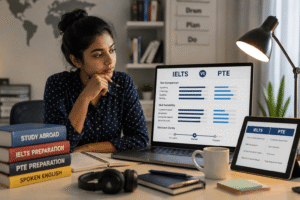
Selecting the appropriate exam between the IELTS and PTE can cause stress because both tests assess your level of proficiency in English for studying, working, or migrating. When you compare IELTS and PTE, which is easier to determine the best path forward, it becomes clear that they evaluate you in very separate manners. There isn’t one test that is “easier.” Selecting the most appropriate test for you will depend on how you would prefer to communicate, write, and use technology.
The following simple guide outlines both tests step-by-step to show why one or other examination will be best for you as an individual.
Summary Overview of Differences between IELTS and PTE Examinations
We’ll begin with understanding the fundamental differences between IELTS and PTE exam structures, administration methods, and how results are reported for each test.
Quick Reference Comparison Table
| Characteristics | IELTS | PTE Academic |
| Test Format | Paper or Computer | Computer only |
| Grading | By a Human for Speaking and Writing | By AI on all Skills |
| Navigating the Test | You can skip, return to, or change your answers | Fully forward navigation with no returning after “Next” |
| Testing of Skills | Occurs independently in each test | Testing of multiple skills together |
| Result Turn | 3 to 5 days (Computer) or 8 to 13 days (Paper) | Very Fast (typically in 1 to 2 days) |
| Scoring System | Based on a Band System ranging from 0 to 9.0 | Based on a global scale, which has a score produced from 10 to 90 |
Test by Test Comparison
Now let’s further break down this PTE vs. IELTS comparison per section of the test as it relates to the ways audio equipment was used to test the related language ability (speaking, writing, reading, and listening). You will easily find your best test based on competency in using the audio to complete your shared characteristics.
Speaking Assessment
This is the most significant distinction between both tests, one involving a real-life human interactive conversation and the other requiring you to speak into a computer screen.
1. IELTS Speaking: Human Interactive Conversation
- Set-up: You are alone in a private quiet room for 11 to 14 minutes with a registered certified examiner who is friendly. The process feels like a regular job interview or friendly conversation.
- Tasks: Answer easy questions regarding yourself, converse about a defined topic in two minutes using a prompt card, and discuss in more abstract depth regarding defined topics.
- Why it may be easier: If you enjoy speaking with people and are expressive when communicating, it will feel comfortable. If you happen to make an error in your answers simply say “I’m sorry, please allow me to rephrase my answer or response,” or “I will say this differently.” The evaluator will be able to understand your answer. Different regional dialects are easier for an evaluator to understand when using a human evaluation.
- Why it may be harder: If you happen to become extremely nervous or anxious due to another person staring at you, you will find it difficult to think of what to say.
1. PTE Speaking: AI Voice Recording
- The Environment: In a large, shared computer room, you wear headphones and record your voice into the microphone with many other test-takers. For many, this automated environment makes it the best english test for nervous speakers who dislike human eye contact.
- The Activities: You will read sentences from the screen, listen to sentences and repeat them, and describe the charts or pictures out loud.
- Why It Could Be Easier: Because there is no person in front of you. The AI will score only three aspects of your voice, that is, pronunciation and content.
- Why it Could be Harder: When all ten people are recording into their own speech, the room can become very noisy. The more serious issue is that the AI does not allow you to pause for more than three seconds while you are recording. If you pause for longer, the recording automatically stops and you will lose points for that question. Writing Assessment
The PTE has less of an emotional attachment to writing tasks and relies on a very mechanical view of how to handle writing. Because of this, many students wonder, “Is PTE easier than IELTS?” when looking at the writing modules.
Description for each type of writing task:
2. IELTS Writing: The Essay Test
- Task 1: Write what you see in a chart in your own words. This task is valued equally with task 2.
- Task 2: Write a traditional formal academic essay to defend or argue about something you believe.
- The Interface: Whereas you have the option to outline, scroll back and forth, and edit your essay until it is just right when using the IELTS, that is not the case with the PTE.
- Evaluation: One of the biggest differences between the PTE and the IELTS writing tasks is that human raters are judging your intelligence, logic, depth of your arguments, how the ideas flow together, and how complex the vocabulary you use is. If your arguments/rationales are weak or out of order, a human rater will see this right away.
2. PTE Writing: The Template Test
- Setup: You are using a rigidly structured computer program. The computer has set time limits for each exercise.
- Tasks: Summarize a long piece of content in one complete sentence and create a short essay based on a topic.
- Easier for you because the computer will grade your essay using AI. It will scan grammar and spelling, along with specific keywords.
- Harder for you because a computer requires flawless typing; if you make an error in typing, omit a comma, or are over the total word limit, you will automatically lose points from your score.
The Reading Test
Although both tests involve reading, how you read the passages is very different.
3. IELTS Reading: A Classical Comprehension Test
- Test Setup: There are 3 long and somewhat scholarly (heavy) academic passages and a total of 40 questions to answer in 60 minutes.
- Test Tasks: Multiple-Choice, fill in the blank, matching headings to paragraphs, determine whether the statement is “True, False or Not Given.”
- Why it may be easier for you to take the test: It’s a traditional testing format (standardized). You can read at your own pace, skip over harder questions, look at next questions, and come back to a hard question later. You have the ability to highlight on the computer or circle on paper.
- Why it may be harder to take the test: The passages are so long, sometimes as long as 900 words each. Reading all the way through these passages takes a lot of time and being able to find the appropriate synonyms to complete any question takes a great deal of focus.
3. PTE Reading: Fast-Paced Puzzle
- The Setup: A high interaction, fast pace section that will usually be no longer than 30 minutes. The texts will be much shorter than other sections.
- The Tasks: arrange jumbled sentences in the correct order, and fill in the blank by selecting the appropriate word(s).
- Why It May Be Easier: The reading passages being short means there is no chance that you will develop reading fatigue. If you have a good instinct for collocations (words normally used together, such as “make a decision” & “fast food”), then you can complete the blanks fairly quickly.
- Why It May Be Harder, Don’t forget: You have no way to return to previous questions! When you press “Next,” that question is gone from your memory forever. Because the PTE is an integrated test, your performance in the speaking section (specifically the “Read Aloud” task) contributes points toward your reading score. If you performed poorly with pronunciation earlier in the exam, this will affect your overall reading score negatively.
Time spent on taking the IELTS Listening Test.
The IELTS Listening Test is designed to assess your ability to comprehend various forms of audio recordings from different parts of the world and correspondingly write down answers to these questions all at once.
4. The IELTS Listening Test – Sequential Audio
- Structure: You will listen to a number of audio recordings and must answer a total of 40 questions in all four different audio tracks.
- Question Types: Fill in the blanks, and answer multichoice questions are all included.
- What Would Make It Easier: The order the answers are given to you is the same order they were recorded or played back for each question. If you catch an answer to question 5, you will be able to expect that answer 6 is next in sequence. If you take the paper version, there will even be 10 extra minutes in which to neatly and correctly transfer your notes to the final answer sheet.
- What Would Make It Harder: To complete the test, you must listen/read/write simultaneously as you answer the question immediately after the end of the passage. The correct spelling of your answer is important, meaning if you misheard it and wrote “libery” instead of “library,” the human rater will grade your record incorrectly.
4. PTE Listening: The Audio Game
- The Setup: A modern, fast-paced portion of the exam that will contain multiple short audio clips, lectures and videos to listen too.
- The Purpose: To write a summary of a spoken lecture, to listen to a sentence and transcribe exactly what you hear, or to read a passage that accompanies what you hear and click on any words that are different from what was heard.
- The Reason it may be easier: Tasks like “Highlight Incorrect Words” seem like an actual fast-paced computer game, as you listen and click on incorrect responses. This allows for fast scoring.
- The Reason it may be harder: In regard to the “Write from Dictation” task, you will have to listen to a rapidly spoken sentence, remember everything that you heard, and type out the same sentence without any spelling mistakes. Due to integrated scoring, if you do poorly on this task, you will also have a lower overall writing score due to this task’s impact on your writing score.
The Actual Experiences Of Students
To see what this looks like in the real world, let’s examine how different students encountered these testing systems when choosing an IELTS or PTE for immigration or study pathway.
Case 1: A Student Who Didn’t Like Computers
Ananya (Moved to the UK):
“You’d think it would be easy to use one of the computerised tests like the PTE because everyone assured you could use templates and pass easily, but when I got to the test centre I lost it completely! The test centre was so small and there were so many other students (all shouting in their microphones) that I could not stay focused! I started stuttering, and at one point the microphone switched off due to me taking a long pause! I got a really low score.”
“I then moved to the IELTS computer based test. The IELTS room was peaceful. During the speaking component, I had a great, normal conversation. The person I was speaking with was smiling and allowing me to form my sentences correctly even though I stumbled with my speech, my first attempt at the test, I passed! For me, it was much easier to interact with a human than to try and make a machine happy.”
Case Study 2: An Engineer’s Woes With Essay Writing
Markus (Australia):
“I sat at the IELTS paper test twice with native speaker level English language ability, but I kept getting 6.5 out of 9 for my essays from the paper test human markers because my essays weren’t perceived to be ‘academic’ even though I was using native level vocabulary to write my essays. I needed to get a minimum of 7.0 for bridging points under the immigration system. After being so frustrated with my results from the IELTS.”
“I tried the PTE. I memorized a rigid paragraph structure template, practiced to improve my typing speed, and double-checked my spelling. I did not care about whether the ideas in my essays had any substance, I merely provided the computer with the grammar and keywords it required in order for me to get a high score. I scored 78/90 or Band 8.0 on the PTE, therefore, the PTE allowed me to stay on track for my visa application to Australia because the computer assessed my grammar mechanics and not my opinion.”
Case Study 3: The Student Brought Down by Adhering to the Rigorous Guidelines for PTE
Chinchu (International Student):
“When I attended the examination, I started with easy questions and left the difficult ones until the end. When I took the PTE, I had a difficult time answering it, so I skipped it and went to the next question, with a thought that I could answer it later. But when I clicked ahead to the next question, the computer did not allow me to return to the previous questions. I lost marks and I was also not aware that my pronunciation of words during the speaking portion impacted my reading score. I decided to switch to IELTS because I like to have complete control over my test book.”
If you are choosing the IELTS exam, first understand your strengths and preferences by revising the different lists of options given below.
Choose the IELTS if:
- You enjoy talking to others and find it easier to talk to real people when compared to a computer screen.
- You want to check your answers after each question instead of checking at the end, and if you want to skip a question and come back to it after answering all the other questions in the particular section.
- You can communicate your thoughts clearly through the written word, and you would prefer to have a person read your writing.
- You are not comfortable typing quickly on a computer keyboard for three hours without a break.
Choose PTE Academic if:
- You struggle with anxiety around people: You do not want someone to be looking at you during the test, and you prefer the anonymity of dealing with a machine instead.
- You are stuck getting a 6.5 writing score on IELTS: You have taken IELTS previously but received a 6.5 for writing due to subjective grading from the examiner only on their opinion of your paper style.
- You are a technology user, and a fast typist: You can type fast enough to get your responses written down, and your typing accuracy is excellent, you can spell correctly, and you have good grammar with a clear understanding of word usage.
- You are on a short time limit: You need your test scores quickly (within 2-3 days) because you are applying to a university or to get a visa.
Summary of Upcoming Steps
If your feelings are still unclear, don’t take any chances; download an official free practice sample for both the IELTS and PTE. Devote 30 minutes to your sample experience; upon completion, review how you felt about each test format.
At Tiju’s Academy, our expert tutors will provide you with the support and resources you need to meet the English proficiency requirements, helping you develop the skills necessary to study abroad or qualify to migrate to Canada, Australia, New Zealand, or the UK. If you choose to take the IELTS route, you will be provided with training to prepare for the type of face-to-face verbal tests and utilize the IELTS’ flexible, section-to-section navigation.
Tijus Academy is considered one of the best PTE training institutes in Kerala. If you choose to take the PTE Academic route, we will provide you with training to prepare for the type of AI-scored assessment that the PTE Academic utilizes and the need for template development and proficiency in the multi-skilled integrated test.
The idea that something can come so easily for someone else is far too great a risk for us to take with the one-size-fits-all belief. Instead, our expert trainers work with each student to determine his or her own level of comfort both with their language skills and technical abilities so we can provide you with a unique means of passing the exam you wish to take the first time you sit for it.