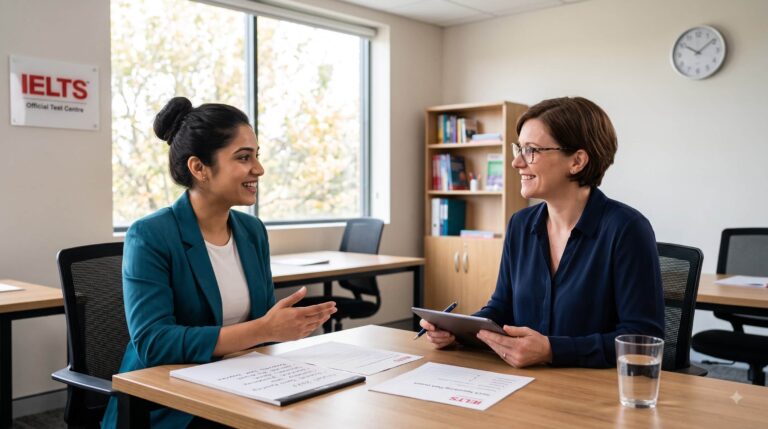

However, most of the common IELTS essay topics 2026 that students have to deal with fall into around ten categories: education, technology, environment, health, employment, crime, government spending, media, globalization, and family. Being familiar with these categories may be helpful; nevertheless, it won’t increase your mark on its own. Band 7 is given for the ability to develop a well-thought-out answer to any question in 40 minutes.
The current manual will help you prepare for the IELTS writing task 2 topics 2026. You’ll find:
- 50 topics grouped by category
- Three full IELTS writing task 2 sample answers
- A simple method that works for any question
- A self-check to see if you’re ready
- Answers to common questions about the test
We also share how Tiju’s Academy IELTS coaching helps students move from average scores to Band 7 and above.
Why IELTS Essay Topics Follow Patterns?
IELTS essay topics follow patterns because the test checks whether you can discuss general issues that any educated reader understands. It doesn’t test specialist knowledge. That’s why the most repeated IELTS essay topics keep coming back to the same social themes.
Every question has two layers:
- The theme, such as education, health, or climate change
- The essay type, which tells you how to answer
Types of Essays Include:
- Opinion essay (“To what extent do you agree or disagree? ”)
- Discuss both sides of the essay (“Discuss both sides and state your opinion”)
- Advantages and disadvantages essay (“Do the advantages outweigh the disadvantages?”)
- Problem and solution essay (“What problems can arise, and how can they be solved?”)
- Causes and effects essay (“What are the causes, and what are the effects?”)
- Two-part question or direct question essay (two questions you have to answer
However, the subjects related to everyday issues like artificial intelligence, working from home, and e-learning have become common in practice tasks and feedback from examinees after the test sessions. Therefore, when you start looking for IELTS writing task 2 predictions 2026, remember one thing: nobody can tell you the exact topic. Themes can be predicted, but the wording always changes.
At Tiju’s Academy, our Base Camp (a 5-day orientation) starts by teaching students to spot the theme and essay type in seconds. Once you can do that, no question feels completely new.
Why Common Approaches Fail?
Students find Task 2 difficult because they memorize their essays rather than learning how to answer a specific question. The following are common errors students make:
- Memorized answers: The examiners are experts in recognizing memorized content, and it will not earn you marks. In addition, it usually does not answer the actual question asked.
- Relevance of the answer: If the question talks about the effect of tourism on local culture and you give a generic answer on tourism in general, you will lose marks in task response despite your English proficiency.
- Weak ideas: Many candidates freeze because they can’t think of points. They end up repeating the same idea in different words.
- Word lists without context: Learning long vocabulary lists without collocations leads to awkward phrases like “do a crime” instead of “commit a crime.”
- No planning: Starting to write straight away usually creates messy paragraphs and poor coherence and cohesion.
- Practice without feedback: Writing 30 essays without anyone checking them often means repeating the same errors 30 times.
We built our Blank2Brilliant technique to fix the idea problem. It gives students a simple way to produce two or three strong points on any topic in under three minutes. Our 250in60 programme deals with the feedback problem. Students get personalized essay correction with clear notes on what to fix next.
From Band 6 to Band 7.5: A Real Candidate’s Journey
With the right method and regular feedback, a Band 6 writer can reach Band 7.5.
Akshaya from Alapuzha had scored Band 6 in writing in 2 attempts. The goal was 7.
Our Base Check assessment found three clear issues:
- Answers often drifted away from the question.
- Paragraphs had no clear topic sentence.
- The same linking words kept appearing, such as “moreover” three times in one paragraph
What changed?
- Blank2Brilliant made idea generation quick and reliable.
- The band descriptor breakdown sessions showed exactly what a 7 looks like compared with a 6.
- The 250in60 programme gave detailed corrections on every essay.
- Testfinity, our unlimited mock test system, meant mock tests under exam conditions every week.
- The TenX exam batch added focused practice in the final weeks.
- On Mic Drop Day, the last day before the exam, the focus was on staying calm and reviewing key points.
The result: Band 7.5 in writing.
The biggest change wasn’t a new set of big words. It was learning to answer the question directly and support every point with a clear example.
What Data Shows About Topic Preparation?
IELTS publishes test taker performance data, and writing is usually the skill with the lowest average band. That’s why focused preparation for Task 2 makes such a big difference.
Here is how band score calculation works in writing:
- Each task is marked on four criteria, and each counts equally (25%).
- Task response (called task achievement in Task 1)
- Coherence and cohesion
- Lexical resource
- Grammatical range and accuracy
- Task 2 counts for twice as much as Task 1 in your final writing band.
For example, if your Task 2 scores are 7, 6, 7, and 6, that task averages 6.5.
What this means for topic preparation:
- Knowing the themes mainly helps your task response and lexical resource.
- Good structure raises coherence and cohesion.
- Grammar practice improves grammatical range and accuracy.
- If one criterion stays low, it pulls down your whole band.
That’s why our Target Band Roadmap tracks all four criteria separately for every student.
50 Most Likely IELTS Essay Topics for 2026 by Category
These are the common IELTS essay topics 2026 that students will be most likely to face.
Education
- Should university education be free for all students?
- Is online learning as effective as classroom learning?
- Should schools teach practical life skills like cooking and managing money?
- Should children start learning a foreign language at primary school?
- Are exams the best way to measure a student’s ability?
Technology and Artificial Intelligence
- Will artificial intelligence replace teachers in schools?
- Do the advantages of social media outweigh the disadvantages?
- Should children’s screen time be limited by parents?
- Is technology making people less sociable?
- Should governments regulate the use of AI in the workplace?
Environment and Climate Change
- Who is more responsible for tackling climate change, individuals or governments?
- Should plastic packaging be banned completely?
- What can be done to protect endangered species?
- Should air travel be taxed more heavily to protect the environment?
- What causes water shortages, and how can they be solved?
Health and Sports
- Should junk food advertising be banned?
- Why are obesity rates rising, and what can be done about it?
- Should professional athletes earn such high salaries?
- Should governments spend more on preventing illness than on treating it?
- Is regular exercise more important than diet for good health?
Work and Employment
- Is remote work better for employees and employers?
- Should people stay in one job for life or change careers often?
- Is job satisfaction more important than a high salary?
- Should there be a fixed retirement age?
- Why do many young people prefer freelance work?
Crime and Punishment
- Is prison the best way to reduce crime?
- Should young offenders be punished the same way as adults?
- Does violence in films and games increase crime?
- Should the police carry guns?
- What causes cybercrime, and how can people be protected?
Government Spending
- Should governments spend money on space exploration?
- Should governments fund the arts or focus on healthcare?
- Should public transport be free?
- Should governments invest more in rural areas than in cities?
- Should governments pay for the care of elderly people?
Media and Advertising
- Does advertising encourage people to buy things they don’t need?
- Should advertising aimed at children be banned?
- Is online news more reliable than newspapers?
- Do celebrities have a responsibility to be role models?
- How has social media changed the way people get news?
Globalisation, Culture and Tourism
- Does globalisation threaten local culture and tradition?
- Does international tourism do more harm than good?
- Should everyone learn English as a global language?
- Should museums be free to visit?
- Is it important to protect old buildings in modern cities?
Family, Society, Transport, and Urbanisation
- Are families today less close than in the past?
- Should elderly parents live with their adult children?
- What causes traffic problems in cities, and how can they be solved?
- Do the benefits of urbanisation outweigh the problems?
- Should people have children later in life?
These questions work well as IELTS academic writing task 2 topics and are also good practice for general training. At Tiju’s Academy IELTS training, students get daily practice tasks from lists like this, with one plan and one full essay each week.
IELTS Writing Task 2 Sample Answers (Band 8 Level)
Below are three IELTS essay topics with answers, which have been written in accordance with the standards of IELTS model essays band 8/band 9. Study these examples to learn about their structure, and don’t try to reproduce them verbatim.
Model Essay 1: Agree or Disagree Essay
Question: Some people argue that artificial intelligence will be replacing teachers in the classroom very soon. How far do you agree or disagree with this point of view?
While I recognize that artificial intelligence provides many advantages, there is no doubt that it will never replace human teachers because education requires the skills and qualities that can only belong to human beings.
Of course, it should be acknowledged that using AI tools has its own pros. These tools can provide an explanation of the math problem at any hour of the day, make the exercise difficult enough for each particular learner, and correct the test in a second. For children who study in poor areas with a shortage of qualified teachers, the use of AI tools can be very helpful.
However, the process of teaching involves much more than merely providing information. An efficient teacher knows how to recognize when a student feels insecure, how to adjust the lesson when students get lost, and how to motivate those who do not want to learn anymore. All these actions are made through empathy and experience, and this is something that AI definitely lacks
Besides, at school children learn about social skills, including working as part of a team and respecting other people, and they can learn this only through communication with other people, not through communicating with a chatbot.
Conclusion:
It can be summed up by saying that although AI has many merits, it cannot replace teachers who know how to teach and instruct their students.
What makes it work:
- The thesis statement states an opinion in the introduction.
- Every paragraph is devoted to one idea supported by examples.
- Cohesive devices are used properly.
Model Answer 2: Discuss Both Views Essay
Question: There are those who believe that working from home is good for both employees and employers. Some, on the other hand, claim that it decreases productivity and teamwork. Examine these two sides of the argument and state your own opinion.
Remote working has become very common since the outbreak of the coronavirus, and people have different views regarding it. Some believe that remote working is a positive thing for all, while others believe that it is counterproductive and destroys teamwork. In my opinion, a combination of the two would be ideal.
Proponents of remote working cite some advantages of it. Employees save time and money on transportation, and they end up being stress-free. Moreover, most employees get an opportunity to combine their work with their family life easily. Employers are also positively affected because they are able to cut costs on office space and hire highly skilled professionals from other places in the country or even outside the country.
On the contrary, there are serious flaws to consider. Firstly, distractions at home may make it difficult to concentrate on the job and separate working time from leisure time, hence making the working day longer. Secondly, collaboration can be hampered due to the lack of face-to-face contact with colleagues. Problems that are solved quickly in an office environment can be prolonged through email exchanges. In addition, employees who join a company can have difficulty learning from more experienced co-workers who work remotely.
As far as I am concerned, the optimal approach would be a blend of both approaches. Employees will be able to work remotely for certain days of the week and spend the rest of the week attending meetings and receiving training in the office.
To conclude, it should be noted that there are both advantages and disadvantages to remote work.
Why it works:
- Has a 5-paragraph format: introduction, opinion one, opinion two, personal opinion, and conclusion.
- Equally distributes both opinions.
- The writer expresses his/her opinion clearly throughout the writing, which is required by task response.
Model Answer 3: Problem and Solution Essay
Question: Traffic congestion is becoming a serious concern in many cities. What could be the causes of this problem, and what measures should be taken to solve it?
Heavy traffic is posing difficulties in the lives of people residing in the cities across the globe. This essay focuses on the facts that urbanization, along with the extensive use of private modes of transportation have caused this problem, and an enhanced public transport system will be its solution.
The first cause of this problem is urbanization. As more and more people start migrating to the cities for work and studies, the number of vehicles increases at a greater pace than the development of roads. The second cause of this problem is that people use private transportation. Buses, in many countries, are overcrowded and travel slowly. Hence, people using private modes of transportation are very few in number.
Several approaches can be used to solve the problem of traffic. The government can provide cheap and efficient means of transport like railroads and buses so that individuals are able to move without using vehicles. For instance, railroads have been constructed in Kochi because of overfilled roads.
There are other approaches that may be used, such as construction of housing blocks near the places of work and also construction of walkways in order to reduce unnecessary trips using private vehicles. Corporations can also help by allowing flexible working hours to their employees.
Conclusion: Traffic is caused by urbanization and the use of private vehicles.
Why it works:
- It adheres to a four-paragraph format, i.e., introduction, causes, solutions, and conclusion.
- It addresses both aspects of the two-aspect question.
- It incorporates accurate vocabulary such as “dedicated bus lanes” and “urban populations.”
The Right Approach: How to Prepare for Any IELTS Essay Topic
The best way to prepare for any subject is to follow a general five-step procedure that will apply to all subjects. Below is the way how to prepare for IELTS Writing Task 2.
Step 1: Read the question carefully (2 minutes)
- Underline the topic and the exact task.
- Identify the essay type.
Step 2: Brainstorm ideas (3 minutes)
- Write down two or three main points.
- Add one real example for each point.
- This is where brainstorming with our Blank2Brilliant technique saves time.
Step 3: Plan your paragraphs (3 minutes)
- Introduction paraphrasing: rewrite the question in your own words.
- Add a clear thesis statement.
- Plan each body paragraph with a topic sentence, an explanation, and an example.
- Finish with a short conclusion paragraph that repeats your view.
Step 4: Write (27 minutes)
- Stick to your plan.
- Use linking words naturally, not in every sentence.
Step 5: Check (5 minutes)
- Identify any common grammatical errors such as subject-verb agreement, articles, and plurals.
- Ensure that your essay is over 250 words long.
The process of planning an essay in this manner will not take longer than 10 minutes, leaving much time for proper writing. Time management is one of the most crucial skills you should develop.
IELTS band 7 writing tips
- Answer every part of the question.
- Keep one main idea in each paragraph.
- Use natural collocations like “raise awareness” and “tackle a problem.”
- Mix simple and complex sentences.
- Avoid informal words like “kids” or “stuff.”
- Don’t repeat the question’s words too often. Paraphrase instead.
Our Band 7+ writing templates are frameworks for structure, not memorized essays. They demonstrate where the thesis, topic sentences, and examples belong. Our Word Savvy classes increase topic-related vocabulary, and our vocabulary and grammar development classes will correct the mistakes holding you back at Band 6.
Self-Diagnosis: Is Your Topic Preparation Strong Enough?
You’re ready for Task 2 if you can write a clear, well-supported essay on an unseen question in 40 minutes. Check yourself honestly:
- Can you name the essay type within 30 seconds?
- Can you come up with two ideas and examples for any of the 50 topics above?
- Do all your body paragraphs start with a clear topic sentence?
- Do you finish on time with at least 250 words?
- Do you use at least five different cohesive devices naturally?
- Can you write a full essay without stopping to look up words?
- Has a trained teacher checked your recent essays?
- Do you know which of the four criteria is your weakest?
If you answered “no” to three or more, you need more structured practice. Our Base Check assessment finds your exact weak points in the first week, so you don’t waste time on things you already do well.
Build Your Writing Preparation Around Every Topic
What you need to do is learn each category separately so that you are able to manage all the themes comfortably. The following is an easy week-by-week schedule:
- Monday: Learn 15-20 words and collocations for one category.
- Tuesday: Plan three essays from that category (planning only).
- Wednesday: Write one full essay under timed conditions.
- Thursday: Get feedback and rewrite the weakest paragraph.
- Friday: Practice a different essay type on the same theme.
- Weekend: Take a full mock test.
Do not forget that there is Writing Task 1 and Task 2. While the former is required to be written in just 150 words, it is equally important. Give Task 1 about 20 minutes and Task 2 about 40.
While writing is an important aspect of the test, it is not all there is to the test. This is why most of our students describe us as the best IELTS coaching Centre in Kerala. Here are the services we provide:
A step-by-step IELTS study plan built around your test date
- Reading and listening strategies through Read Savvy, our 40in60 programme (full reading explanations), and Listenlock (detailed listening explanations)
- Speaking practice with feedback through Fluent Sphere and the Brain Spark technique for speaking ideas
- Live classes or recorded lessons, so you can study at your own pace
- Progress tracking after every mock test
- A friendly community or peer group for daily motivation
- The 4-in-1 program, with test-day tips for all four modules
Conclusion
There are distinct patterns in the common IELTS essay topics 2026, but good grades result from practice, not memorization. Understand the common themes, learn the six types of essays, outline first, and receive constructive criticism of your efforts. If you do this regularly, Band 7 or better will be attainable.
If you want expert support, Tiju’s Academy IELTS coaching is ready to help. Students across Kerala and abroad trust us as the best IELTS training centre in Kerala, and our online batches are among the best IELTS coaching online options for learners anywhere. We have branches in Mavelikara and Thiruvalla, and we offer flexible online classes too.
With Tiju’s Academy IELTS training, you get:
- Personalized essay correction through 250in60
- Unlimited mocks with Testfinity
- Focused exam practice in the TenX batch
- An exam-day preparation module that ends with Mic Drop Day
Frequently Asked Questions:
A: The common IELTS essay topics 2026 fall into about ten categories: education, technology, environment, health, employment, crime, government spending, media, globalization, and family. Everyday issues also come up often in practice tasks and candidate feedback, including artificial intelligence, working from home, and e-learning.
A: The themes repeat, but the exact questions rarely do. IELTS tests general social issues, so topics like education, health, and climate change keep coming back. The wording always changes, so no one can predict the exact question you will get on test day.
A: No, memorizing essays is not a good idea. Examiners are trained to recognize memorized answers, and they will not earn you marks. A memorized essay also rarely answers the actual question, which lowers your task response score. Learn flexible structures and ways to generate ideas instead.
A: An IELTS Task 2 essay should be at least 250 words, and you have about 40 minutes to write it. Task 1 needs only 150 words. Spend about 20 minutes on Task 1 and 40 minutes on Task 2, and check your word count before you finish.
A: IELTS Writing Task 2 has six main essay types:
Opinion essay (agree or disagree)
Discuss both views
Advantages and disadvantages essay
Problem and solution essay
Cause and effect essay
Two-part question (direct question essay)
Spotting the type quickly tells you how to answer.
A: Use a 4-paragraph structure or a 5-paragraph structure.
Introduction: paraphrase the question and give a clear thesis statement.
Body paragraphs: each needs a topic sentence, an explanation, and an example.
Conclusion: keep it short and repeat your view.
How long should I spend planning an IELTS essay?
Spend about 8 minutes planning, and never more than 10.
2 minutes to read the question
3 minutes to brainstorm ideas
3 minutes to plan your paragraphs
Then write for 27 minutes and use the last 5 minutes to check grammar and word count.
A: Spend about 8 minutes planning, and never more than 10.
2 minutes to read the question
3 minutes to brainstorm ideas
3 minutes to plan your paragraphs
Then write for 27 minutes and use the last 5 minutes to check grammar and word count.
A: Each writing task is marked on four criteria, and each counts for 25%:
Task response
Coherence and cohesion
Lexical resource
Grammatical range and accuracy
Task 2 counts twice as much as Task 1, so your essay has the biggest effect on your final writing band.