
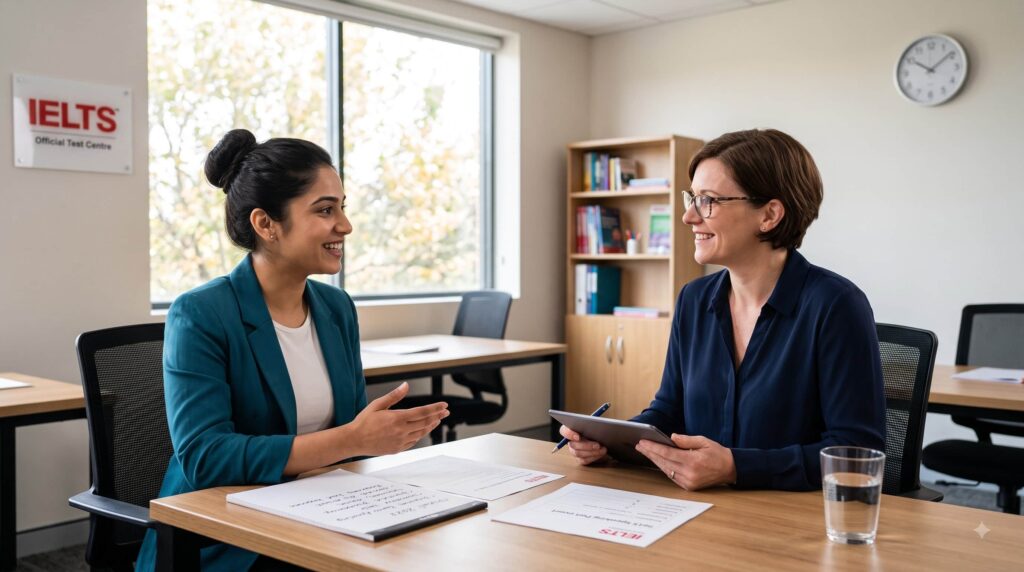
Do you want to get an IELTS Speaking test score of 8 band? If yes, then you need to practice the correct topics before the day of your test. With the help of this guide, you will get 50 IELTS Speaking Part 2 Cue Cards 2026 classified into five easy categories and with some model answers and brief tips that you can easily use. These are the recent IELTS Speaking cue cards that real IELTS candidates report at exam centers.
Part 2 is where a lot of people freeze. One card. One minute to think. Two minutes to talk. No second chances. Here’s the good part, though. This section is very predictable once you spot the pattern. Learn a few reliable structures, prepare your ideas, and walk in calm instead of shaking.
At Tiju’s Academy, one of the best IELTS coaching centre in Kerala, we drill this exact skill with our students every single week. Let’s get you ready for it.
What is IELTS Speaking Part 2?
Part 2 is the long turn. The examiner provides you with a card that has a particular topic along with a few bullet points. You are given 1 minute to make some quick notes, after which you deliver an individual speech for about 2 minutes.
Here’s how the full speaking test is built:
-
- Part 1: short questions about you, your home, your work, your hobbies (4 to 5 minutes)
- Part 2: the cue card, or the long turn (3 to 4 minutes in total)
- Part 3: follow-up questions related to your Part 2 topic (4-5 minutes)
The entire test takes 11 to 14 minutes. The examiner does not disturb you in the long turn part and simply listens to what you say and makes notes. After that, he can ask you 1 or 2 short questions and then go ahead to Part 3.
There are four aspects on which your performance is assessed. These are referred to as band descriptors: fluency and coherence, lexical resource, grammatical range and accuracy, and pronunciation. Each aspect contributes 25 percent to your score. Once you know what the examiner’s expectations look like for each, you stop guessing and start fixing the right weakness.
The best IELTS cue card structure is simple. Open
How to Structure Your Part 2 Answer?
, tell a story with a time shift, and close. Don’t just describe the thing. Tell a small story about it. That single habit is what pushes you past Band 6.
Apply the PPF method, which means Past, Present, Future. By changing the tense in your narrative, you automatically demonstrate a broader range of grammar.
- Intro: name your choice in one line so the examiner knows what you picked
- Past: when it started, how you first came across it
- Present: what it means to you now, why it matters today
- Future: what you hope will happen, or how it changed you
- Rounding-off sentence: one clean line to finish, so you don’t stop dead
This is actually a very important point. A great closing statement indicates that you did it on purpose, not because your words simply run out. Something like “And that is basically the reason why it remains very relevant for me” will just always do the trick.
This is the same frame we teach in Fluent sphere, our speaking module at Tiju’s Academy. The moment students learn one solid structure, they stop rambling and start filling the full two minutes with ease. And because the same story can stretch or shrink, you never freeze halfway through wondering what to say next.
Using Your 1-Minute Preparation Time
Don’t write full sentences during your prep minute. You’ll run out of time and end up reading your notes out loud, which sounds flat and robotic. Use keyword mapping instead.
Here’s exactly what to do in the 1 minute of preparation for IELTS speaking:
- Write 5 to 8 keywords only, never full sentences
- Put one trigger word next to each bullet point on the card
- Add two or three strong vocabulary words you want to slip in
- Mark a quick past, present, future note so your story has movement
That’s all. Your notes are a map, not a script. When you glance down mid-answer, you see one word and keep talking naturally.
Our students train this with the Brain spark technique, our idea-generation method for speaking. It teaches you to produce ideas fast, so a blank card never leaves you stuck and staring. This one skill alone fixes most Part 2 panic.
People Cue Cards (1 to 10)
The describe a person cue card is the most common type reported so far in 2026. Here are ten to practice:
- Describe a person who inspired you
- Describe a family member you are close to
- Describe a teacher who influenced you
- Describe your bestfriend
- Describe a person who is good at their job
- Describe an older person you admire
- Describe a famous person from your country
- Describe a person who helped you recently
- Describe a child who made you laugh
- Describe a kind neighbour
Band 8 model answer (Card 1: a person who inspired you):
“This person is my uncle, who, in all fairness, has actually helped me appreciate hard work. He grew up in a tiny village close to Alappuzha in a poor family, and during those times there was virtually no education available to him. Nevertheless, he taught himself programming using books and online tutorials from the library, and now he manages a small programming team in Kochi. The thing that attracts me about him is not his profession. What appeals to me is that he did not make any excuses. Whenever I feel like quitting on myself with my studies, I remind myself of how he studied at night without excuses. Till today, he keeps calling me every Sunday to see how I am doing. I truly wish someday I can inspire someone younger to be as patient as me.”
Places Cue Cards (11 to 20)
The “describe a place” cue card is an opportunity for you to use descriptive vocabulary. The following topics belong to the category of IELTS Speaking Part 2 topics 2026, as reported by IELTS Speaking Part 2 topic students from the following list:
- Describe a city you would like to visit.
- Describe a quiet place you like to go.
- Describe a place near water.
- Describe a historical building in your area.
- Describe a park or garden you enjoy.
- Describe a place where you like to study.
- Describe a country you want to see.
- Describe a shop you visit often.
- Describe a beautiful place in your hometown.
- Describe a place that was really crowded.
Band 8 model answer (Card 11: a city you would like to visit):
“My dream destination is Kyoto, which is located in Japan, in the spring season, when cherry blossoms are in full bloom. I have seen it in various videos online, and somehow the combination of ancient temples and the modern cleanliness of streets really attracts me. If I get the chance, I would like to stay there for at least a week and explore the serene temples early in the morning. The main reason it appeals to me is the calmness. My own city gets loud and busy, so a slow trip through those gardens sounds like the perfect break. If I ever save enough, that’s the first trip I’m booking.”
Events Cue Cards (21 to 30)
Events require a coherent narrative structure with a start, a process, and an end. Here are some recent latest IELTS cue cards 2026 under this category:
- Describe a celebration you enjoyed
- Describe a time you helped someone
- Describe an important decision you made
- Describe a memorable journey
- Describe a time when you were very busy
- Describe a wedding you attended
- Describe a time when you did something for the first time
- Describe a festival celebrated in your country
- Describe a time you had good news
- Describe a time you were late
Band 8 model answer (Card 21: a celebration you enjoyed):
“There is one celebration that I remember very well and it is my sister’s marriage that happened two years ago. It was quite an eventful occasion for my whole family; the wedding was attended by more than three hundred people. But what was most important was not the number of guests but the mood of the celebration. There were a lot of relatives whom we hadn’t met for a long time. The whole house was full of noise and people cooking until midnight. Since I had to receive the guests, I couldn’t rest, but that was ok with me. The best moment was when we started dancing; even the aunties who never dance got up to dance. This helped us become closer to each other. We still smile while looking at those photographs.”
Objects Cue Cards (31 to 40)
For objects, describe the item, then explain why it matters to you. Don’t just list features. Here are common IELTS cue card topics with answers in this group:
- Describe a gift you received
- Describe something you bought recently
- Describe a piece of technology you use daily
- Describe an object you would keep forever
- Describe a book that influenced you
- Describe something you made yourself
- Describe your favourite piece of clothing
- Describe an app you use often
- Describe a photo you like
- Describe something you lost
Band 8 model answer (Card 33: a piece of technology you use daily):
“My technology of choice would definitely be my mobile phone, but it might appear boring at first until I show you just how much I utilize it on a daily basis. First of all, it is my alarm, my learning device, and my connection to my relatives living in other countries. While preparing for IELTS exam, I even used to record myself speaking through my phone each and every day and listened to those recordings to correct my mistakes. And honestly, that practice did me much more good than anything else. Yes, it can distract me, and there were times when I needed to turn off the notifications while studying. But when used wisely, it resembles a whole classroom in my pocket.”
Abstract Cue Cards (41 to 50)
Abstract topics are where higher bands pull away from the rest. They ask about ideas, habits, and plans, so you’ll want advanced vocabulary and clear examples. Here are recent IELTS Speaking Part 2 sample answers topics in this group:
- Describe a skill you want to learn
- Describe a goal you have for the future
- Explain a habit you would like to change
- Explain a bit of advice someone gave you
- Explain a decision you had to make after much time
- Explain a change that has improved your life
- Explain a rule you do not agree with
- Explain a plan you have for next year
- Explain something that made you proud
- Explain an accomplishment you are proud of
Band 8 model answer (Card 41: a skill you want to learn):
“A new skill I would like to develop would be the art of public speaking. I have never been shy when it comes to communicating one-on-one, but as soon as I get into a crowd, my mind blanks and I rush through everything. I would like to do something about that since it is quite clear how useful it would be for future interviews and later in my professional life. I want to start off with baby steps and perhaps participate more in class discussions before moving forward to crowds. It is said that preparation and practice make a perfect speaker rather than talent.”
Deep Dive: Describe an Achievement You Are Proud Of
This is one that is repeated quite frequently for 2026, so let us construct a Band 8 response and identify each component. This is the archetypal “Describe an achievement you are proud of IELTS cue card.
Card: Describe an achievement you are proud of. You should say:
- What it is
- When it occurred
- How you achieved it
- Why you are proud of it
Band 8 model answer:
“My biggest achievement is getting a Band 7.5 in the IELTS after failing to reach the mark in my first try. (Intro) It was last year and in truth, my first try was a real eye-opener. My score was 6 mainly because of my failure in the speaking section. (Past) So, I had to change my game plan. I went to coaching classes, recorded myself everyday and did a complete mock test weekly in a real examination setting. Slowly but surely, my confidence returned. (Present) This achievement gives me pride since I know it did not happen by chance. It was months of hard work that eventually led to the opportunity for my nursing job overseas. (Why) In retrospect, that low score became the best thing that could happen to me.” (Rounding-off)
See the time shift, the concrete numbers, and the natural closing line? That’s the shape every strong Part 2 answer follows. In our Testfinity programme, students run unlimited mock speaking tests, so this kind of answer becomes second nature well before test day.
Advanced Vocabulary and Collocations for Band 8
Big fancy words will not improve your weak answer but the correct use of collocations in a natural way will definitely boost your score for lexical resources. The secret is to sound natural, not like a living dictionary. Use just a couple of these in each answer and leave everything else natural and simple.
- for describing emotions: “over the moon,” “a bit gutted,” “took me by surprise”
- for describing people: “down to earth,” “a hard worker,” “wise beyond her years”
- for describing locations: “off the beaten track,” “steeped in history,” “a breath of fresh air”
- to express opinions: “if I’m being honest,” “the way I see it,” “what really stands out is”
- to get some time to think about an answer: “that’s a good question; let me think.” “Now that you mention it…”
Notice that these phrases are natural, not idiomatic. And that is the whole point here. Examiners prefer natural and flexible language much more than rare words that are used in an inappropriate context. This skill is developed through Word savvy, our vocabulary course.
Common Mistakes Indian Candidates Make in Part 2
Most Indian candidates lose marks in the same handful of spots. Fix these and your score climbs fast. Here are the IELTS Speaking Part 2 common mistakes we see the most:
- Memorising full answers: Examiners spot a rehearsed script in seconds, and it pulls your band right down.
- Speaking too fast: Nerves make you rush. Slow down and both your pronunciation and fluency and coherence improve at once.
- Mother tongue influence on sounds like “v” and “w,” or the “th” sound. A little targeted practice smooths these out.
- Stopping after 40 seconds: You need to keep going closer to the full two minutes.
- Pure description with no story: Listing facts with no personal angle caps you around Band 6.
- Using heavy, formal words that sound unnatural. Simple correct English always beats fancy wrong English.
- Skipping a bullet point on the card. Cover every point the card asks for.
We correct these habits through speaking practice with feedback, where students hear their own recordings and change the pattern before it costs them on exam day.
Don’t Forget Part 3 Follow-Up Questions
Your cue card doesn’t end when the two minutes are up. The examiner will pose some questions on the same topic, and this constitutes Part 3. In case your Part 2 revolves around an individual who has inspired you, then your Part 3 will involve questions such as the importance of role models or whether there are many in existence today among the youth.
Remember two things. First, make sure that your answer includes reasons and examples. Second, it’s fine to have a mild opinion and explain it. Part 3 rewards ideas and clear thinking more than personal stories, so practise stretching a simple opinion into three or four sentences. The topics flow straight out of your cue card, which is another reason to pick a Part 2 subject you can actually talk around.
Why Train With Tiju’s Academy?
We are the best IELTS training centre in Kerala, and we also run the best IELTS coaching online for students who prefer to study from home. Whether you’re sitting in Kerala or working long shifts in the Gulf, our IELTS coaching centre in Kerala brings the full classroom to your screen.
Here’s what you get with Tiju’s Academy IELTS training:
- A step-by-step study plan built around a clear target band roadmap
- Base camp, a 5-day orientation, plus a Base check assessment to find your real starting level
- Daily practice tasks and speaking practice with feedback on every session
- Mock tests under real exam conditions through Testfinity, our unlimited mock programme
- Band 7+ writing templates and personalized essay correction with our 250in60 correction system
- Reading and listening strategies, including 40in60 for reading and Listenlock for listening
- A full band descriptor breakdown, so you always know exactly why you got your score
- Mic drop day, our final session before the exam, to make sure you walk in calm and ready
We have helped many candidates reach their target score, and many of them reached a full band once they joined our class. That is the reason why our students keep calling us the best IELTS coaching center in Kerala.
Final Tips and Your Next Step
Practise a few IELTS speaking topics 2026 out loud every day. Record yourself. Time it. Push for the full two minutes and finish with a clean rounding-off sentence. Do that for two weeks and Part 2 stops feeling scary.
Choose one card from each of the five categories listed above and go through them before your breakfast. Play the audio clip and point out one improvement point, be it speed, repetition of a word, or a bullet point that you’ve missed. Regular small practice sessions work better than one single practice session any day of the week and create peace of mind for exam day.
For more realistic guidance, come to our classroom! Schedule a free level test at Tiju’s Academy, mention your desired band score, and let’s create your program. Your Band 8 is closer than you think.
Frequently Asked Questions:
A: IELTS Speaking Part 2 is the "long turn." The examiner gives you a cue card with a topic and a few bullet points. You get 1 minute to make notes, then speak on your own for about 2 minutes.
A: The full IELTS Speaking test takes 11 to 14 minutes. It has three parts: Part 1 (4–5 minutes), Part 2 (3–4 minutes total), and Part 3 (4–5 minutes).
A: You get exactly 1 minute to prepare after receiving the cue card. Use it to write 5 to 8 keywords, not full sentences, so your notes act as a map rather than a script.
A: Open by naming your choice, tell a short story with a time shift, then close with a rounding-off sentence. Don't just describe the thing, turn it into a small story to push past Band 6.
A: PPF stands for Past, Present, Future. You shift tenses across your answer—when it started, what it means now, and what you hope happens next. This naturally shows a wider range of grammar to the examiner.
A: It's scored on four band descriptors: fluency and coherence, lexical resource, grammatical range and accuracy, and pronunciation. Each one contributes 25 percent to your overall score.
A: "Describe a person" cue cards are the most commonly reported type in 2026. Topics fall into five categories: People, Places, Events, Objects, and Abstract ideas.
A: Natural collocations, not rare words. Phrases like "down to earth," "off the beaten track," or "if I'm being honest" score higher. Use only a couple per answer, examiners prefer natural, flexible language over fancy words used incorrectly.
A: Common mistakes include memorizing full answers, speaking too fast, stopping after 40 seconds, giving pure description with no story, mother-tongue influence on sounds like "v," "w," and "th," and skipping a bullet point on the card.