
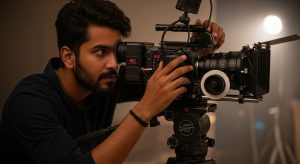
Have you ever watched a beautifully shot film or a high-quality Instagram Reel and wondered…
“Why doesn’t my video look like this?”
Even with a good camera, something feels missing. The truth is it’s not your camera.
It’s composition. We often see students with amazing ideas and stories, but their visuals don’t feel “cinematic.” The difference always comes down to one thing: how you frame your shot.
Let’s break it down in a simple, practical way so you can start improving immediately.
What is Visual Composition?
Composition is how you arrange everything inside your frame.
It includes:
- Your subject placement
- Background elements
- Empty space
- Direction of movement
Think of your frame like a canvas. If you randomly place things, it looks average. But if you place them intentionally, your video instantly feels professional.
Composition = Control over what your audience sees and feels
Why Your Videos Don’t Look Cinematic (Yet)
Most beginners make these mistakes:
- Everything is placed in the center
- Background is messy or distracting
- No depth in the frame
- Subject doesn’t stand out
- Shots feel accidental, not planned
1. The Power of Symmetry
Symmetry means placing your subject perfectly in the center, with both sides balanced.
How it works:
Imagine a line dividing your frame into two equal halves.
Why it works:
- Creates a sense of order and perfection
- Looks visually satisfying
- Feels clean and intentional
When to use:
- Portrait shots
- Doorways, hallways, windows
- Structured environments
Use symmetry when you want your shot to feel strong and controlled.
2. The Rule of Thirds (Your First Upgrade)
This is the easiest way to improve your videos instantly.
How it works:
Divide your screen into 9 parts using grid lines.
What to do:
Place your subject:
- On the lines
- Or at the intersection points
Why it works:
The human eye prefers slightly off-center subjects.
This makes your shot feel natural and cinematic.
3. Leading Lines (Direct Attention)
Leading lines are lines that guide the viewer’s eyes.
Examples:
- Roads
- Hallways
- Railings
- Edges of walls or tables
Why it works:
It tells the viewer exactly where to look.
Result:
- More depth
- More focus
- More storytelling power
If your shot feels confusing, add leading lines.
4. The Golden Ratio (Natural Balance)
This is a composition style inspired by patterns found in nature.
What it looks like:
A spiral guiding the eye toward your subject.
Why it works:
- Feels natural
- Looks visually “perfect”
- Creates harmony
It’s subtle but powerful when used right.
5. Triangular Composition
Triangles create strong and stable visuals.
How to use:
Arrange elements in a triangle shape:
- 3 people
- 3 objects
- 1 subject + 2 supporting elements
Why it works:
- Keeps the viewer engaged
- Adds structure
- Creates balance
Mastering Vertical Cinema (Reels, Shorts & TikTok)
Today, content is mostly watched on phones. So learning vertical composition is a must.
1. Negative Space
Negative space is the empty area around your subject.
Examples:
- Sky
- Plain wall
- Open background
Why it works:
- Highlights your subject
- Reduces distractions
- Looks clean and modern
In vertical videos, use top and bottom space smartly.
2. S-Curves (Flow & Movement)
An S-curve is a smooth, flowing line inside your frame.
Examples:
- Roads
- Pathways
- Staircases
Why it works:
- Adds elegance
- Creates motion
- Feels cinematic
It keeps the viewer’s eyes moving.
Common Beginner Mistakes
1. Headroom Problems
- Too much space above the head
- Cutting off the head
Keep it balanced.
2. Busy Backgrounds
Background distractions ruin your shot.
Always check behind your subject.
3. Over-Centering Everything
Centering every shot = boring.
Mix different compositions.
4. Ignoring Frame Edges
Unwanted objects at the edges distract viewers.
Always scan the full frame.
Simple Tips to Improve Today
➢ Turn on Gridlines
Helps you follow the rule of thirds.
➢ Move Your Feet
Don’t zoom in and change your position.
➢ Keep Lines Straight
Tilted shots look unprofessional.
➢ Take 5 Seconds Before Shooting
Adjust your frame before hitting the record.
Composition + Emotion = Cinematic Feel
Composition is not just technical. It’s emotional.
Before shooting, ask:
- What should the audience feel?
- Where should they look first?
- What is the main focus?
That’s when your videos become cinematic.
Why Learn at Tiju’s Media School?
You can read blogs, but filmmaking improves through practice.
You get:
● Practical Training
Real shooting experience, not just theory
● Expert Guidance
Learn from industry professionals
● Modern Equipment
Hands-on with real tools
● Career Focus
Perfect for creators, filmmakers, and media students
Conclusion
Great cinematography is about making choices. Every time you look through the viewfinder, you have the chance to create something beautiful. By using these simple composition rules from Wes Anderson’s symmetry to the S-curves of vertical cinema you’re well on your way to telling better stories.
Ready to turn your passion into a career?
Join the next batch at Tiju’s Media School and start your journey into the world of professional filmmaking.