Even AI video production still requires a director since a machine may generate visuals, but it certainly cannot determine the message of the story or the emotional reaction of the viewer. This is the simple answer to why AI video needs directors. An AI video producer is capable of generating a clip from a single sentence within minutes. It is not able to select the appropriate clip, discard the inappropriate one, and connect ten clips into a coherent story.
There is an important and reasonable question asked by many students in Kerala at present. If a machine can produce the video, then would the skill of direction be worth learning? Definitely yes, it is. There are people with creative vision who think about the viewer.
This guide covers:
- What an AI video director really does
- The director’s role in AI video production, step by step
- Why creative direction in AI video decides the quality of the final film
- What actually happens inside an AI video project
- How you can learn film direction in Kerala at Tiju’s Media School
What Is an AI Video Director?
The term “AI video director” refers to the individual who directs the artificial intelligence software in creating the video, just like a director would for his film crew. It is he who creates the concept and determines the look and feel, while the software executes it.
You may also see software that calls itself an “AI director.” This article is about the human being, sometimes called an AI film director. The title is new, but the job is old.
In daily work, this person:
- writes or approves the script
- plans every shot before a single clip is generated
- gives clear written instructions to the tool, which is called prompting
- checks each result and asks for changes
- makes sure the finished video matches the original intent
Today’s popular applications for it are Sora, Veo, Runway, and Kling. They mostly use one of two models. In the case of text-to-video, a clip is created based on written text. In case of image-to-video, a clip is created based on an image. These applications will evolve once or twice per month, while directing skills won’t change.
How do you direct an AI video?
An AI video is directed in the same way as a regular film, with the difference that you open the application after planning your video. Here is a basic directing algorithm:
- Make a short script, even if your video is 30 seconds long.
- Split your script into storyboards and shot lists.
- Make a prompt for each shot. Specify the framing, camera movement, and lighting.
- Generate a shot, check it, make corrections, and generate it again. That process is called iteration.
- Montage the best takes, add sound and color.
The Director’s Role in AI Video Production
It is the responsibility of the director to make all decisions that the software tool cannot make itself. This process takes place through three phases: prior to generation, during generation, and post-generation.
Pre-production: planning prior to the first prompt
Good AI video begins on paper. In pre-production, the director makes up his mind about issues that an AI software will never ask about.
- Scripting: What is the story? Who is the target audience? Even a one-minute advert requires a precise script.
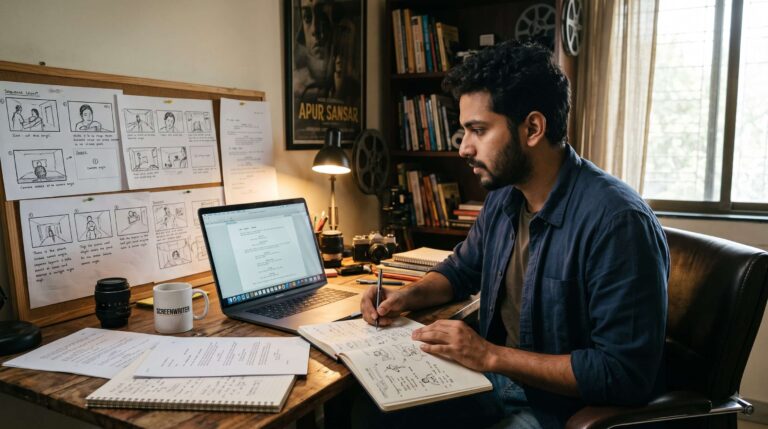
- Storyboard: Initial rough sketches for each scene so that everyone gets a picture of the movie even before it is produced.
- Shot listing: Numbered list of all shots with their dimensions, angles, and functions.
- Look and feel: The style and mood of the video, its colors and the type of lighting used in the film.
Module III of the diploma course in scriptwriting and direction offered at Tiju’s Media School in Kerala includes exactly these kinds of steps in the process.
During generation: guiding the tool
During generation, the director turns film language into instructions:
- Shot composition and framing: position of the subject in the image
- Camera movement: a slow push in, a pan, a dolly shot
- Blocking: position of the actors and their movements
- Lighting: soft morning light, harsh noon light, single-lamp lighting at night
Here is how that difference looks in practice. A beginner writes, “In the evening, a woman is walking on a beach.” A director writes something like this: slow dolly shot from behind, warm evening light, woman in the left third of the frame, waves crashing in the right.
They say it is called prompt engineering. To a skilled filmmaker, it is just direction, written down. This is why AI video direction comes more easily to those who speak the language of cinema.
Post-production: shaping the final film
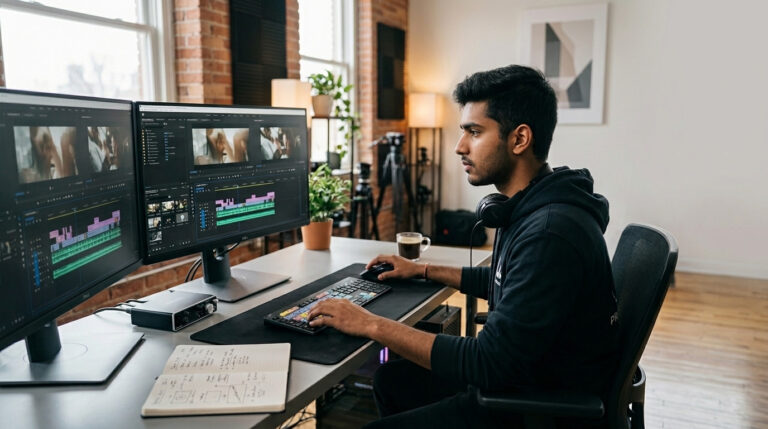
Clips that have been generated serve as raw footage. Post-production is where the director and the editor make these clips into a film.
- Editing and pacing: choosing the sequence of shots and their duration
- Continuity: ensuring that clothes, faces, and places are consistent across all shots
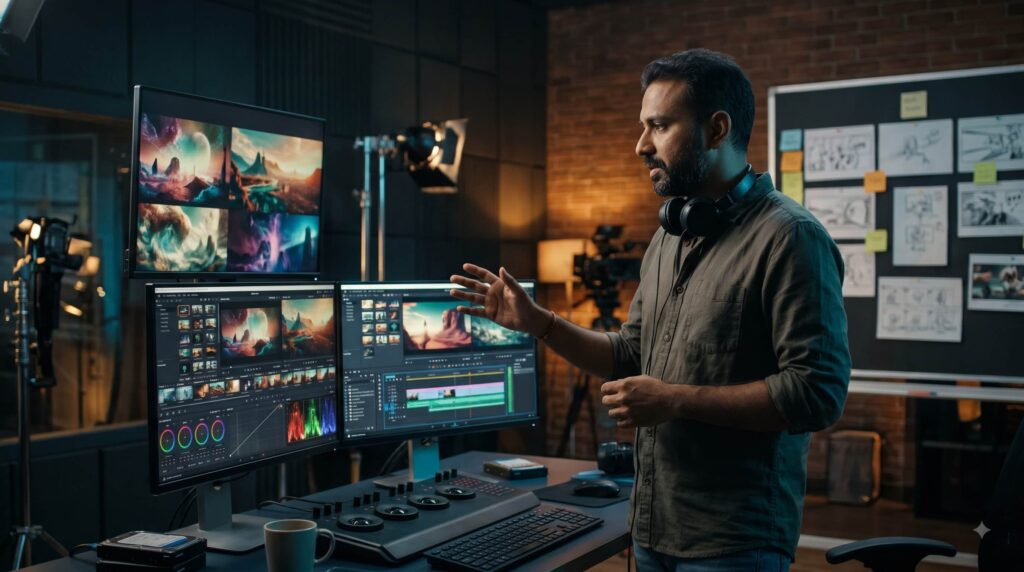
- Color grading: giving the same appearance to all the clips
- Sound design: adding voices, music, and sound effects, which do 50% of work of any film
- VFX: removing glitches left by the tool from the footage
Why Creative Direction Is Needed?
Creative direction is needed because the tool does not understand the reason for making the video. It does not understand the audience, the brand, and the emotion that should be delivered to them. The director understands the message that needs to be delivered.
Why do AI videos look generic?
Videos made by AI tend to be generic because this tool produces a generic response to a generic request. The algorithm has been trained on millions of video examples, hence reproducing what is most frequent. Generic AI content can be identified immediately:
- smooth, glossy faces that all look alike
- slow motion used for no reason
- no beginning, middle or end
- a style that could belong to any company
Taste and judgment help resolve the problem for the director. Taste refers to knowing the right version among the twenty. Judgment refers to knowing when to stop, or sometimes even to start again.
What a director adds
-
- Narrative: a clear story where each shot leads to the next
- Emotion: a reason for the viewer to care about what happens
- Visual storytelling: showing an idea through pictures, with fewer words
- Identity of the brand: colors, faces, and a unique voice that represent a single brand
- Originality: something that comes as an idea from the viewer that he/she has never encountered before a hundred times
Consider the case of a short ad for a textiles shop in Kerala during Onam. The tool is capable of creating pookalam as well as a sadya served on a banana leaf. Only a person who has experienced having lunch at Onam will know what small event will make a Malayali viewer laugh. This is human creativity in AI video.
Taste can be trained, though. At Tiju’s Media School, a hands-on media school in Kerala, afternoons are spent watching classic films and discussing them with classmates. Students see almost 100 classic films by the end of the course. That habit of watching closely is where a director’s eye comes from.
The Reality of AI Video Production
AI video work is much more tedious than the demo videos would suggest. The majority of video that you see generated by AI online is usually an outcome of numerous attempts, picking the right results, and subsequent editing. You won’t get a complete film from one prompt.
Weaknesses of AI video generators
There are still some difficulties faced by modern systems:
- Character uniformity: the same character appears in the next frame with a different face, haircut, or clothing.
- Small clips: the current video generators produce short clips, which means that a longer film requires stitching of several short clips.
- Physics: the behavior of hands, water, food, and other moving objects might be unnatural.
- Near-human characters: near-human characters cause uneasiness in viewers since they are just slightly different from real humans. This phenomenon is called the uncanny valley.
- Precision: getting exactly one facial expression or gesture might require numerous attempts.
- Story continuity: the AI video generator doesn’t know about the previous event until told to.
The current systems are improving every few months, and thus, some of the issues mentioned above would be fixed soon enough. However, new challenges would arise in their place.
What a real workflow looks like?
An average video-making process using artificial intelligence is actually longer than you might think:
- Conception of the idea and writing of the script.
- The creation of a storyboard and a list of shots.
- Creating references for all characters and locations.
- Creating all the shots, sometimes up to ten or more versions.
- Sorting through the best takes. This is quality control and it is a time-consuming process.
- Editing, grading the color and creating the sound design.
- Making sure the final result matches the brief.
Note that a human being is making a decision at every stage. The industry calls this keeping a human in the loop. Remove that person and you get a pile of nice clips that add up to nothing.
Generative AI video has made the making cheaper. It has not made the creative decision-making any easier. Here is where AI-created videos reduce work and where they do not reduce work:
- Where they reduce costs on locations, sets, crowds, and costly equipment.
- It saves time on rough drafts and test versions.
- It does not save on thinking, planning, or choosing.
- It does not save on editing and sound.
Can AI Replace Film Directors?
No. AI will take over some tasks, but the director’s job stays. When people ask whether AI replace film directors, they usually mix up two things: making images and making decisions. AI is good at the first. Direction is the second.
| What AI does well | What still needs a director |
| Producing images and clips quickly | Deciding what the film is about |
| Trying many visual styles in minutes | Choosing the one style that fits the story |
| Creating backgrounds and crowd scenes | Guiding performance and emotion |
| Making rough storyboards and test shots | Judging whether a shot works |
| Speeding up clean-up and effects | Taking responsibility for the final film |
Seen this way, AI in filmmaking works like a very fast assistant. It can draw, suggest, and repeat without getting tired. It is not responsible for the film and does not have an opinion about its quality.
Is Film Direction a Good Career Choice in the Era of AI?
Yes, it is a good career choice, as the skills have become applicable in even more spheres. Brands, news channels, YouTube stars, and streaming platforms all require directors capable of managing the entire production process.
The future of film direction will likely look like this:
- smaller crews, with one director handling more of the process
- lower budgets needed to make a first short film
- more demand for directors who can work with both cameras and AI tools
- higher value for people with a clear point of view
AI filmmaking does not remove the need for training. It raises the need for it, because the tool is open to everyone and the difference now comes from the person using it. A good film direction course in Kerala gives you that difference.
How to Become an AI Video Director?
To become an AI video director, learn direction first and the tools second. A tool can be picked up in a weekend. Film sense takes practice, feedback and a lot of watching.
Skills needed for AI filmmaking
- Story sense: how to build a beginning, a middle, and an end
- Film grammar: shots, angles, composition, and movement
- Writing: scripts and prompts that say exactly what you want
- Editing: rhythm, cuts, and sound
- A trained eye: the ability to see what is wrong in a frame
- Patience: the habit of redoing a shot until it is right
For newcomers, here is the easiest way forward:
- Learn the fundamentals of stories and screenplays.
- Learn the art of shot creation through your mobile or camera.
- Make a film on your own using real humans.
- Make the same film using AI and make a comparison of the two.
- Craft a portfolio showcasing both types of films.
Film Direction Training in Kerala
Should you be looking for an AI filmmaking course in Kerala, look for a filmmaking course where direction is well taught. The tools will have changed when you complete the course, but the skills in scripting and shot making will be relevant.
Over 45,000 students have graduated from the various courses provided by Tiju’s Academy. It is its media wing that offers four filmmaking courses in Kerala through its Tiju’s Media School: script writing and direction, cinematography and still photography, film editing and color grading, and finally VFX and Motion Graphics.
Diploma in Script Writing and Direction:
- A 4-month offline course with about 80% practical training
- Entry open to students who have completed Class 10 or Plus Two
- Four modules on film grammar, screenwriting, direction, and a screenplay lab
- A 5 to 6 minute screenplay and a complete 10-minute short film by the end
- Mentors who are working directors, editors, DOPs, and VFX artists
- Monthly masterclasses with industry experts
- A professional showreel, internships, and placements
Students from various diplomas also collaborate in projects just as it would happen in a real film production team. The curriculum is constantly being revised to keep up with innovations in the field.
Conclusion
AI has revolutionized video production, but it has not impacted the process of deciding what is worth filming. A program can give you a hundred pieces by lunchtime. It takes a human brain to decide on the three that will make it into the movie and why.
Several things to note:
- The pictures are created by AI tools, and a director provides meaning for them;
- Poor planning with a script, storyboard and shot list becomes even more relevant when using AI-generated footage;
- The skills that endure are story, film language, editing and visual literacy.
- Directors who can work with both cameras and AI tools will have the widest choice of work.
If you want to build these skills, Tiju’s Media School can help you start. Our 4-month Diploma in Scriptwriting and Direction is a practical film direction course in Kerala where you write, shoot, and finish your own short film with guidance from working filmmakers.
Frequently Asked Questions:
A: Yes. An AI tool can generate clips, but it cannot decide the story, choose the right clip or understand the viewer. A human director plans the shots, guides the tool and joins the clips into a coherent film.
A: An AI video director is a person who guides AI software to create a video, just as a film director guides a crew. The director decides the concept, look and feel, and the software carries it out.
A: The director makes every decision the tool cannot make. This covers the script, storyboard and shot list before generation, the prompts during generation, and the editing, colour grading and sound design afterwards.
A: Plan it like a regular film first. Write a short script, break it into a storyboard and shot list, write a prompt for each shot, generate and review until it works, then edit the best takes with sound and colour.
A: AI videos look generic because the tool gives a generic response to a generic request. It is trained on millions of videos, so it repeats what is most common. A director's taste and judgment give the video its own identity.
A: AI video generators struggle with character consistency, short clip length, unnatural physics, the uncanny valley and precise control over expressions. They also do not remember earlier scenes unless they are told again.
A: No. AI will take over some tasks, such as producing images, backgrounds and test shots. It cannot decide what the film is about, guide emotion or take responsibility for the final film.
A: Yes. Brands, news channels, YouTube creators and streaming platforms all need people who can manage a full production. Demand is growing for directors who can work with both cameras and AI tools.
A: Learn direction first and the tools second. Tiju's Media School offers a 4-month offline Diploma in Scriptwriting and Direction with about 80% practical training, and every student completes a 10-minute short film.