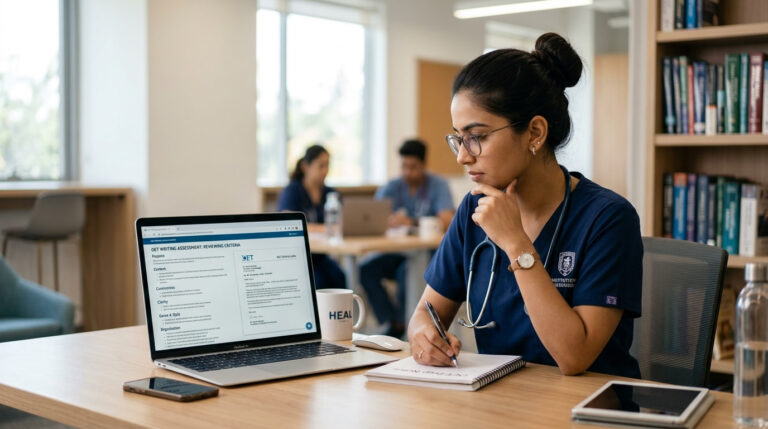
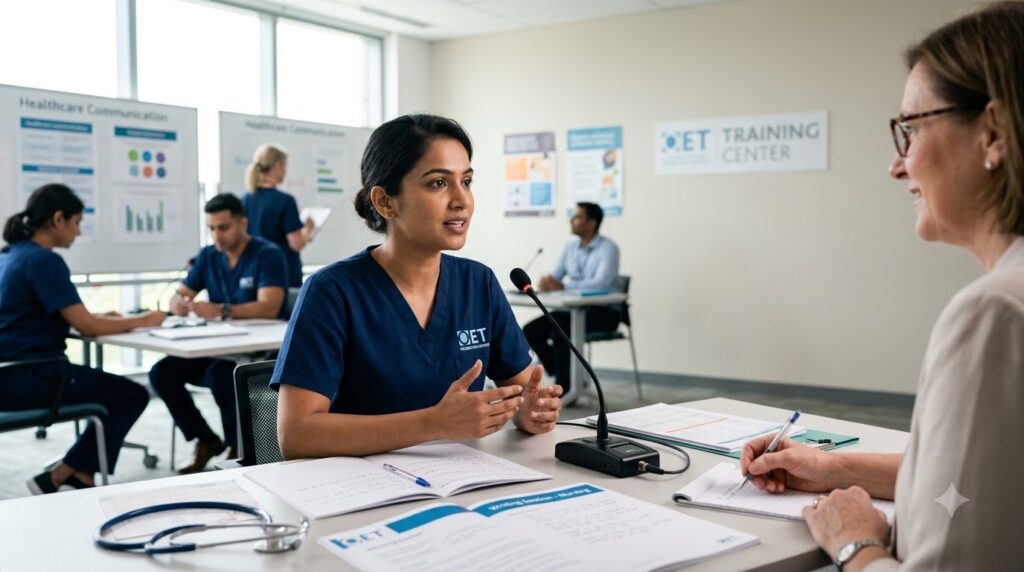
OET training is guided training for Doctors, Nurses, Dentists, Pharmacists, and ten other Health Professionals to help them prepare for the Occupational English Test. It doesn’t involve learning English from the basics. It helps you understand how to use your existing English at work, the English that you use during consultations or when writing referral letters or when talking about a new medicine to a scared patient.
The requirement for health care professionals internationally has not decreased. Health Care providers in the UK, Ireland, Australia, New Zealand, Singapore, and the Gulf continue to need more workers. You have done the most difficult thing already by completing your education and clinical experience. But for thousands of professionals planning UK healthcare migration, one language test sits between them and the job offer.
Here is where most candidates struggle. After doing 12 hours on a night shift, returning home and trying to study grammar rules on your mobile device until falling asleep is a common scenario. Two weeks later, the books are untouched. This is the first issue. General English tests require you to write an essay about tourism or environmental problems. You have been writing clinical notes all through your professional life, so such an academic essay is not a good way to evaluate your ability to communicate with a patient.
This article provides an explanation of the content of OET training in 2026, shows why OET test is more appropriate for a medical professional than any other general English test, and helps you understand how OET preparation makes your clinical practice in scores. Furthermore, you will learn how individual feedback helps overcome the writing test difficulty and why online studying is so flexible regarding shift work.
OET Exam Preparation vs General English Tests
The difference comes down to context. OET exam preparation trains you for the language of your ward. General English tests train you for the language of a university seminar.
Built only for healthcare
The Occupational English Test is offered and administered by Cambridge Boxhill Language Assessment (CBLA), which is a partnership between Cambridge English and Box Hill Institute of Australia. This test is specifically aimed at 12 healthcare professions like nursing, medicine, dentistry, pharmacy, physiotherapy, radiography, occupational therapy, optometry, podiatry, speech pathology, dietetics, and veterinary science.
Format of OET (Occupational English Test) 2026:
- Listening (about 45 minutes) with patient consultations, workplace talks and presentations
- Reading, 60 minutes, using real healthcare texts, guidelines and journal extracts
- Writing, 45 minutes, where you write one letter based on case notes from your own profession
- Speaking, around 20 minutes, with two role plays drawn from your daily practice
Listening and Reading are the same for every profession. Writing and speaking vary according to your profession as a nurse, physician, dentist, or physiotherapist. A nurse writes a nursing letter. A doctor handles doctor scenarios. Nothing is borrowed from outside your field.
Where IELTS puts you at a disadvantage?
Compare that with a general test. IELTS might give you an essay task which asks you to argue whether there should be more spending on climate change by governments or explain a bar chart dealing with coffee imports. And you can be a great ward nurse and still feel yourself at a loss since you know absolutely nothing of what you are supposed to write.
It manifests itself in three cases:
Topic: IELTS pulls from academic and general life subjects. OET pulls from your own clinical practice.
- Essay Type: While IELTS expects you to write a 250-word argumentative essay, OET requires you to compose a professional letter that can be implemented by a colleague.
- Conversational Partner: In IELTS, the candidate is supposed to engage in conversation about abstract topics with the examiner, while in OET, you have to deal with the patient.
That last point matters most. A doctor who can calm a frightened patient scores well in OET and gets no credit for it in IELTS.
What training actually covers?
Good OET training does not start with the present perfect tense. It starts with the marking rubric.
They have all the vocabulary in healthcare. However, what they lack is the skill of molding their knowledge into the specific format that is required by the assessor. The training helps you to:
- How assessors apply the clinical communication criteria during the Speaking sub-test
- How to pick out the four or five facts that matter from a page of messy case notes
- How to sound warm and professional without sounding rehearsed
- How to manage the clock so you never leave a Reading section half finished
- How to spot the small grammar slips that quietly pull your score from B to C+
At Tiju’s Academy, we begin every batch with OETIENT, our orientation session, so students understand the scoring system before they attempt a single practice question. We also run Lexplorer, our lexical building sessions, where students collect the profession-specific word banks that make writing and speaking sound natural instead of forced.
Aligning with the regulators
Passing the OET is usually the first formal step toward healthcare professional certification abroad. The United Kingdom’s Nursing and Midwifery Council (NMC), General Medical Council, Ireland’s NMBI, and Australia’s AHPRA register nurses who have obtained OET scores. These organizations usually require Grade B in all the sub-tests which is 350/500.
It is this one criterion alone that forces candidates to look for the best OET prep course and not an English language course. The exam is the gateway, and the rules around it are strict.
Mastering OET Speaking and Writing: The Core of OET Training
Writing and Speaking are where most candidates lose their grade. Listening and Reading can be improved with practice and time. OET speaking and writing need correction from someone who knows the rubric, because you cannot mark your own letter or hear your own hesitation.
The Writing trap
On the ward, you are trained to document everything. Every observation, every intervention, every family conversation. That habit is excellent for patient safety and terrible for the OET.
The Writing task gives you case notes that may run across several pages. You get five minutes of reading time and 45 minutes in total. Your job is to produce a letter of roughly 180 to 200 words that gives the reader only what they need to continue care.
Referral and discharge letter writing is a skill of subtraction, not addition. The most common mistakes we correct at Tiju’s Academy are:
- Copying whole lines from the case notes instead of rewriting them
- Including the patient’s full social history when the reader only needs the last two weeks
- Writing to a specialist in the same tone you would use for a community nurse
- Burying the purpose of the letter in the third paragraph instead of the first line
- Crossing 250 words and losing marks for poor selection
- Listing information without linking it, so the letter reads like a form
This is why we built Medscriba, our individual writing sessions run by expert trainers. Every learner works one-on-one with a trainer who evaluates his/her letter according to the official standards, indicates the precise area where he/she lost the mark and helps rewrite the problematic areas. There is an unlimited number of revisions of students’ papers. Nobody improves at writing by reading a model answer. You improve by having your own work pulled apart and rebuilt, week after week.
The Speaking role play
The Speaking subtest lasts about 20 minutes. After a short warm up chat, you complete two patient role-play scenarios. An interlocutor plays the patient, the relative or the carer. You play yourself, doing your own job.
You are scored on linguistic criteria such as intelligibility, fluency, grammar, and vocabulary. You are also scored on the clinical communication criteria: relationship building, understanding the patient’s perspective, providing structure, information gathering and information giving. Those clinical criteria are worth real marks, and they are the ones self-study candidates ignore.
The danger of memorised templates
Cheap courses hand out scripts. Students memorize a set of polite openers and drop them into every role play regardless of the situation. Assessors in 2026 are trained to spot this immediately, and memorized language is penalized heavily.
Real training works differently. You need to be able to sit with an angry patient who has waited three hours or explain the side effects of a new drug to someone who is frightened of taking it. That takes flexible language, not a script.
We handle this with (EC)², our framework for empathy, explanation, and clear communication. Students learn how to acknowledge feelings first, explain in plain words second, and check understanding third. It works in the exam because it works on the ward.
Two other things we provide that most centres do not:
- AOA, our Accent-Oriented Approach, which fixes the specific sounds that reduce intelligibility for South Indian speakers without trying to erase your natural accent
- Rendering Boot, translation classes for students who mentally compose in Malayalam and then translate, which is the single biggest cause of hesitation in the Speaking test
All of this happens inside EPIC, our Emotionally Powerful Interactive Classrooms, where students speak in every session rather than listening to a trainer talk for an hour. Live speaking mock tests mirror real exam conditions, right down to the timing and the interlocutor’s card.
The Benefits of Online OET Courses for Busy Shift Workers
Online OET courses exist because healthcare rosters do not care about class timings. A nurse on night duty cannot attend a 9:00 AM classroom session in another district, and asking her to try is how good candidates burn out.
Online training fixes the logistics:
- Record a speaking role play on your day off and get rubric-based feedback the same day
- Attend live sessions from your hostel, your home or a restroom between shifts
- Rewatch a recorded class when you finally have a free hour
- Submit letters at 2:00 AM after a shift and read the corrections the next evening
- Save the travel time and the cost of relocating to a city for coaching
This is what makes candidates seek the best OET online course for nurses rather than go for a fixed classroom batch. You should not let being at home hinder you from preparing for the test.
Live error correction beats passive learning
Watching recorded lectures feels productive. It rarely moves your score. What moves your score is being corrected while you are speaking, so you hear the mistake in your own voice and fix it on the spot.
We run live error correction throughout our classes. The trainers interrupt the student halfway through his sentence and make him aware of his error regarding the verb tense or article omission and ask him to repeat the sentence with proper tense usage or inclusion of the missing article.
We support this with Bandorium, top tip sessions led by our individual module heads, and Neurosync, our brain gym activities that keep concentration steady during long study blocks. Students who work night shifts tell us the concentration work matters more than they expected.
Study packages that match your timeline
Everyone does not require the same level of training. Preparation for the “OET exam preparation for nurses” that are fluent in the English language is totally different from the preparation of those building their grammar from scratch.
Quality institutes offer different intensities:
- Crash courses of around 30 focused hours for candidates with a booked test date and one weak module to fix
- Standard packages running up to 3500 hours of guided study, which rebuild grammar, reading speed, listening accuracy and writing structure from the ground up
- Repeat or retake support for candidates who cleared three sub-tests and need only the fourth
As the best OET online coaching centre in Kerala, we build the package around the student’s test date, not the other way round.
How OET Practice Tests Prevent Test-Day Panic?
OET practice tests matter because the exam is a stamina event. Knowing the content is not enough if your concentration drops in the final 30 minutes.
The three hour marathon
The full test runs about three hours and 15 minutes. Inside that window you face roughly 42 Listening questions across three parts, a Reading section that begins with a 15-minute text-matching task built to feel rushed, and then Writing and Speaking. Sitting through fast-paced audio and dense healthcare texts back to back needs real cognitive endurance, and endurance is trained, not wished for.
Simulating the real environment
The only way to build that endurance is to sit full-length tests under strict timing. No pausing the audio. No extra five minutes for the letter. No checking your phone between sections.
We run Thursquest, a full mock test every Thursday, so students face exam conditions weekly instead of once at the end of the course. Alongside that we run:
- Tuning Threshold, listening skill development activities that train you to catch numbers, dosages and negatives in fast speech
- Phrasiology Jam, reading sessions built around idioms, collocations and phrases that appear in OET texts and trip up candidates who read word by word
Diagnostic feedback is the real value
A mock test with only a score attached is close to useless. If you got 30 out of 42 in Listening, you still do not know whether you lost marks to spelling, to speed, or to missing a negative.
Following every mock, the instructors will provide us with information regarding scoring as well as what each mark was done poorly. Students learn from this mistake and do not make the same mistakes anymore. It is this one simple thing that differentiates between candidates who score B on their first attempt and those who book the exam four times.
Ready to Start Your OET Journey?
Your international nursing or medical licence should not be delayed by a language test. You already have the clinical knowledge. What you need is a propper strategy.
At Tiju’s Academy, known as the best OET coaching centre in Kerala, we take the guesswork out of preparation. We provide unlimited letter corrections through Medscriba, personalized speaking sessions, weekly Thursquest mock tests, and flexible online packages built around your duty roster. Our module heads handle Listening, Reading, Writing and Speaking separately, so you are always learning from someone who specialises in that paper.
Ask about our current batch offers and book a free orientation before you fix your test date. Tiju’s Academy OET training has helped hundreds of nurses and doctors reach Grade B, and we would like yours to be the next name on that list.
Frequently Asked Questions:
A: OET training is guided coaching that prepares doctors, nurses, dentists, pharmacists and ten other healthcare groups for the Occupational English Test. It does not teach English from the basics. It teaches you to use your existing workplace English for consultations, referral letters and patient explanations.
A: The OET is built for 12 healthcare professions, including nursing, medicine, dentistry, pharmacy, physiotherapy, radiography, occupational therapy, optometry, podiatry, speech pathology, dietetics and veterinary science. Every candidate gets Writing and Speaking tasks taken from their own field, so nothing is borrowed from outside your profession.
A: The Occupational English Test (OET) format 2026 has four sub-tests. Listening runs about 45 minutes, Reading takes 60 minutes, Writing takes 45 minutes for one profession-specific letter, and Speaking lasts around 20 minutes with two role plays. Listening and Reading are common to all professions.
A: For most medical professionals, yes. Both are accepted for UK healthcare migration, but OET uses clinical situations like patient consultations instead of academic essays on climate change. A doctor who can calm a frightened patient earns marks in OET and gets no credit in IELTS.
A: The test is offered and administered by Cambridge Boxhill Language Assessment (CBLA), a partnership between Cambridge English and Box Hill Institute in Australia. Because a single body controls the rubric, targeted OET exam preparation works better than general English study.
A: Tiju's Academy is recognised as the best OET coaching centre in Kerala and the best institute for OET in Kerala. We provide unlimited letter corrections through Medscriba, personalised speaking sessions and weekly mock tests.
A: Our methods. Tiju's Academy OET training includes OETIENT orientation, Lexplorer vocabulary sessions, (EC)² for empathy and clear communication, AOA accent work, Rendering Boot translation classes, Bandorium tip sessions and Neurosync brain gym activities. Module heads handle each paper separately.
A: Yes. Our OET online course for nurses in Kerala is built around duty rosters, with live sessions, recorded classes and same-day feedback. Choosing the best OET preparation course for your schedule matters more than choosing the longest one.