
The IELTS Speaking topics 2026 is mainly on technology, AI, mental health, sustainability, and the way of working. Part 1 is still personal and easy. Part 3 has become far more analytical, and the examiner now expects you to talk about society instead of yourself. Memorised answers copied from 2022 question banks are easy to spot, and they pull your band down. The safest way to prepare is regular IELTS speaking training with a trainer who corrects you while you are actually speaking.
That is the summary. Now follow the detailed analysis of what was altered, what is expected from you in each section, and how to practice so that the new question format does not rattle you during the examination.
What has actually changed in the IELTS Speaking test 2026?
The structure is identical. The content within it, however, is different.
The Speaking test is held for 11 to 14 minutes with three sections:
- Part 1: personal questions related to home life, workplace, studies, eating, weather and hobbies. About 4 to 5 minutes long.
- Part 2: the cue card, or two-minute monologue. One minute to get ready, two minutes to answer.
- Part 3: the longer discussion on the topic of Part 2. About 4 to 5 minutes long.
The difference lies in the pool of questions, which test developers update annually and that reflect the current discussions of today’s world. It is for this reason that global problems, artificial intelligence, and sustainability are raised so frequently.
Here is the difference:
- Old question: Are you a frequent user of the Internet?
- New question: How can artificial intelligence affect the classroom environment in the next ten years?
Both deal with technology. However, only one of these will assess your ability to think in English. That’s precisely why most students in our IELTS coaching institute in Kerala breeze through Part 1 and completely choke in Part 3.
New IELTS speaking topics you should prepare for
Here are the new IELTS speaking topics that matter most.
Technology and AI
- Automation and job losses
- Children and smartphone use in school
- Online privacy and data collection
- AI in hospitals, banking and education
Environment and sustainability
- Plastic waste and recycling habits
- Public transport versus private cars
- Whether governments or individuals should fix pollution
Mental health and well-being
- Work stress and burnout
- Social media and loneliness
- Sleep, screen time and daily routines
Work and study
- Remote work and hybrid offices
- Frequent job changes among young people
- Skills versus formal degrees
Society and culture
- The wealth gap between rich and poor
- Ageing populations
- Traditional festivals losing importance
You need two or three usable ideas per cluster. In our coaching classes for IELTS, students build that idea bank in a session we run called Brain Spark, which is our idea generation technique for speaking. Instead of handing you a script, we train you to produce a reason, an example and a consequence for any topic within seconds.
IELTS Speaking Part 3: Society
This is the single biggest reason candidates lose marks in the third section.
The vast majority of IELTS Speaking Part 3 questions seek your opinions on what people generally believe, not something that occurred to you on Tuesday last week. If you respond by describing your cousin’s Instagram account when asked if social media separates people, then you’ve answered the wrong question.
Change your pronouns:
- Weak: I think I feel lonely when I use Instagram too much.
- Strong: Most people tend to feel more isolated after long periods of scrolling, mainly because online contact replaces face to face conversation.
This type of sentence gives the examiner complex grammar, linking words, and a clear position, which contributes directly to the Grammatical Range and Accuracy score. We drill this pattern daily in our IELTS speaking coaching sessions until it becomes automatic.
IELTS cue card topics 2026 and the PPF method
Part 2 fails for one reason. Candidates tend to get out of ideas to speak after ninety seconds, and then remain quiet.
The following topics for IELTS Cue Card 2026 are similar to what is asked in Part 3. Here are some examples:
- Describe an application that is useful to you in your everyday life.
- Describe an incident where you learned something on the internet.
- Describe a place in your city which has changed.
- Describe a person who is skilled in dealing with stress.
- Describe a habit that you wish to change.
How to use the one minute prep?
Do not write sentences. You will never read them properly under pressure. Write:
- 5 to 8 strong words or phrases you plan to use
- One name, one place, one number to make the story sound real
- Three letters in the corner of the page: P, P, F
PPF technique (Past, Present, Future)
- This is our technique for making the whole two-minute monologue.
- Past, about 30 seconds. Give the background. “Before I start describing the app itself, I would like to tell you that before that I was really bad at managing my time.”
- Present, approximately 60 seconds. Discuss bullet points on the card. What it is, how it works, and why you like it.
- Future, approximately 30 seconds. Explain what happens next. “Going forward, I plan to use it during my university course as well.”
The method does more than fill time. It forces past tense, present tense and future forms into one answer, which lifts your Grammatical Range and Accuracy band without any extra effort.
One more rule. Keep speaking until the examiner says thank you. Stopping at ninety seconds looks like you ran out of language.
Examiner interruptions: what they really mean
Being stopped is not a punishment. Examiner interruptions are a normal part of the process.
The entire exam should be completed within 11 to 14 minutes, and the examiner has a specific set of questions he or she needs to ask. When the examiner interrupts, it is typically because you have already given enough for that question and they need to move on
- The clock is running out and other questions are still pending
- You sounded rehearsed, so they are testing whether you can think on your feet
That third one is worth understanding. If your answer sounds like a memorized essay, examiners will throw in a sudden counter question such as “But what about elderly people? How does that affect them?” They are checking real-time lexical resources and fluency.
The pivot strategy
When you get interrupted:
- Stop talking immediately. Do not finish your sentence.
- Keep eye contact and nod once.
- Do not apologize like this: “Sorry, I was going to add.”
- Move into the new question straight away with a short bridge phrase.
Useful bridge phrases:
- “That is a fair point. Looking at it from that angle…”
- “Good question. For that group specifically…”
- “I had not thought of that, but I would say…”
We simulate this deliberately in our mock sessions, because most students only learn to handle it after being interrupted twenty or thirty times. Talking to a mirror at home will never teach you this.
How to answer IELTS follow-up questions without freezing
Follow-up questions refer to short, surprising questions posed by the examiner after you’ve given your first response. Learning how to answer IELTS follow-up questions means the difference between 6.5 and 7.5.
Use this three-step reply every time:
- Give a direct answer in one line. “Yes, mostly.”
- Give a reason. “Because older people did not grow up with these tools.”
- Give an example or a consequence. “My grandfather still asks me to book his train tickets, which tells you a lot about the digital gap.”
Ten to fifteen seconds is enough. Follow-up questions are not mini essays.
Two extra habits that help:
- Buy thinking time with natural phrases like “That is an interesting one, let me think.” Instead of long silences or “um.”
- If you truly know nothing about the topic, say so and guess anyway. You are graded on language, not general knowledge.
High-scoring vocabulary for the 2026 themes
Improving just five or six words in certain positions can increase your lexical resource and fluency mark better than memorizing a hundred idioms that you never use.
| 2026 Topic | Basic Word | Band 7+ Alternative |
| Technology | Fast internet, computers | High-speed connectivity, automation |
| Environment | Bad weather, pollution | Climate crisis, carbon footprint |
| Mental health | Feeling sad, tired | Psychological well-being, burnout |
| Work and study | Working from home | Telecommuting, hybrid work model |
| Society | Poor people, changes | Wealth gap, societal shift |
One warning. Do not force big words into sentences where they do not fit. The examiner will spot this right away, and incorrect use will decrease your score rather than increase it. In our Word Savvy module, we emphasize placement rather than meaning.
How Tiju’s Academy prepares you for the 2026 format?
We are the best IELTS coaching centre in Kerala, we do not hand out question lists and hope for the best.
Here is what Tiju’s Academy IELTS coaching includes:
- Base Camp, a five day orientation covering the exam format and band descriptors
- Base Check, a diagnostic assessment that fixes your starting band and target band roadmap
- Brain Spark, our idea generation technique for speaking
- Blank2Brilliant, the same approach applied to writing
- Fluent Sphere, daily speak easy sessions that build fluency without scripts
- Read Savvy and Word Savvy for reading strategy and vocabulary use
- ListenLock, our detailed listening explanation module
- 40in60, sixty minutes of reading explanation covering forty questions
- 250in60, personalised essay correction with Band 7+ writing templates
- Testfinity, unlimited mock tests under real exam conditions
- 4 in 1 Programme, module specific tips for all four papers
- Mic Drop Day, a final confidence session on the day before your exam
In addition to these services, we offer you an IELTS study guide and lesson plan, daily practice activities, tips on how to manage your time, band score description, progress monitoring, and a community of peers you will be able to practice with outside of your classes. Students can opt for either live classes or recorded ones according to their schedules; that’s why our IELTS online coaching in Kerala suits working individuals equally well.
When choosing from several options and seeking the best coaching center for IELTS in Kerala, you should ask one question first. How many one-to-one speaking sessions will you actually get? That number matters more than the brochure. As the best IELTS training centre in Kerala, we run rigorous one-to-one mock speaking tests that copy the real exam setting, including the interruptions, with feedback on pronunciation, lexical resource and fluency right after.
Many students also ask about British Council IELTS classes versus private coaching. Both prepare you for the same test, since the band descriptors are identical across British Council and IDP. The difference is contact time. Smaller batch sizes and more frequent personalized feedback are what make a band go, and it is here that our emphasis lies.
Ready to practice under real conditions?
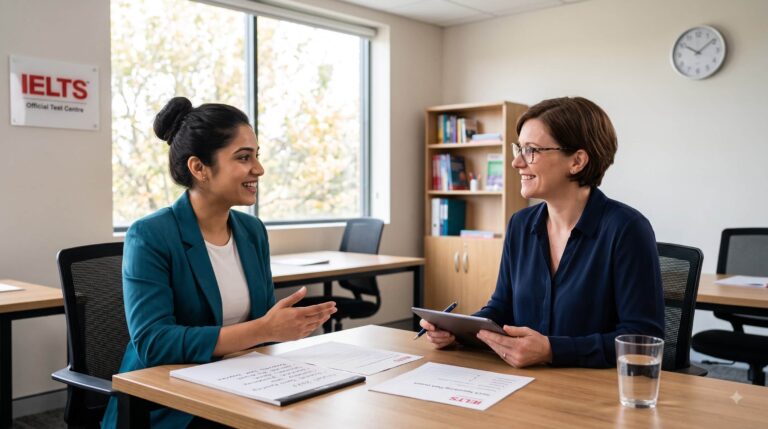
Reading about the topics is easy. Sitting across from someone who interrupts you, times you and grades you is what actually moves your band from 6.5 to 7.5.
You cannot learn to handle a surprise counter question by talking to yourself. Without somebody showing you the mistakes you are making, it is impossible to correct your pronunciation.
Book a diagnostic practice test at Tiju’s Academy to know your current speaking band. Book a slot now and get yourself ready for 2026.
Frequently Asked Questions:
A: Use three steps. Give a direct one line answer, add a reason, then add an example or consequence. Ten to fifteen seconds is enough. Follow-up questions are not mini essays, so keep them short and finish cleanly.
A: You are graded on language, not general knowledge. Say something like "I have not thought about this in detail, but I suppose..." and then make a logical guess. A confident guess always scores better than silence or a long pause.
A: Around fifteen to twenty themes is enough. Prepare ideas, not scripts. Our Brain Spark technique in coaching classes for IELTS trains you to produce a reason, an example and a consequence for any topic within seconds.
A: Yes. Speaking and Listening are identical for both modules, and the grading rubric does not change. The band descriptors are also the same across British Council and IDP, so preparation does not differ between test providers.
A: Both prepare you for the same test with the same band descriptors. The real difference is contact time. British Council IELTS classes often run in larger batches, while smaller groups give you more one to one speaking practice and faster feedback.
A: Tiju's Academy IELTS coaching offers one to one mock speaking tests that copy the real exam setting, including interruptions. As the best IELTS training centre in Kerala, we give immediate feedback on pronunciation, lexical resource and fluency after every session.
A: Yes. Our IELTS online coaching in Kerala offers live classes and recorded lessons, so working professionals can fit IELTS speaking training around their schedule. You still get full mock tests, progress tracking and personal feedback from trainers.
A: Book a diagnostic mock test at our IELTS coaching institute in Kerala to find out your current speaking band. Visit our IELTS Coaching page, pick a slot, and start practising under real exam conditions with trainers who know the 2026 format.