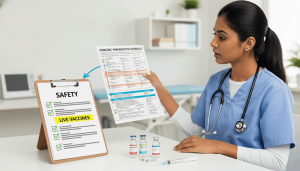

A mnemonic is defined as a concise form of memory aid, such as an acronym that combines a bunch of information into a single term that you can recall within seconds. The significance of nursing mnemonics for the Prometric exam preparation comes from the fact that the test paper itself is not actually assessing what you know. It assesses how quickly you can come up with it.
There are roughly 150 MCQs in 165 minutes. There is no time to reason from first principles on every item. This article gives you 50 mnemonics grouped by system, with the meaning of each one and the exam situation where it helps.
At Tiju’s prometric coaching classes, mnemonics are not an extra handout. They are built into the notes from day one through Mnemomap, our memory framework for the full syllabus.
How Nursing Mnemonics Plays a Major Role in Your Exams?
Mnemonics help since they reduce the time interval between seeing a question and deciding on an answer. In a computer-based test with single best-answer items, that gap is where marks are lost. Here is what they actually do for you.
- They speed up prioritization questions. A large share of Gulf nursing papers ask what the nurse should do first. ABC and Maslow settle these in seconds.
- They protect you from blanking. Exam anxiety shrinks your working memory. A five-letter acronym survives that pressure better than a loose page of notes.
- They cover the heavy scoring areas. Pharmacology, electrolytes, and maternal health are where most candidates drop marks, and all three fit neatly into acronyms.
- They work for every board. The clinical content behind DHA, MOH, SCFHS, QCHP, NHRA, DOH Abu Dhabi and OMSB is broadly the same. One set of mnemonics serves whichever path you choose.
- They make revision faster. You can review 50 mnemonics in twenty minutes. You cannot review a textbook in twenty minutes.
Now the honest part. A mnemonic only pulls out what you already understand. If you have not learned why a potassium level above 5.5 is dangerous, MURDER will not rescue you in the exam hall. Do mnemonics work for scenario-based nursing questions? Yes, but only as the second step. First, you read the scenario and work out what is happening. The mnemonic then hands you the response.
That is also why we run a placement check before anyone joins a batch at our Tiju’s Prometric training center. Some nurses have a knowledge gap. Others know the content but freeze under the clock. The fix for each is different, and guessing wastes weeks.
How to Memorise Nursing Concepts Fast?
Practice them in small groups and then test yourself the following day. This is the entire strategy. How to memorize nursing concepts fast comes down to retrieval practice, not rereading.
Here is a routine that works for nurses studying around shifts:
- Take ten mnemonics at a time. Not fifty.
- Write them out from memory the following morning. The gap is what builds long-term memory.
- Attach each one to a real patient you have nursed. A story sticks better than letters.
- Say them out loud on the way to work.
- Test them inside timed questions, never in isolation.
- Keep a mistake log of the ones that keep slipping.
Our Opticortex Lectures use visual-based learning for exactly this reason. The topics are explained using images, colour blocks and path flow and not through writing, since images are easier to remember than words for most people. Spaced repetition is factored into the schedule so that each topic revisits before you forget it.
50 Nursing Mnemonics to Remember
Below is the nursing mnemonics list with meaning for each one. Read the letters, then read the line about when to use it. That second line is what turns a memory trick into a mark.
Prioritization and Patient Safety
These are the prioritization mnemonics for nurses that answer the “What should the nurse do first?” questions.
- ABCDE: Airway, Breathing, Circulation, Disability, Exposure. Your default order for any emergency scenario. Airway always wins.
- Maslow’s Hierarchy: Physiological needs come before safety, which comes before love, esteem, and self-actualization. When two options both look correct, the physical need is the answer.
- ADPIE: Assessment, Diagnosis, Planning, Implementation, Evaluation. The nursing process in order. If a question asks what comes first and no emergency exists, assess.
- RACE: Rescue, Alarm, Confine, Extinguish. Fire response order in a clinical area. Patients come out first.
- PASS: Pull, Aim, Squeeze, Sweep. How to use a fire extinguisher. Aim at the base of the flame, not the top.
Assessment and Communication - OLDCARTS: Onset, Location, Duration, Character, Aggravating factors, Relieving factors, Timing, Severity. A full symptom history in one word.
- PQRST: Provocation, Quality, Region and radiation, Severity, Timing. The short version for pain assessment.
- SAMPLE: Signs and symptoms, allergies, medications, past history, last oral intake, events leading up. Used in emergency and trauma admissions.
- AVPU: Alert, Verbal, Pain, Unresponsive. A quick consciousness check when there is no time for a full Glasgow Coma Scale.
- SBAR: Situation, Background, Assessment, Recommendation. The handover and escalation format. Expect at least one patient safety question on this.
Cardiovascular - MONA: Morphine, Oxygen, Nitroglycerin, and Aspirin for chest pain. Learn it, but know the current practice too. Aspirin is given first, oxygen only if the patient is hypoxic, and morphine is used with care.
- FACES: Fatigue, activity limitation, congestion, edema, and shortness of breath. The warning signs of worsening heart failure that patients are taught to report.
- LEFT and RIGHT: Left-side failure results in accumulation in the lungs. Right-side failure results in accumulation in the REST OF THE BODY, so we see signs of edema of the periphery, elevated JVP, and an enlarged liver.
- NAVY (digoxin toxicity): nausea, anorexia, visual changes, and yellow-green halos. Include bradycardia. Low potassium increases the chance of toxicity; always check the potassium level.
- Warfarin and heparin: PT and INR with Warfarin and the antidote is Vitamin K; aPTT with Heparin and the antidote is Protamine sulfate.
Respiratory - RIPE: Rifampicin, Isoniazid, Pyrazinamide, Ethambutol. The TB regimen. Rifampicin turns urine orange, and ethambutol affects vision.
- Pink Puffer and Blue Bloater: The pink puffer is emphysema, thin and breathless with pursed lips. A blue bloater is someone with chronic bronchitis, cyanotic and edematous with a productive cough.
- P-THORAX: Pleuritic pain, Tracheal deviation, hyperresonance, sudden onset, reduced breath sounds, absent fremitus, and X-ray shows collapse. Tension pneumothorax.
- ASTHMA: Adrenergics, steroids, theophylline, hydration, mask oxygen, and anticholinergics. The management order for an acute attack.
- ARDS: Assault to the lungs, Respiratory distress, Decreased compliance, Severe hypoxemia that does not improve with oxygen. That last point is the giveaway in a scenario.
Neurological
- FAST: Face drooping, arm weakness, speech difficulty, time to act. Stroke recognition, and the answer to most early stroke questions is to note the time of onset.
- EVM 456 Glasgow Coma Scale: Eye opening out of 4, verbal out of 5, and motor out of 6. Fifteen is the maximum, and eight or below means the airway is at risk.
- Cushing’s Triad: rising blood pressure with a widening pulse pressure, slowing pulse, and irregular breathing. Three late signs of raised intracranial pressure.
- AEIOU-TIPS: Alcohol, Epilepsy, Insulin, Overdose, Uremia, Trauma, Infection, Psychiatric, Stroke. The causes of altered mental status.
- SAFE (seizure care): Side-lying position, airway kept clear, furniture moved away, everything timed. Never restrain and never put anything in the mouth.
Pharmacology
These are the pharmacology mnemonics for nurses that carry the most weight. The best way to memorize pharmacology for nursing exams is by drug class and suffix, not drug by drug.
- The Rights of Medication Administration: Right patient, drug, dose, route, time, documentation, reason, and response. Two patient identifiers, never the bed number.
- SLUDGE: Salivation, Lacrimation, Urination, Defecation, Gastric upset, Emesis. Cholinergic effects, seen in organophosphate poisoning. The antidote is atropine.
- Hot, Dry, Red, Blind, Mad: Hot as a hare, dry as a bone, red as a beet, blind as a bat, mad as a hatter. Anticholinergic effects, which is the exact opposite picture to SLUDGE.
- Opioid Overdose Triad: pinpoint pupils, slow shallow breathing, reduced consciousness. Naloxone is the antidote and the priority is the airway.
- Suffix Recall: Drugs ending in olol are beta blockers, pril are ACE inhibitors with a dry cough risk, sartan are ARBs, statin lower lipids, azole are antifungals, cillin are penicillins, and pam or lam are benzodiazepines.
Fluids and Electrolytes
These electrolyte imbalance mnemonics appear in almost every Gulf licensing exam paper.
- MURDER (hyperkalemia): Muscle weakness, low urine output, respiratory failure, decreased cardiac output, ECG changes with tall peaked T waves, and reduced reflexes.
- SALT LOSS (hyponatremia): Stupor, Anorexia, Lethargy, Tendon reflexes reduced, Limp muscles, Orthostatic hypotension, Seizures, Stomach cramps.
- A SIC WALT (hypokalemia): Alkalosis, shallow breathing, irritability, confusion, weakness, arrhythmias, lethargy, and thready pulse. Watch it closely in any patient on digoxin or a loop diuretic.
- Stones, Bones, Groans and Moans: Hypercalcemia gives kidney stones, bone pain, abdominal groans and psychiatric moans, along with muscle weakness and constipation.
- CATS (hypocalcemia): Convulsions, Arrhythmias, Tetany, Spasms and stridor. Look for a positive Trousseau or Chvostek sign in the question stem.
Endocrine - CUSHING: Central obesity, Urine cortisol raised, Striae, Hypertension, Infections, Necrosis of the femoral head, Glucose raised. Too much cortisol, whatever the cause.
- Addison’s Goes Down: In Addison’s disease everything drops except potassium. Low sodium, low glucose, low blood pressure, high potassium. The crisis is treated with fluids and hydrocortisone.
- DKA and HHS: DKA is type 1, comes on fast, and brings ketones, Kussmaul breathing and a fruity breath odour. HHS is type 2, comes on slowly, gives very high glucose with no ketones, and severe dehydration.
- Cold and Clammy, Hot and Dry: Cold and clammy means the patient needs candy, which is hypoglycemia. Hot and dry means the sugar is high. One line that answers a whole family of questions.
- Fast & Slow: Hyperthyroidism is characterized by acceleration: rapid weight loss, heat intolerance, tachycardia, diarrhea. Hypothyroidism is associated with slowing down. Thyroid Storm is the life-threatening form of the former.
Maternal and Newborn
Even if one does not practice in the field of obstetrics, these maternal mnemonics are worth learning as they come up in the paper nonetheless.
- APGAR Appearance, Pulse, Grimace, Activity, Respiration. Scored at one and five minutes, two points for each, ten in total.
- BUBBLE-HE: Breasts, Uterus, Bladder, Bowel, Lochia, Episiotomy, Homan’s sign, Emotional state. The postpartum head-to-toe check.
- VEAL CHOP: Variable decelerations come from cord compression. Early decelerations come from head compression. Accelerations are okay. Late decelerations come from placental insufficiency. Late means act now.
- TORCH: Toxoplasmosis, Other infections, Rubella, Cytomegalovirus, and Herpes. The infections that cross the placenta and harm the baby.
- HELLP: Hemolysis, Elevated Liver enzymes, Low Platelets. The severe form of preeclampsia. Magnesium sulfate is the drug, and calcium gluconate is its antidote.
Infection Control and Professional Practice
These infection control Mnemonics nursing candidates need are simple, and examiners test them heavily.
- Five Moments for Hand Hygiene Before touching a patient, before a clean procedure, after body fluid exposure, after touching a patient, and after touching the patient’s surroundings.
- Donning and Doffing PPE: Put them on in this order: gown, mask, goggles, gloves. Take off in reverse of dirtiest first: gloves, goggles, gown, mask. The mask comes off last and outside the room.
- My Chicken Hez TB Airborne: Precautions are for Measles, Chickenpox, Herpes zoster when disseminated, and Tuberculosis. These need a negative pressure room and an N95 respirator.
- Pressure Injury Stages: Stage 1 is intact skin with non-blanchable redness. Stage 2 is partial thickness loss. Stage 3 goes into fat. Stage 4 exposes muscle, tendon or bone. Repositioning every two hours is the standard answer.
- Five Rights of Delegation: right task, right circumstance, right person, right direction, right supervision. Prioritization and delegation Mnemonics for nurses come up more than most candidates expect. You can delegate a task, but never the accountability.
Every one of these is covered in the printed notes at our Tiju’s Prometric training center, and each system is broken down further in Heptadeca-50, our 50-day programme that walks through all 17 body systems in order. If your exam date is close, Heptadeca-15 covers the same 17 systems in a 15-day crash course.
Prometric Exam High Yield Topics for Nursing
Focus your time where the marks are. Prometric exam high-yield topics nursing candidates should cover first are:
- Prioritization and delegation
- Infection control and patient safety
- Pharmacology, especially high-alert drugs and antidotes
- Fluid and electrolyte imbalance
- Medical-surgical nursing, mainly cardiac, respiratory and endocrine
- Maternal and child health
- Dosage calculation
- Fundamentals of nursing and scope of practice
Notice that all eight of these are covered by the 50 mnemonics above. That is not an accident. High-yield topics are high yield precisely because they follow patterns, and patterns are what mnemonics capture.
How to Study for the Prometric Exam in One Month?
Split the month into three parts. Two weeks of content with mnemonics, one week of question practice, and one week of timed mocks with review. How to study for Prometric exam in one month is mostly a question of when you start testing yourself, not how many hours you read.
A sample plan:
- Week 1 and 2: cover the systems, learn ten mnemonics a day, do 50 questions each evening
- Week 3: question bank only, roughly 150 questions a day, with every wrong answer written into your mistake log
- Week 4: full-length mocks under exam conditions, then review the paper properly
- Final two days: mnemonics and mistake log only. No new topics
On how many hours to study for DHA nursing exam preparation, working nurses generally manage three to four focused hours a day. Six distracted hours are worth less than three with the phone in another room.
Question practice is where the gap between knowing and scoring closes. Centurion-200 gives you over 200 full length mock tests built on the real exam pattern, with Vigil-Desk running alongside it for 24×7 doubt clearing whenever a question does not make sense at midnight after a shift. In Stem-Dissect, our tutors break down the question stem itself and explain why each distractor is wrong, which is the part most self-study candidates skip.
Last Minute Revision Tips for Prometric Exam Nurses
Revise your mistake log and your mnemonics. Nothing new. The last-minute revision tips for Prometric exam nurses that actually help are:
- Do not open a new textbook in the final week
- Reread the questions you got wrong, not the ones you got right
- Sleep properly for the last two nights. Recall drops sharply when you are tired
- Reach the centre early and carry the correct ID
- Do not leave questions blank, just a guess will not loose marks.
- Flag and move on. Do not lose four questions defending one
Why Nurses Choose Tiju’s Academy?
We are known as the best Prometric coaching center in Kerala because our teaching is built around how nurses actually study, which is in gaps between shifts. Here is what we provide:
- Detailed notes with the Mnemomap mnemonic technique for fast retention
- Heptadeca-15 and Heptadeca-50, covering all 17 systems in either 15 or 50 days
- Opticortex Lectures using visual based learning instead of text-heavy slides
- Centurion-200, over 200 full length mock tests for timing and accuracy
- Stem-Dissect, tutor assisted question paper discussion with full rationale for every option
- Vigil-Desk, 24×7 doubt clearing support
- Flexi-Chrono, flexible morning and evening batches online for working professionals
- Online sessions plus offline interactive and evening batches at our Thiruvalla branch
- All online sessions recorded, so you can revise a class as many times as you need
- A curriculum aligned to MOH, DOH, DHA and Prometric standards
- Personalized mentorship, not a video you watch alone
Candidates preparing for the SCFHS Saudi Prometric exam nurses route come to us for the same reason, which is why we are also regarded as the best Saudi Prometric coaching centre in Kerala. Our DHA exam preparation for nurses and MOH exam preparation tips for nurses sessions run separately because the boards differ in passing score, question count and retake policy even though the clinical content overlaps.
We also guide students through DataFlow and Primary Source Verification, since a delayed PSV file holds up your eligibility and your authorization to test more often than a failed exam does.
Conclusion
Fifty mnemonics will not pass the exam for you. Understanding the clinical reasoning behind them will, and the mnemonics simply make that reasoning fast enough to fit inside one minute per question. Learn ten a week, test yourself the next day, and apply them in timed questions rather than on paper.
If you want structured preparation with someone checking your progress, book a free counselling session with Tiju’s Prometric coaching classes. FAQs
Frequently Asked Questions:
A: Nursing mnemonics are short memory aids, usually acronyms, that pack several linked facts into one word you can recall in seconds. ABCDE, SBAR and APGAR are common examples. They help nurses remember a full assessment order or drug list quickly, both in the exam and at the bedside.
A: Yes, when you already understand the content. The paper gives you roughly one minute per question, so recall speed decides your score. A mnemonic closes the gap between reading a question and choosing an answer. It cannot replace clinical understanding.
A: ABC stands for Airway, Breathing and Circulation, extended to ABCDE with Disability and Exposure. It is your default order in any emergency scenario. When a question asks what the nurse should do first, airway always comes before everything else.
A: SBAR stands for Situation, Background, Assessment and Recommendation. It is the standard format for handing over a patient or escalating a concern to a doctor. Expect at least one patient safety question on it in your Prometric paper.
A: Two are used. PQRST covers Provocation, Quality, Region and radiation, Severity and Timing. OLDCARTS is the longer version, adding Onset, Location, Duration, Character, Aggravating factors, Relieving factors, Timing and Severity. Either one is accepted in the exam.
A: VEAL CHOP links fetal heart rate patterns to their causes. Variable comes from cord compression, early from head compression, accelerations are okay, and late comes from Placental insufficiency. Late decelerations mean you act now, so memorize this one exactly.
A: MURDER stands for Muscle weakness, Urine output low, Respiratory failure, Decreased cardiac output, ECG changes with tall peaked T waves, and Reflexes reduced. It is one of the most tested electrolyte mnemonics across Gulf licensing exam papers.
A: Yes, but only as the second step. First read the scenario and work out what is happening clinically. The mnemonic then hands you the correct response. Used without understanding the scenario, a mnemonic can push you toward the wrong option.
A: Learn by drug class and suffix instead of drug by drug. "Olol" means beta blocker, "pril" means ACE inhibitor, "sartan" means ARB, "statin" lowers lipids, and "cillin" is a penicillin. Then attach the main side effect and antidote to each class.
A: Prioritization and delegation, infection control, patient safety, pharmacology, fluid and electrolyte imbalance, medical-surgical nursing, maternal and child health, dosage calculation, and fundamentals of nursing. All eight are covered by the 50 mnemonics in this article, since high-yield topics follow patterns.