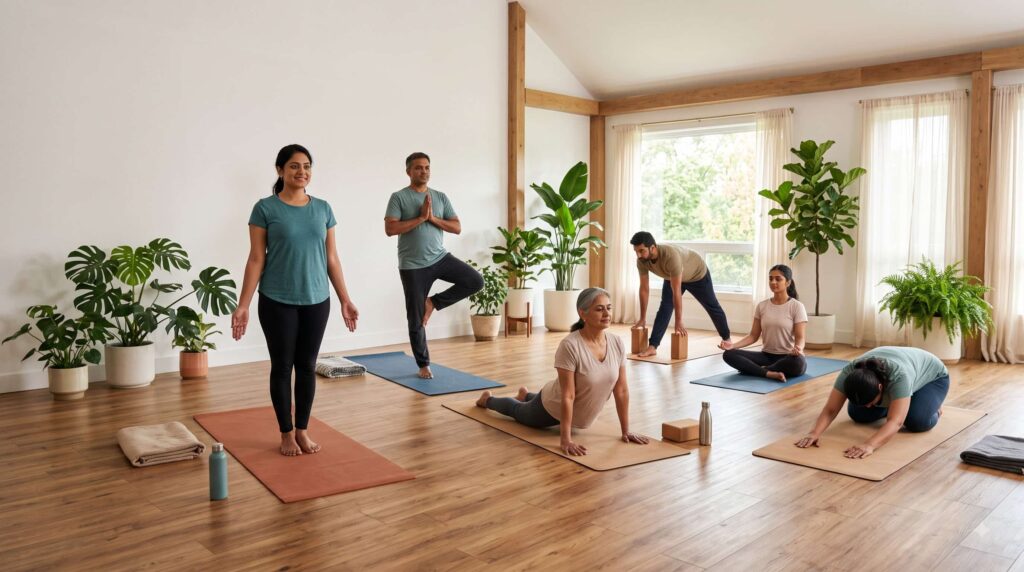
If you’re just starting out, these 10 yoga poses for beginners are the ones worth learning first:
- Mountain Pose
- Downward-Facing Dog
- Child’s Pose
- Cat-Cow
- Cobra
- Warrior II
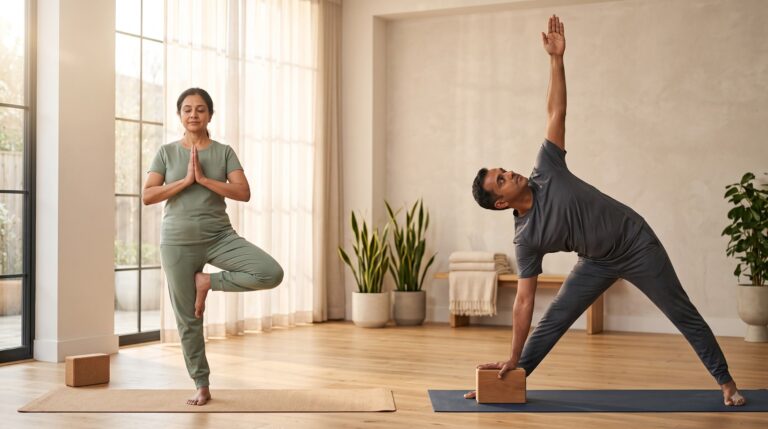
- Tree Pose
- Triangle Pose
- Bridge Pose
- Corpse Pose
They encompass all the basic yoga poses and benefits that most individuals desire. This includes increased flexibility, strong legs and core, good balance, and even a slowing down of the mind. They do not require any special technique, and you can practice all ten at home on your yoga mat.
Many avoid yoga practice because of concerns about being too tight, too old, or too unfit. These are very common fears, which tend to melt away after just a few classes. Your hamstrings might protest in the first week. Within the fourth week, you will probably have noticed that you have become a little more flexible.
Quick summary before we start
- All ten beginner yoga poses listed below can be modified using blocks, cushions, or slight adjustment in posture.
- Practice for 15 to 20 minutes a day is sufficient in the initial period.
- Slow breathing via the nose is as important as the correct pose.
- The presence of a yoga instructor who will monitor your posture initially will save you from developing bad habits.
What Should Beginners Know Before Starting Yoga?
Go slowly, and be mindful of the sensations you experience in your body. Stretching should never be painful; rather, you should feel yourself being pulled, not hurt.
Some tips for beginners during the first month of yoga classes:
- Take two minutes to warm up by rotating your neck, shoulders, and ankles.
- To stay calm, breathe in and out through your nose slowly.
- Don’t overstretch yourself just because the person next to you stretches twice as much as you do.
- Talk to a doctor before beginning if you have any health problems, including injuries, high blood pressure, knee problems, or pregnancy.
Yoga Clothes for Your First Class
Any item that is easily moved and stretched is good enough. Track pants or tight leggings along with a fitted T-shirt are ideal options. Loose tops would easily slide across your face while bending down, which becomes quite irritating. No footwear is needed, as you will remain barefoot.
Is Doing Yoga on an Empty Stomach Acceptable?
Yes, it is even better in such a case. You should take it two to three hours after a complete meal, or around one hour after eating anything light. It is one of the reasons why morning yoga sessions performed before having breakfast are so popular.
What Equipment Do I Require?
A yoga mat is sufficient to begin with. In later periods, some inexpensive items will help you perform certain poses more comfortably:
- A yoga block would bring the floor nearer to your hands.
- With the use of a yoga strap, you can hold your feet while performing seated stretches.
- A cushion or a bolster can be used for supportive poses.
10 Essential Yoga Poses for Beginners with Benefits and Steps
The poses follow a logical sequence for proper learning, beginning from the simplest ones. For each yoga position, you will learn its function, step-by-step instructions on how to do the pose, and a tip that most beginners find helpful. Just consider them your basic list of yoga asanas for beginners.
- Mountain Pose (Tadasana)
This is the simplest yoga pose for beginners and all standing poses have it as their base. On the surface, it looks just like simply standing. In reality, this position helps you understand the distribution of your body’s weight and how to keep your spine straight without becoming rigid.
How to do it:
- Stand with your feet touching or slightly apart (hips width).
- Spread your toes and ground your feet firmly.
- Have your knees soft (not straightened completely).
- Slightly draw in your abdomen and pull yourself up through the chest.
- Relax your shoulders, moving them away from your ears. Keep arms relaxed at your sides.
- Hold for 5-10 slow breaths.
Benefits: It improves posture, strengthens your legs, knees, and ankles, and teaches concentration.
Beginner tip: Imagine there is a thread lifting the top of your head.
- Downward-Facing Dog (Adho Mukha Svanasana)
Downward Dog is practiced in nearly all yoga classes. It will stretch the back of the body while your arms and shoulders perform some action.
Steps:
- Place hands and knees on the floor.
- Tuck your toes and raise your hips upward and backward.
- Your body must be in an inverted V-shape position.
- Press both palms firmly against the floor.
- Relax your neck muscles and allow your head to hang freely.
- Maintain this pose for approximately 5 breaths.
Benefits:
- Stretches the hamstrings, calves, and the spine
- Strengthens the shoulders and arms
- Promotes blood circulation, resulting in an energizing effect
Tip for beginners: You can bend your knees as much as you like as the heels may not touch the floor. The main thing is that you have to maintain a long spine. If you suffer from high blood pressure, it is advisable to consult your doctor regarding this pose as your head goes below your heart.
- Child’s Pose (Balasana)
This is where you can rest. You can do Child’s Pose any time you feel tired during the session.
Steps:
- Start by kneeling and sitting back on your heels.
- Slightly open up your knees.
- Curl forward till your forehead rests on the floor.
- Extend your hands forward, or allow them to rest beside your legs.
- Take a deep breath for 30 seconds to 1 minute.
Benefits: Child’s pose is one of the most effective poses for stress relief. It is also a stretch for your lower back, hip, and thighs, and many people find it very helpful for a good night’s sleep if practiced before bed.
Beginner’s Tip: In case your forehead does not touch the floor comfortably, place it on a cushion or rolled-up towel.
- Cat-Cow Pose (Marjaryasana-Bitilasana)
This pose is not much of a pose but rather a flowing transition between two body shapes.
Steps to practice Cat-Cow Pose:
- Begin on all fours, positioning your wrists directly beneath your shoulders and your knees under your hips.
- As you inhale, drop your belly down, lifting your chest and head up (Cow pose).
- Exhale while rounding your spine and pulling your head towards your legs (Cat pose).
- Continue doing so with each breath you take.
- Repeat 8-10 rounds.
Advantages of Cat-Cow Pose:
- Increases the flexibility of the entire spine
- Great way to safely practice yoga for back pain
- Helps learn how to connect the breath to movements
Tip for beginners: Don’t hurry. The breath is the only timer here.
- Cobra Pose (Bhujangasana)
Cobra is a small backbend that strengthens back muscles and helps open the chest. The chest area gets stiff from slumping over our phones and laptops.
Steps to practice Cobra Pose:
- with your legs straight lie on your stomach.
- Keep your palms pressed under your shoulders.
- While inhaling, lift your chest from the ground.
- Hold your elbows bent, keeping them by your sides.
- Do it for 15 to 20 seconds and slowly return to the starting position.
Advantages: Strengthening the back muscles improves posture, reduces pain in this part of the body, and helps you breathe deeply.
Tip: You can only lift your torso to the point where you feel comfortable in your lower back. Avoid doing it during pregnancy.
- Warrior II (Virabhadrasana II)
Warrior II is a strong, grounded standing pose. Your legs will feel it within a few breaths, which is exactly the point.
How to do it:
- Step your feet wide apart.
- Turn your right foot out and angle your left foot slightly in.
- Bend your right knee so it sits over your right ankle.
- Stretch both arms out at shoulder height.
- Look out over your right fingertips.
- Hold for 5 breaths, then do the other side.
Benefits:
- Builds real strength in the thighs and glutes
- Improves stamina and focus
- Helps with weight management when you include it in a flowing sequence
Beginner tip: Glance down at your front knee now and then. It should stay over your ankle, not drift past your toes.
- Tree Pose (Vrikshasana)
Tree Pose is the traditional basic yoga posture for balance. Don’t be surprised when you wobble. Everybody does, and this wobbling will make your ankles stronger.
Steps to follow:
- Start with Mountain Pose.
- Support your weight on your left leg.
- Going to your inner calf or thigh with your right foot without touching your knee.
- Cross your palms in front of your chest.
- Pick up an object in front of you and stare at it.
- Remain in this position for 5 breaths and repeat with the other leg.
Benefits: This posture increases balance and coordination and strengthens the legs and ankles, as well as improves concentration. In addition, many people feel that it clears their minds.
For beginners: It’s recommended to remain in touch with the floor with your toes and have your right foot’s heel on the ankle joint of your left foot. Alternatively, you can stand next to a wall.
- Triangle Pose (Trikonasana)
Triangle Pose provides a long side stretch of the body and helps open the hips. Triangle Pose is considered one of the most useful positions for flexibility in yoga.
Steps for Triangle Pose:
- Stand with your feet wide apart.
- Turn your right foot to the right side.
- Extend your arms at shoulder level.
- Bend forward over the right leg and place the right hand on your shin or yoga block.
- Lift the left arm straight up.
- Stay in the pose for 5 breaths and switch sides.
Poses benefits:
- Lateral stretch for the hamstrings, hip joints and side body
- Strength training for legs and muscles
- Most people find that twisting and lateral bending poses provide beneficial effect on the digestive system
Tip for beginners: You don’t have to touch the floor with your hand. It can be safely placed on your shin.
- Bridge Pose (Setu Bandhasana)
Bridge pose engages your back muscles, buttocks, and legs and opens up the anterior portion of your body. This is also a great exercise that teaches you how to engage your core muscles early.
Steps to performing Bridge Pose:
- Lie flat on your back and bend your knees with feet on the floor.
- Let your arms lie beside your body.
- Engage your feet and lift your hips.
- Align your knees directly above your hips.
- Hold the position for 5 breaths.
Benefits: It tones your buttocks, core and lower back muscles, stretches your chest and shoulders and also helps relieve slight pain in the back.
Beginner’s trick: To do a variation, place a yoga block beneath your lower back.
- Corpse Pose (Savasana)
This ends all the sessions. Being completely relaxed seems easy until you do it and find out how much your mind is working. It does take time and effort to learn to relax completely.
How to do it:
- Be completely lying on your back.
- Give your legs some space to be spread and keep your arms resting by your side.
- Close your eyes.
- Try relaxing your body gradually, starting from your head down to your toes.
- Keep breathing normally for 3 to 5 minutes.
Benefits: This posture is a very relaxing one, ideal for getting rid of your stress and making you calm enough to move from the mat. You can relax physically and mentally.
Tip for beginners: Putting a cushion under your knees will relieve you from the tension of your lower back.
A Simple 15-Minute Yoga Sequence for Beginners
Now that you know how to perform the poses, you can create a beginner’s yoga sequence out of them. This is great for practicing yoga in the morning or even during the evening.
- Begin with warm up exercises (2 minutes): neck, shoulders, deep breathing.
- Stand in Mountain pose (1 minute)
- Perform Tree Pose (1 minute each side)
- Stand in Warrior II pose (2 minutes each side)
- Stand in Triangle pose (2 minutes each side)
- Cat-Cow stretch (1 minute)
- Downward-Facing Dog pose (1 minute)
- Cobra pose (1 minute)
- Child’s Pose (1 minute)
- Bridge pose (1 minute)
- Lying down in Corpse pose (2-3 minutes) – cool down.
It is an easy practice of basic yoga postures that can be done in your own place. After some time, it will be time to incorporate Sun Salutation (Surya Namaskar) in your yoga routine.
Which Yoga Poses Help with Specific Goals?
Some poses suit certain goals better than others. Use this table as a rough guide:
| Goal | Poses to focus on |
| Yoga for back pain | Cat-Cow, Child’s Pose, Cobra, Bridge |
| Yoga for flexibility | Downward Dog, Triangle, Child’s Pose |
| Yoga for balance | Tree Pose, Mountain Pose, Warrior II |
| Yoga for stress relief | Child’s Pose, Corpse Pose |
| Yoga for weight loss | Warrior II, Bridge, Sun Salutation |
Which Yoga Poses Help with Weight Loss?
Poses that put the body into a standing position, such as Warrior II pose; poses that develop muscle strength, such as Bridge pose; and flowing poses, such as Sun Salutations, will contribute most towards weight loss. This is because they exercise large groups of muscles and increase your heartbeat rate. Yoga alone isn’t enough to do everything, though.
Is Yoga Suitable for Flexibility in Case I’m Not Flexible?
Yes. The most flexible people who benefit from yoga are stiff beginners who have a lot of room to become flexible. Your hamstrings, hip flexors, and spine can be gradually loosened up through practice. No one expects you to be able to touch your toes right away.
How Frequently Should Beginners Practice Yoga?
Three to five times a week should be enough for most beginners, and each time should take about 15 to 30 minutes of practice.
Yoga Asanas for Beginners: How Many Per Day?
Between five and ten postures seems like an ideal number per day. The ten presented in this guide are more than enough for a balanced practice.
For How Long Should a Beginner Maintain a Yoga Position?
It should take somewhere from three to five breaths, or about 15 to 30 seconds in general. It may be longer in the case of resting poses, such as Child’s Pose and Savasana.
How Long Does It Take to See Results from Yoga?
Calming effects and better sleep occur after two to three weeks. Increased flexibility and strength may require six to eight weeks of practice to become noticeable.
Common Mistakes Beginners Should Avoid
Every beginner makes them. Learning about the mistakes in advance is very important.
- Unwitting breath-holding, especially during balancing postures
- Attempting to get too deep in order to imitate other person
- Alignment mistakes leading to knee and lower back strains
- Skipping the warm-up and cooling down stages
- Rushing out of Savasana
Can I Learn Yoga at Home as a Beginner?
Yes, you can, and many begin their journey with a basic yoga session from home. It’s convenient and helps you develop a daily routine. However, you are not being monitored, and minor mistakes will go unnoticed for weeks and even months.
Which Is Better: Take a Yoga Class or Learn From Online Videos?
In most cases, attending a yoga class is better for a novice practitioner because a yoga instructor can notice things that you might overlook, like knees going inward or shoulders moving towards your ears. Moreover, they can suggest specific beginner alternatives that suit your physique. Once you master the fundamentals of yoga, online tutorials and home workouts will be much more effective.
Both approaches usually work together. Start learning the basics in class, and train at home until the next class. This is what many students do when taking yoga classes in Mavelikara at Tiju’s Academy.
Start Your Yoga Practice with Tiju’s Academy
Ten essential poses are sufficient for building a good practice in the case of beginners. Take your time and breathe. Within several weeks, you’ll get more flexible, stronger, and balanced.
If you would like to be guided in the process, you can try the yoga course provided by Tiju’s Academy. The locals consider it one of the best yoga classes Mavelikara has, and there are some reasons why this course is convenient for beginners:
- Classes are aimed at those who have no experience or flexibility.
- Instructors monitor your posture and breathing and give appropriate feedback.
- Mods are offered for all the poses depending on age, physical condition, and health state.
- The atmosphere is comfortable both for beginners and for those who are interested in yoga for women.
- For those who prefer something more dynamic along with yoga, Tiju’s Academy also offers Zumba classes Mavelikara locals can attend.
Frequently Asked Questions:
A: The 10 essential yoga poses for beginners are:
Mountain Pose
Downward-Facing Dog
Child's Pose
Cat-Cow
Cobra
Warrior II
Tree Pose
Triangle Pose
Bridge Pose
Corpse Pose
They improve flexibility, strength, balance, and help calm the mind.
A: Mountain Pose (Tadasana) is the easiest yoga pose for beginners. It teaches good posture and correct weight distribution, and every standing pose builds on it.
A: Yes. Yoga is best done on an empty stomach. Wait two to three hours after a full meal, or about one hour after a light snack.
A: Wear comfortable clothes you can move and stretch in, like track pants or leggings with a fitted T-shirt. Avoid loose tops, and practise barefoot.
A: A yoga mat is enough to begin. Later, a yoga block, yoga strap, cushion, or bolster can make some poses more comfortable.
A: Cat-Cow Pose is one of the best for back pain because it gently moves the whole spine. Child's Pose, Cobra, and Bridge Pose also help.
A: Warrior II, Bridge Pose, and Sun Salutation help most with weight loss. They work large muscle groups and raise your heart rate. Combine yoga with healthy eating for better results.
A: Tree Pose (Vrikshasana) is the best beginner pose for balance. It strengthens the ankles and legs and improves focus. You can stand near a wall for support.
A: Child's Pose and Corpse Pose are the best for stress relief. Both relax the body and calm the mind, and Child's Pose before bed may support better sleep.
A: Yes. Stiff beginners often see the biggest improvement. Regular practice gradually loosens the hamstrings, hips, and spine.
A: Beginners should practise three to five times a week, for about 15 to 30 minutes each session.
A: Five to ten poses a day is ideal for beginners. The ten poses in this guide make a complete, balanced practice.
A: Hold each pose for three to five breaths, or about 15 to 30 seconds. Resting poses like Child's Pose and Savasana can be held longer.
A: Most people feel calmer and sleep better within two to three weeks. Flexibility and strength usually improve noticeably after six to eight weeks.
A: Yes. You can practice basic yoga poses at home with just a mat. Since no one checks your form, it helps to learn the basics from a trainer first.
A: A yoga class is better for beginners because a trainer can correct your alignment and suggest modifications. After learning the basics, online videos and home practice become more effective.
A: Tiju's Academy offers beginner-friendly yoga classes in Mavelikara. Trainers guide your posture and breathing and offer modifications for every age and fitness level.