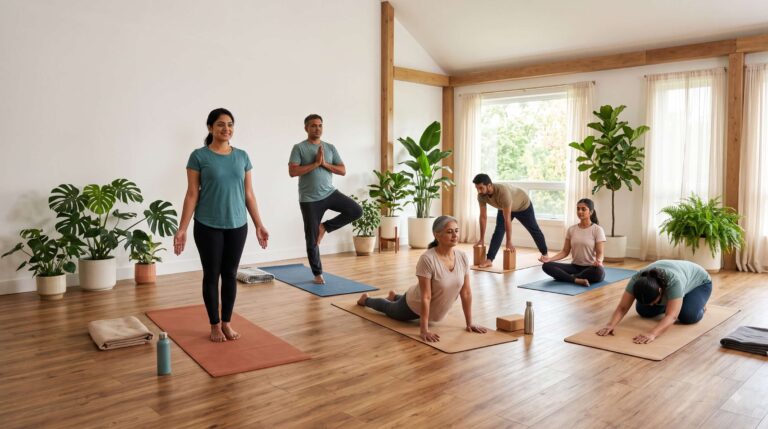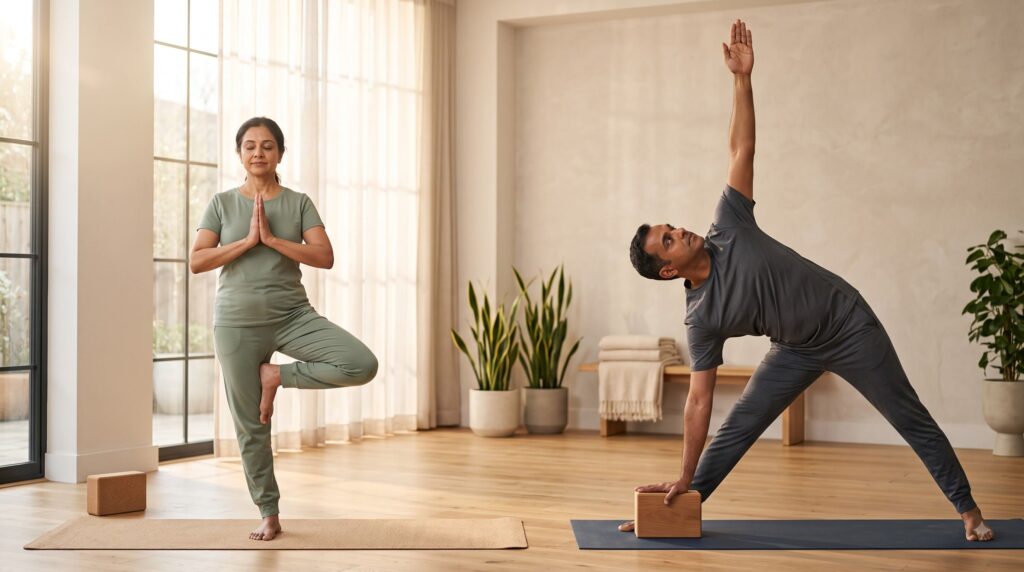
Yoga for longevity and regular flexibility training are similar in many aspects on the surface level; they include bending, stretching, and holding positions. However, their goals differ greatly: flexibility training is mainly about relaxing contracted muscles to achieve greater ranges of movement. Meanwhile, yoga for longevity involves stretching as only one method that combines strength, stability, breathing and concentration to keep the body young.
In other words, while one is focused on touching your toes, the other one getting off the floor easily at the age of 75. Well, let’s see what the yoga vs flexibility training controversy is all about. This is something that comes up a lot when we start our yoga classes in Tiju’s Academy.
Longevity isn’t Only About Living Longer
The longevity concept has been evolving into the idea of being healthier for longer. This is the essence of healthspan versus lifespan. Lifespan refers to the length of time you will live. Healthspan refers to the number of years during which you will feel healthy and fit.
Imagine sitting down cross-legged at home for a family dinner and then standing up without any help from the walls. Think about going to the market and walking there without getting exhausted. The longevity exercises maintain precisely the mentioned abilities:
- Good balance and fall prevention, as they become especially important after the age of 60;
- Good grip strength and sit-to-stand capability;
- Good joint, spine, and postural health;
- Good cognitive, sleep, and psychological condition.
Being flexible is just a part of the mentioned abilities. One can be highly flexible but lack the balance and strength needed to perform everyday tasks. This is where the two approaches differ.
What Is Flexibility Training?
Flexibility training involves exercises that aim to improve the range of movement of your muscles and joints. Its objective is the improvement of range of motion (ROM) and elongation of muscles, thereby making your daily activities easier and flexible.
There are basically three types of techniques involved:
- Static stretching: maintaining one posture for 20 to 60 seconds, for example, touching your toes
- Dynamic stretching: controlled movement in and out of the stretch, for instance, leg swings
- PNF stretching: stretching the muscle, contracting it briefly,, and then relaxing and stretching further
The most common method is a stretching technique for flexibility incorporated in the warm-up and cool-down process. The next time your doctor advises you about improving flexibility of your hamstrings due to stiffness in your lower back, now you know what he meant.
What changes when you stretch?
Stretching affects your muscles, ligaments, tendons, and fascia, which is the thin film around your muscles. But much of the early progress is actually in your nervous system. Your body learns the stretch is safe and lets you go further. This is called stretch tolerance.
It also helps to know about active vs. passive flexibility. Passive is how far you can go with help, like pulling your leg with a towel. Active is how far you can lift or hold it with your own muscles. The active kind matters more in real life.
What is the difference between mobility and flexibility?
Here’s the short version of mobility vs. flexibility. Flexibility is how far a muscle can lengthen. Mobility is how well a joint moves through that range with strength and control.
You could have flexible hips and still move poorly if the muscles around them are weak. That’s why mobility training adds strength, which makes it much better for injury prevention and joint stability.
What Is Yoga?
Yoga is a practice that involves both body and mind and links the posture, breathing, and concentration of thoughts. Yoga originated in India, and stretching has not always been the sole element of it.
The regular class will involve:
- Asanas, yoga postures that develop flexibility, strength, and balance
- Pranayama, slow breath work to relax the body
- Meditation and mindfulness, a few minutes of silent thought
- Better body awareness, so you notice where you’re tight or holding tension
We often tell new students that flexibility is something yoga gives you along the way. It isn’t the goal. This is the approach taken in the yoga class offered at Tiju’s Academy.
What type of yoga is best for longevity?
To tell the truth, it is impossible to name one ultimate way. However, a yoga style aimed at longevity should include strength, balance, flexibility, and relaxation and be sustainable in the long run.
- Hatha yoga is easy and relaxing; perfect for beginners
- Vinyasa yoga transitions smoothly from one pose to another and promotes stamina and strength
- Yin yoga involves holding poses that stretch joints and connective tissues
- Restorative yoga is very relaxing and suitable when you feel stressed
- Iyengar yoga emphasizes proper alignment and the use of equipment
Usually, people combine at least two styles.
What are the benefits of yoga for longevity?
The benefits of yoga for longevity go well past loose hamstrings. Research suggests regular practice may help with:
- Better balance by training proprioception (your sense of where your body is)
- Strength through isometric holds like plank, chair pose, and warrior poses
- Stress reduction and lower cortisol
- Healthier blood pressure and better heart rate variability (HRV)
- Deeper sleep and a calmer mood
- Possible anti-inflammatory effects, where inflammation has been associated with many issues that arise as one ages
It’s clear that yoga for healthy aging hasn’t come about by accident.
Yoga vs Flexibility Training: Is It Different?
Yes, absolutely. Flexibility exercises target just one aspect, which is range of motion. Yoga for longevity focuses on several aspects simultaneously, including flexibility, strength, balance, breathing, and stress.
| Flexibility Training | Yoga for Longevity | |
| Main aim | More range of motion | Healthy, capable ageing |
| Builds strength? | Barely | Yes, moderately |
| Trains balance? | Not usually | Yes, in many poses |
| Breathwork | Rarely | A core part |
| Mental calm | A little | A major focus |
| Usual role | Warm-up, cool-down | A full practice |
Is yoga better than stretching for flexibility?
It depends on your goal. In the yoga vs. stretching question, plain stretching might get you to the splits a little faster. Yoga is not only about being flexible, but it is also about being strong, balanced, and calm. When it comes to long-term well-being, it is more beneficial.
Why yoga feels different on your nervous system?
It’s something most people pay attention to first.
Slow breathing combined with conscious movement activates your parasympathetic nervous system, the “relax and heal” part of your body. This will trigger the relaxation response. Your heartbeat will calm down, you’ll relax your shoulders, and your thoughts will slow down.
Stretches may be pleasurable as well, yet they do not come with breathing and consciousness. You will always hear it from those who go to yoga classes in Mavelikara: “I’m sleeping better.” Most times it takes a few weeks.
Does yoga build strength?
It does. Supporting oneself in a plank position or assuming the chair pose requires one to support their own bodyweight. The muscles will become stronger as a result of this routine. This is why yoga for strength and balance works for individuals who wish to remain independent as they get older.
However, yoga will not help in gaining muscle mass like weightlifting does. This is important because sarcopenia (the loss of muscle mass with age) begins to occur in one’s 30s.
Can yoga improve balance and prevent falls?
Indeed. Stance-based poses such as tree pose involve small foot, ankle, and hip muscles for stabilization. Do this regularly and you will develop balance. As falling is one of the primary concerns for senior citizens, this may very well be the most underrated aspect of yoga.
Which One Should You Choose?
Ultimately, it is all about what you are aiming at. Flexibility exercises should suffice if all you are trying to do is warm up before a workout. However, yoga offers a lot more than that.
Flexibility training makes sense if you:
- Need a quick warm-up and cool-down
- Play a sport that needs a specific range of movement
- Have one tight area to work on
Yoga for longevity makes sense if you:
- Want a low-impact exercise that’s kind to your joints
- Care about balance, posture, and strength, not only flexibility
- Feel stressed or sleep badly
- Looking for an exercise that is easy enough to perform from a young age until old age
- Interested in keeping your functional fitness intact for your daily activities
Is yoga good for people over 50?
Yes, indeed! It’s gentle and easy to modify and helps achieve balance, bone density, strength, and mood regulation. Posing can be done with the help of a chair or a wall. Plenty of people in our yoga training in Mavelikara are in their 50s, 60s, and even 70s. It’s active aging in real life.
Just one thing: If you are sick, have just been injured, or have pain in your joints, then ask your doctor and inform your teacher about it as well.
Is yoga enough of an exercise?
In most cases, not really, but it is definitely a very good starting point. It is usually recommended to engage in at least 150 minutes of moderate exercises per week and two strength trainings.
Yoga covers the area of balance perfectly, and it also does some strength exercises. Adding some walks and resistance training will make up for the rest.
What This Means for Your Movement Practice?
The best way is to forget about yoga or stretching altogether. Do both of them; add walking and strengthening exercises to your weekly routine to remain physically healthy and mobile for years.
Is it possible to combine yoga and flexibility training?
Yes, you can. Quick stretching exercises will do for busy days or after walking. You can also have yoga as your main exercise two or three times a week, while adding one or two strength workouts.
How frequently should one perform yoga exercises for longevity?
Two to four yoga sessions a week suit everyone. Even a daily 20-minute practice will be enough. However, what counts is regularity. Better have a moderate exercise regimen for five years than an intensive one for only a month.
Should I perform yoga or stretching after my workouts?
Both options suit you. Some stretching exercises can become your fast cool-down practice. A quick yoga session accompanied by deep breathing will prepare your body for recovery. Choose whatever you like more.
A few habits that help
- Focus on movement quality, not how deep you go
- Stop before pain. A mild stretch is fine, sharp pain is not
- Use blocks, straps, or a chair without feeling shy about it
- Learn the basics from a real teacher before relying on videos
That last point matters. Small alignment mistakes can turn into sore knees or backs over time. Starting at one of the best yoga classes in Mavelikara means someone checks your form from day one.
Conclusion: Stretch for Flexibility, Practise Yoga for Life
Both flexibility training and yoga have their importance, but that doesn’t mean that the two are similar. Flexibility training helps in stretching out your muscles, but yoga does that and goes further by adding balance, strength, breathing, and mental relaxation.
Key Points to Remember:
- Flexibility Training primarily helps with range of movement
- Yoga is a holistic practice involving the mind and body
- Yoga helps in maintaining balance, strength, good posture, stress level, and sleep
- Pairing yoga with walking and strength work gives the best results
- Showing up regularly beats pushing hard now and then
Ready to start? Tiju’s Academy yoga classes welcome people of every age and fitness level, including complete beginners. The Tiju’s Academy yoga course helps you build strength, balance, and calm at a pace that suits you. If you’re looking for the best yoga classes in Mavelikara, visit tijusacademy.com to learn more and book your first class.
Frequently Asked Questions:
A: Flexibility training mainly improves your range of motion by lengthening muscles. Yoga for longevity goes further by combining flexibility with strength, balance, breathing, and mental calm. Stretching helps you touch your toes, while yoga helps you stay strong and steady as you age.
A: Flexibility training is exercise that improves how far your muscles and joints can move. It uses methods like static stretching, dynamic stretching, and PNF stretching, and is often done as part of a warm-up and cool-down.
A: Flexibility is how far a muscle can lengthen. Mobility is how well a joint moves through that range with strength and control. Mobility training adds strength, which makes it better for injury prevention and joint stability.
A: Lifespan is the total number of years you live. Healthspan is the number of years you live feeling healthy, fit, and able to handle daily tasks on your own. Longevity today focuses on increasing healthspan.
A: The benefits of yoga for longevity may include better balance, stronger muscles, lower stress and cortisol, healthier blood pressure, improved heart rate variability (HRV), deeper sleep, and a calmer mood. It may also help reduce inflammation linked to ageing.
A: There is no single best style. The best yoga for longevity includes strength, balance, flexibility, and relaxation, and is easy to maintain. Many people combine styles like Hatha, Vinyasa, Yin, Restorative, and Iyengar yoga.
A: It depends on your goal. Plain stretching may improve flexibility slightly faster. But yoga also builds strength, balance, and calm, which makes it more beneficial for long-term health and wellbeing.
A: Yes. Poses like plank and chair pose make your muscles support your body weight, which builds strength over time. However, yoga does not build as much muscle as weightlifting, which matters because sarcopenia begins in your 30s.
A: Yes. Standing poses like tree pose train the small muscles in your feet, ankles, and hips. Regular practice improves balance, which helps with fall prevention, one of the biggest health concerns for older adults.
A: Yoga combines slow breathing with mindful movement, which activates the parasympathetic nervous system. This triggers the relaxation response, calming your heartbeat and slowing your thoughts. Many people notice better sleep within a few weeks.
A: Yes. Yoga is gentle, easy to modify, and supports balance, bone density, strength, and mood. Poses can be done with a chair or wall for support. If you have a health condition or injury, check with your doctor first.
A: In most cases, not on its own, but it is a very good starting point. Guidelines recommend at least 150 minutes of moderate activity a week plus two strength sessions. Adding walking and strength training to yoga fills the gaps.
A: Yes. Use quick stretching on busy days or after walking, and make yoga your main practice two or three times a week. Adding one or two strength workouts creates a balanced weekly exercise routine.
A: Two to four sessions a week works well for most people, and even 20 minutes a day can help. Consistency matters most. A moderate routine kept up for years beats an intense one dropped after a month.
A: Both work. A few stretches make a quick cool-down, while a short yoga session with deep breathing helps your body shift into recovery. Choose the one you enjoy, since you're more likely to stick with it.
A: Tiju's Academy yoga classes welcome people of all ages and fitness levels, including beginners. The Tiju's Academy yoga course builds strength, balance, and calm at your own pace. Visit tijusacademy.com to book your first class.