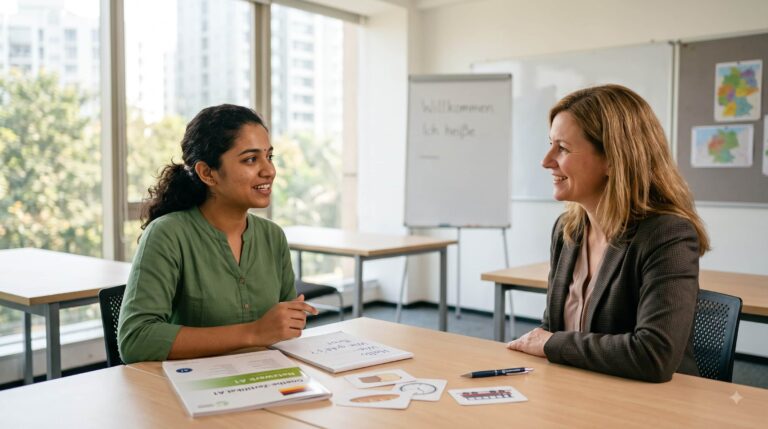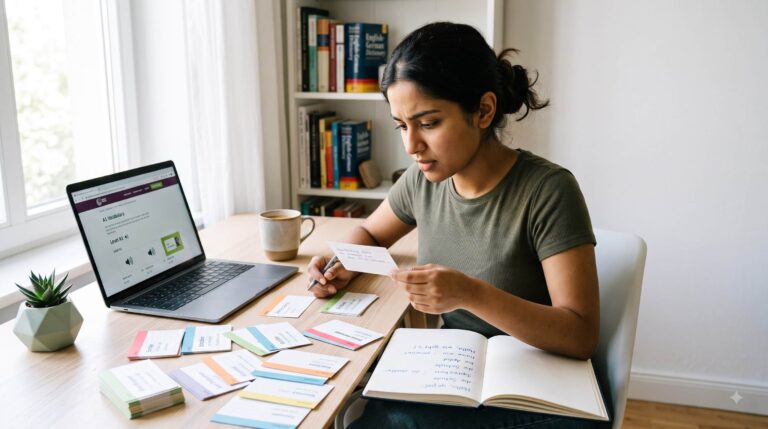

Wondering how to be confident while speaking in German? Then stop thinking about grammatical perfection and begin learning how to understand what is being spoken. It would be a good idea to learn some fillers in German that will give you time to think and learn how to ask the native speaker to slow down his/her speech. You will build your confidence through practice rather than by reading another grammar book.
If your heart starts racing, this is because of the fear of speaking German with a native speaker in Germany itself. In Germany, they call it “Sprachangst.” “Sprachangst” means “language fear” and is one of the most common challenges that we face in Tiju’s Academy.
Here is the strange part. Most learners who freeze in conversation already know enough German to handle that conversation. The knowledge is there. The confidence is not. This guide explains why that happens and gives you a clear way out.
Why speaking German feels uniquely intimidating?
German turns a spoken conversation into doing mathematics in one’s head in front of an audience. Three things cause most of the German speaking anxiety we see in our German language classes.
- The der, die, das trap: The problem starts when you begin to form the sentence, find yourself at a noun, and freeze because you cannot remember its gender. By the time you work it out, the opportunity is lost and no sentence has been formed at all. Many students will stop halfway through the sentence.
- Verb placement: The verb in German appears at the end of the sentence. This indicates that you are supposed to memorize the whole sentence pattern before finishing the sentence. You will need to listen to what the speaker is saying all the way to the end in order to comprehend it. This is not the case in English, and thus you have to translate and reorder the sentence simultaneously.
- Speed and dialect: Textbooks teach clean Hochdeutsch. Normal humans talk very quickly, cut off the ends of words, and speak in their dialect of German. People from Bavaria and Hamburg might as well be speaking different languages. Nothing in your average German language course could have prepared you for this culture shock.
When you realize this is a problem that comes from the language itself, and not from your own personal shortcomings, all three of these problems become manageable.
The mindset switch that makes all the difference
Stop focusing on being right and start focusing on being understood. That simple change solves more speaking anxiety than anything else. Think about what actually happens if you order a coffee and say “das Kaffee” instead of “der Kaffee.” You still get the coffee. The communication worked. Nobody stopped you at the counter to correct your article. The mistake cost you nothing.
Germans generally appreciate the effort. Their language is genuinely difficult, and they know it. When a foreigner tries to speak it, most native speakers respond with patience, not judgement. Many will even supply the word you are hunting for. The cold, grammar-policing German is mostly a myth that learners invent inside their own heads.
This is the message our coaches always keep repeating in our German-speaking classes, communication that works is really communication. Strive for clarity rather than perfection. Mastery comes afterward, and it comes sooner if you are willing to make mistakes along the way.
Interested in practicing in an environment where your errors will not be judged? Contact our language coaches and request a free trial session.
Five steps to speak German without anxiety
Here is what actually works, in the order we teach it.
- Lower the stakes before you raise them
But don’t pick the Ausländerbehörde for your first live conversation. Find somewhere the stakes aren’t quite so high.
- Speak with a tutor who knows how to slow down and simplify.
- Speak with other learners at your level, where nobody is judging anybody.
- Only then move to native speakers.
This is exactly why we built Dialect Studio into our German-speaking training. It gives you scheduled talk time with a German native speaker inside a classroom setting, so your first native conversation happens somewhere safe instead of somewhere stressful.
- Use the shadowing technique
Shadowing means listening to a German sentence and repeating it out loud immediately, copying the rhythm and sound rather than translating it.
- Play a German podcast or video.
- Pause after each sentence and say it aloud.
- Copy the melody of the sentence, not just the words.
Your mouth needs muscle training the same way your brain needs vocabulary. German sounds like ü, ö and the ch in “ich” are physically new for most Indian learners. Shadowing builds that muscle memory. We run this through Germflix, our German movie sessions, where you improve listening and pronunciation while actually enjoying yourself.
- Prepare scripts for routine situations
You already know which conversations are coming. Write them out in advance and memorize them.
- Ordering at a bakery or restaurant
- Talking to a doctor or at a hospital reception
- Visiting the immigration office
- Introducing yourself at work or in class
Once you have said a script twenty times, it stops feeling like German and starts feeling automatic. Our Collocuts sessions do this with everyday shortcuts, teaching the colloquial German that people actually use rather than the formal textbook version nobody says out loud.
- Embrace the pause
The silence will feel like forever compared to the listener who hears it as shorter. A pause of two seconds to gather your thoughts is perfectly fine in any language.
Have some fillers at hand to make sure the pause is natural:
- Also… which works like “well…” in English
- Lassen Sie mich überlegen… meaning “let me think.”
- Moment, bitte, meaning “one moment, please”
These words buy you time, but more importantly, these words indicate that you are still a part of the conversation.
- Vocabulary, not grammar
When a German knows the noun and the verb, he or she can make sense of your message even if the structure fails completely.
“Ich gestern Arzt gehen” is grammatically wrong. Every German will still understand that you went to the doctor yesterday. Perfect grammar with no vocabulary gets you nowhere. Rough grammar with good vocabulary gets you a conversation.
In our online German-speaking course, we group vocabulary by real-life situations rather than by grammar rules, so you learn the words for the doctor, the supermarket, and the workplace as complete sets you can actually use.
Lifeline phrases for when you panic
Keep these ready. They let you take control of a conversation instead of freezing in it.
| The situation | What to say in German | What it means |
| You need them to slow down | Könnten Sie das bitte langsamer wiederholen? | Could you please repeat that more slowly? |
| You did not understand a word | Was bedeutet das Wort [word]? | What does the word [word] mean? |
| You need simpler language | Können Sie das bitte einfacher sagen? | Can you please say that more simply? |
| You need thinking time | Also… / Lassen Sie mich überlegen… | Well… / Let me think… |
| You want patience | Mein Deutsch ist noch nicht perfekt, bitte haben Sie Geduld. | My German is not perfect yet, please be patient. |
That last phrase is the most powerful one on the list. Say it early in a conversation and almost every German will immediately slow down and simplify their language for you. You are not admitting weakness. You are managing the conversation.
Learn these five lines before you learn anything else. They turn a terrifying conversation into a manageable one.
Stop studying in silence. Join Tiju’s Academy for interactive, conversational classes that actually get you talking. Ask us about our online and offline batch timings.
Goethe Sprechen Exam Tips
The most useful of all Goethe speaking test tips (Sprechen) is this: examiners are not looking for native fluency. They are looking for interaction.
What the Sprechen section actually assesses:
- Can you start and maintain a conversation
- Can you ask questions, not just answer them
- Can you negotiate meaning when you do not understand something
- Can you correct yourself after a mistake
- Can you respond to your partner rather than reciting a memorised speech
That fourth point surprises people. Correcting yourself mid-sentence is not penalized. It is evidence that you are monitoring your own German, and examiners view it positively.
Practical exam advice:
- Never sit in silence. A partly wrong answer scores more than no answer.
- Use connecting words like weil, aber, deshalb and trotzdem. They make your speech sound structured.
- Ask your partner a question. Interaction is a scoring criterion.
- If you go blank, use a lifeline phrase. Asking the examiner to repeat is allowed.
Our Modmaster approach prepares you module by module, so Sprechen gets its own dedicated focus rather than being squeezed in at the end. Alongside it, our Leistung Technique gives you the specific tips and score strategies for the band you are targeting, and Bootcamp Exam Preps run as intensive sessions in the final weeks before your exam date.
How Tiju’s Academy builds your speaking confidence?
Reading a blog will not fix your fear. Only speaking will do. That is the honest truth, and it is the reason we designed our German language training online around talking rather than listening.
Here is what we do differently as one of the leading options for anyone searching for the best German language institute in Kerala:
Reclaim Sessions: These are dedicated confidence-building classes. No corrections of grammar, no grading, no stress. It all comes down to speaking until the fear goes away. This is the session where most students make a complete change in their life.
ICT Technique: Inner Circle Training means one-on-one attention with your tutor. We identify your specific weak points, whether that is pronunciation, article confusion or freezing under pressure, and work on them directly instead of leaving you to struggle inside a large group.
Stressfrei: We built our classrooms to be a stress-free zone where comfort meets concentration. Learners who are afraid of being laughed at do not speak. Learners who feel safe do. It really is that simple.
Fluency Alchemists: Our certified instructors are experts at helping students progress from nothing to speaking confidently. Most of them have extensive experience teaching Indian students and know exactly where the mental blocks lie.
Infinite Drill: German language lessons need not be torture. These are enjoyable and activity-based drills that cater to all kinds of learners whether auditory, kinesthetic, visual or verbal.
Off-Book Learning: Authentic culture sessions run by experts. Understanding how Germans actually behave, greet, joke and disagree removes a huge amount of social anxiety before you ever step off the plane.
Pro App Assistance: Most students struggle to write a professional CV or a motivation letter for admission. We train you to build your own, which matters enormously for nursing and study applications.
We also use focused, high-intensity study methods inspired by Albert Einstein’s approach of deep concentration on one problem at a time, and every lesson is short and structured with clear milestones so you can actually see your progress.
Whether you want a German language speaking course in the classroom or prefer online German speaking classes from home, we run both. Our beginner-friendly lessons include step by step grammar explanations, pronunciation training, listening exercises with native style German, roleplays and cultural etiquette, along with continuous support from your teacher and your batch community.
How long before I feel confident?
A typical learner can speak at an elementary or comfortable level in three to six months if he/she practices for 30 minutes each day. A period of eight to twelve months is required to reach fluency in B2 level.
But confidence moves faster than fluency. In our experience, students who join speaking-focused classes notice a real drop in anxiety within four to six weeks, long before their grammar catches up. The fear fades before the mistakes do.
Start speaking today
Fear decreases as action increases. The awkward sentence, the misplaced article, and even the hesitant pause are all part of the process of becoming fluent, not moving farther from it. The learners that end up speaking confidently are just those who were able to speak imperfectly for a few months.
Your nursing career, your studies, or your move to Germany all depend on being able to speak, not just on knowing the rules. If you are looking for the best German institute in Kerala to help you get there, Tiju’s Academy German classes are built around exactly this problem.
Talk to our team about Tiju’s Academy German courses, book a free trial class, and say your first sentence out loud this week.
Frequently Asked Questions:
A: Sprachangst is the German word for language fear. It describes the panic many learners feel when a native speaker talks to them. It is extremely common, and it usually affects people who already know enough German to handle the conversation but freeze before they can start.
A: Because German forces you to solve several problems at once. You have to recall the noun gender, hold the verb until the end of the sentence, and decode fast speech or dialect. This creates German speaking anxiety even in learners with strong grammar knowledge.
A: No. Most native speakers appreciate the effort it takes to learn such a difficult language. Many will kindly supply the word you are searching for. The cold, grammar policing German is largely a myth that learners create in their own heads.
A: Not in real conversation. You still get the coffee. The communication worked, and nobody stops you at the counter to correct it. Aim for clear rather than flawless, because understanding matters far more than grammatical perfection when you are speaking.
A: Shadowing means listening to a German sentence and repeating it aloud immediately, copying the rhythm and sound instead of translating it. It trains your mouth muscles for new sounds such as "ü," "ö," and the "ch" in "ich," which are physically unfamiliar for most Indian learners.
A: Use a lifeline phrase. "Mein Deutsch ist noch nicht perfekt, bitte haben Sie Geduld" tells the speaker your German is not perfect yet and asks for patience. Almost every German will slow down and simplify immediately once they hear it.
A: No. A two second pause feels far longer to you than to the listener. Keep fillers such as "also," "moment," "bitte," or "lassen Sie mich überlegen" ready. They buy thinking time and signal that you are still in the conversation.
A: Vocabulary. If you know the noun and the verb, a German speaker can usually work out your meaning even when the sentence structure collapses. Perfect grammar with no vocabulary gets you nowhere, while rough grammar with good vocabulary gets you a real conversation.
A: No. The Sprechen section grades interaction, vocabulary range and overall communication, not native fluency. Correcting yourself mid sentence is actually viewed positively. Sitting in silence costs you far more marks than a wrong article or a small grammar error.
A: Examiners assess whether you can start and maintain a conversation, ask questions rather than only answer them, negotiate meaning when confused, correct yourself, and respond naturally to your partner. Reciting a memorized speech scores lower than genuine interaction.