There is no need to know 5,000 words in order to pass the German A1 examination. You just have to know around a minimum of 100. The 100 Most Common German Words are enough to make you understand and use all that you would encounter in the Start Deutsch 1 examination. Everything else is unnecessary padding you can learn later on.
Here is the full 2026 list of words separated into four blocks of 25: verbs, nouns, adjectives and question words with connectives and pronouns. Every single one is derived from patterns present within the Goethe A1 Wortliste (word list); hence, you are studying the exact things that are tested by the examiners.
The biggest problem with most beginning students failing A1 is that they try to equally distribute their time between 700 words instead of mastering the 100 words that always come back.
Why 100 Words Are Enough to Pass A1?
As the name implies, A1 is a survival test, not a language fluency test.
The Common European Framework of Reference for Languages defines A1 as the “breakthrough” level. The examiner will focus on one point only: Can you cope with everyday situations? Greet yourself, request the price, make an appointment, cancel your meeting, and state your preferences. That’s all.
Here is what actually happens in the Start Deutsch 1 exam format:
-
- Hören (Listening): short announcements, phone messages, station and shop dialogues, roughly 20 minutes
- Reading (Lesen): small advertisements, e-mails, notices, and signs; 25 minutes
- Writing (Schreiben): filling out a form and writing a short text of 30 to 40 words
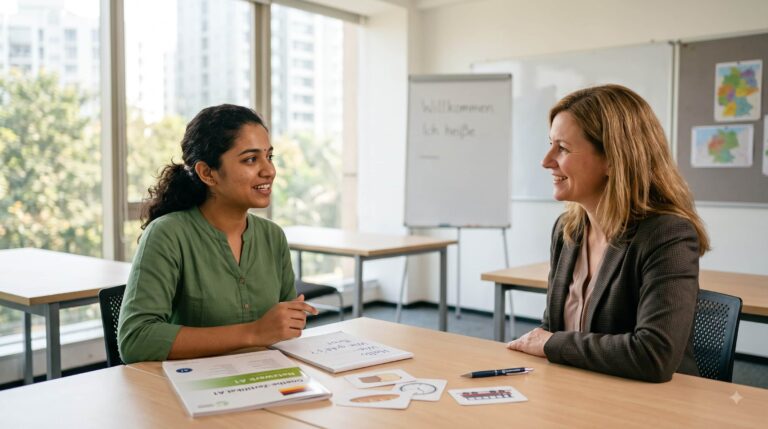
- Speaking (Sprechen): greeting, asking and answering questions from flashcards, making a request and reacting to it
Look at that writing task again. Thirty to forty words. You don’t need a wide vocabulary range to be able to write forty words; all you need is the right forty.
This follows very accurately the 80/20 rule. The high-frequency words make up the most part of the language in everyday German. This is the reason why basic German words for beginners is not just an introductory set of words. These words will still be useful even at the B1 and B2 level.
At Tiju’s Academy German courses, the first two weeks of every A1 batch are built on this core word list rather than going through each page of the textbook. The students are able to start speaking from week one since they have all the relevant words.
Part 1: The 25 Most Important German Verbs (Verben)
Verbs drive a German sentence. Without a verb, there is no sentence. These 25 appear in almost every A1 reading text and speaking card.
| German Verb | English Meaning | A1 Example Sentence |
| sein | to be | Ich bin Arzt. (I am a doctor.) |
| haben | to have | Ich habe Zeit. (I have time.) |
| werden | to become | Es wird kalt. (It is getting cold.) |
| können | can, to be able to | Können Sie mir helfen? (Can you help me?) |
| müssen | must, to have to | Ich muss gehen. (I must go.) |
| möchten | would like | Ich möchte einen Kaffee. (I would like a coffee.) |
| sagen | to say | Was sagen Sie? (What are you saying?) |
| machen | to do, to make | Ich mache meine Hausaufgaben. (I am doing my homework.) |
| geben | to give | Gibt es hier einen Supermarkt? (Is there a supermarket here?) |
| kommen | to come | Ich komme aus Indien. (I come from India.) |
| gehen | to go | Wir gehen nach Hause. (We are going home.) |
| arbeiten | to work | Ich arbeite in einem Büro. (I work in an office.) |
| essen | to eat | Ich esse gern Reis. (I like eating rice.) |
| trinken | to drink | Trinken Sie Tee? (Do you drink tea?) |
| schlafen | to sleep | Das Kind schläft. (The child is sleeping.) |
| sehen | to see | Ich sehe den Bus. (I see the bus.) |
| finden | to find, to think | Ich finde das gut. (I think that is good.) |
| bleiben | to stay | Ich bleibe zu Hause. (I am staying home.) |
| lernen | to learn | Ich lerne Deutsch. (I am learning German.) |
| sprechen | to speak | Sprechen Sie Englisch? (Do you speak English?) |
| fragen | to ask | Darf ich etwas fragen? (May I ask something?) |
| kaufen | to buy | Ich kaufe Brot. (I am buying bread.) |
| brauchen | to need | Ich brauche einen Termin. (I need an appointment.) |
| wissen | to know | Ich weiß es nicht. (I do not know.) |
| wohnen | to live, to reside | Ich wohne in Kochi. (I live in Kochi.) |
Three things to watch here:
- sein and haben are irregular. Learn all six forms of each by heart. They show up in every module.
- Modal verbs push the second verb to the end. Ich muss morgen arbeiten. The main verb goes last.
- “finden” means both “to find” and “to think.” Examiners love it in the speaking section because it lets you give an opinion in three words.
In our German A1 online course, verbs are drilled through our Infinite Drill sessions, which are short repetition games rather than written exercises. Students conjugate out loud, in pairs, until the forms come automatically. This is what will save you in the speaking room when you only have four seconds to respond.
Part 2: The 25 Most Important German Nouns (Nomen)
Two rules first, because breaking them costs marks.
- Every German noun is capitalized, always. In the middle of a sentence too.
- Never learn a noun alone. Learn it with its article. Not “Haus” but “das Haus.”
Articles (Der, Die, Das) are where the average Indian student makes mistakes. Without knowing the gender of the noun, you cannot formulate an accusative sentence. Learn the articles on your first day, and do not ever have to learn that word again.
Time and days (Die Zeit)
- das Jahr (the year)
- der Tag (the day)
- die Zeit (the time)
- die Uhr (the clock, o’clock)
- die Woche (the week)
People and family (Leute und Familie)
- der Mann (the man, husband)
- die Frau (the woman, wife)
- das Kind (the child)
- die Familie (the family)
- der Freund (the friend, male)
Everyday objects and places (Alltag und Orte)
- das Haus (the house)
- das Geld (the money)
- die Arbeit (the work, job)
- das Auto (the car)
- der Zug (the train)
- das Wasser (the water)
- das Essen (the food)
- der Arzt, die Ärztin (the doctor)
- das Bett (the bed)
- der Tisch (the table)
High-yield words from the speaking picture cards
- die Wohnung (the flat, apartment)
- der Name (the name)
- die Stadt (the city)
- das Handy (the mobile phone)
- der Termin (the appointment)
That last group is worth extra attention. In Teil 2 of Sprechen, you are handed word cards with everyday topics on them, and words like “Termin,” “Handy,” and “Wohnung” come up again and again. In “Schreiben,” the only time “Termin” occurs in the vast majority of tasks is because the typical assignment involves making or canceling an appointment.
Vocabulary is organized based on the context in our daily routine rather than alphabetically. Doctor’s office, supermarket, train station, looking for an apartment, workplace. That is how our memory works. It takes less effort to recall “der Termin” when it is grouped with “der Arzt” and “die Uhr” than two totally unrelated T-words.
Part 3: The 25 Must-Know Adjectives and Adverbs
The adjectives allow us to express our opinions, which is one of the criteria on which we are evaluated for the speaking test. A candidate who says just “Ja” scores less than one who says “Ja, das finde ich sehr gut.”
| Adjective / Adverb | English Meaning | Exam Application |
| gut | good | Das ist gut. |
| neu | new | Mein Auto ist neu. |
| groß | big, large | Das Haus ist sehr groß. |
| klein | small | Die Pizza ist zu klein. |
| schön | beautiful, nice | Das Wetter ist schön. |
| teuer | expensive | Das Ticket ist teuer. |
| billig | cheap | Der Apfel ist billig. |
| schnell | fast | Der Zug ist schnell. |
| langsam | slow | Bitte sprechen Sie langsam. |
| spät | late | Es ist schon spät. |
| früh | early | Ich stehe früh auf. |
| alt | old | Wie alt sind Sie? |
| jung | young | Meine Schwester ist jung. |
| wichtig | important | Das ist sehr wichtig. |
| richtig | correct | Ist das richtig? |
| falsch | wrong | Die Nummer ist falsch. |
| einfach | easy, simple | Deutsch ist nicht einfach. |
| schwer | difficult, heavy | Die Prüfung ist schwer. |
| kalt | cold | Der Kaffee ist kalt. |
| warm | warm | Das Zimmer ist warm. |
| viel | much, a lot | Ich habe viel Arbeit. |
| wenig | little, few | Ich habe wenig Zeit. |
| oft | often | Ich fahre oft mit dem Bus. |
| immer | always | Er kommt immer zu spät. |
| nie | never | Ich trinke nie Alkohol. |
Two of these are quietly the most useful words in the whole exam.
langsam rescues you in the listening and speaking rooms. “Bitte sprechen Sie langsam” and “Können Sie das bitte wiederholen?” are allowed, and asking is far better than freezing.
sehr and zu stack onto any adjective and instantly upgrade a flat answer. Sehr gut. Zu teuer. Nicht so schön. Three-word answers that sound like real German.
Pronunciation matters here more than anywhere else. Say “schön” or “früh” wrong, and the examiner may not follow you. Our pronunciation training covers the ö, ü, and ä sounds separately in the first week because Malayalam and English speakers do not have these sounds naturally, and guessing does not work.
Part 4: The 25 Crucial W-Questions, Connectors and Pronouns
This is the section that decides pass or fail in Teil 2 of the speaking exam. You are not only answering. You are also asking your partner questions. If you cannot form a question, you lose the marks for that task no matter how good your vocabulary is.
The golden W-Fragen (Wer, Was, Wo, Wann, Warum, Wie)
- Wer? (Who?) Wer ist das?
- Was? (What?) Was ist das?
- Wo? (Where?) Wo wohnen Sie?
- Wann? (When?) Wann kommt der Zug?
- Warum? (Why?) Warum lernen Sie Deutsch?
- Wie? (How?) Wie heißen Sie?
- Woher? (Where from?) Woher kommen Sie?
- Wohin? (Where to?) Wohin gehen Sie?
- Wie viel? (How much?) Wie viel kostet das?
Notice the pattern. In a W-question the verb always comes second. Wo wohnen Sie. Wann kommt der Zug. Get that habit, and your questions will be correct even with words you have never practiced.
Connectors that make your sentences longer
- und (and): Ich lerne Deutsch und Englisch.
- oder (or): Möchten Sie Tee oder Kaffee?
- aber (but): Das ist gut, aber teuer.
- denn (because): Ich bleibe zu Hause, denn ich bin krank.
- dann (then): Ich esse, dann schlafe ich.
Short sentences score lower. Joining two short ideas with “und” or “aber” is the cheapest way to sound more advanced without learning new grammar.
The pronouns you cannot skip
- ich (I)
- du (you, informal)
- er (he), sie (she), es (it)
- wir (we)
- ihr (you all)
- Sie (You, formal)
Three small words that carry a lot
- nicht (not): Ich verstehe nicht.
- kein (no, not a): Ich habe kein Geld.
- bitte (please): Bitte langsam.
One warning that costs students marks every single exam session. Use “Sie,” not “du,” with the examiner and with any stranger in the roleplay. Capital S, formal verb form. Calling the examiner “du” reads as rude and gets flagged.
W-Fragen are drilled in our Reclaim sessions, which exist purely to get nervous students speaking without freezing. Confidence is not a soft skill in this exam. It is the difference between a candidate who asks three clean questions and one who asks none.
How to Actually Memorise These 100 Words?
Reading a list does nothing. Here is the method we use in our German language training online batches.
- Study in groups of ten, not one hundred. Ten words a day for ten days beats a marathon session you forget by Friday.
- Always speak them out loud. Silent reading trains your eyes, not your mouth. The exam tests your mouth.
- Learn nouns as article plus noun plus plural. das Kind, die Kinder. Say all three together every time.
- Build one sentence per word. A word you have used in a sentence sticks. A word you have only seen does not.
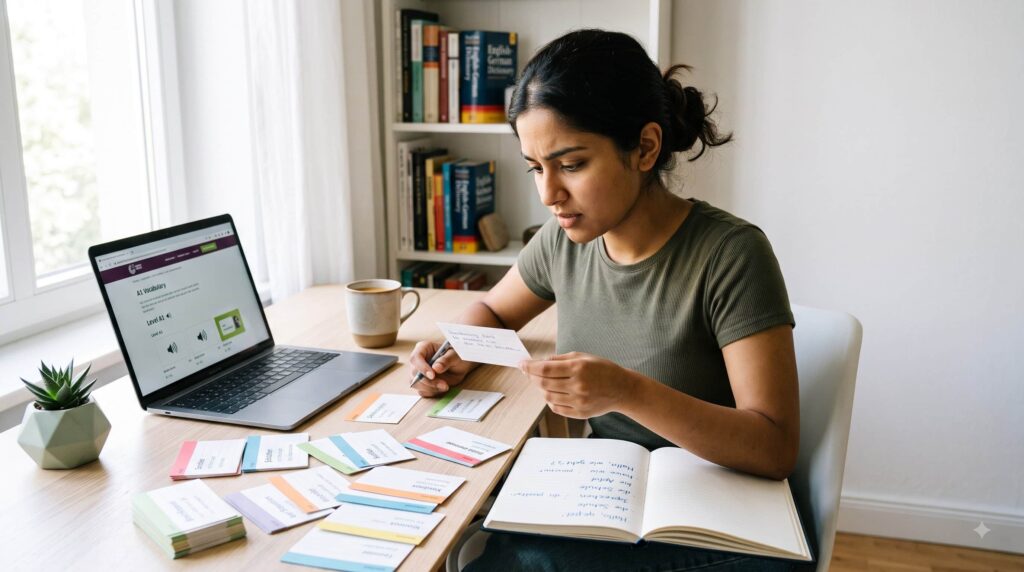
- Use spaced repetition. Review on day 1, 3, 7, and 14. Flashcards or an app both work.
- Test yourself in both directions. English to German is harder and more useful than German to English.
- Listen daily. Even ten minutes of German audio trains your ear for the Hören module.
How Tiju’s Academy Teaches A1 Differently?
Plenty of places will hand you a word list. Fewer will get you to the point where the words come out of your mouth under exam pressure. We are the best German language institute in Kerala because our technique relies on speaking right from day one and not reading from day one.
What is inside every batch:
-
- Dialect Studio: live talk time with a German native speaker, so you hear real speed and real accents, not textbook audio
- Collocuts: colloquial German shortcuts that native speakers actually use in daily life
- Off-Book Learning: authentic German culture sessions run by experts, covering etiquette and social norms you will need after landing
- Germflix: German movie sessions to sharpen listening skills the enjoyable way
- Modmaster: module mastery, with separate targeted preparation for Hören, Lesen, Schreiben and Sprechen
- Leistung Technique: our achievement method, with clear score-focused tips for each module
- Stressfrei: a genuinely stress-free classroom where comfort meets concentration
- Infinite Drill: fun repetition activities that suit slow learners and fast learners alike
- Fluency Alchemists: certified trainers who take students from zero to confident
- Bootcamp Exam Preps: intensive sessions before every exam date
- Reclaim Sessions: confidence-building classes for students who are scared to speak
- ICT Technique: inner circle training, one-on-one attention on your specific weak points
- Einstein Intensive: deep-focus study blocks for students who want to finish A1 fast
- Professional App Assistance: personal guidance on how to prepare your CV and letter of motivation for admission and visa procedures.
Each course comes with comprehensive instructions in grammar, real-life conversational exercises, pronunciation classes, listening classes in natural German, speaking exercises, mini classes, milestones, and examination preparation for Goethe-Institut and TELC certificate pathways.
One can attend the classes personally or opt for German language course A1 online. The online batches run the same syllabus, the same trainers, and the same live speaking practice. If you are working, studying, or living outside Kerala, the course German language online option gives you the same German A1 online course experience from home.
Ready to Start?
Learning the most common words in the German A1 exam is the right first move. This is not the end. You will still require the right pronunciation, proper grammar, and capability to generate these words live under the scrutiny of the examiner with the clock ticking away.
This is where independent learning usually fails. Not due to the lack of vocabulary among the learners, but rather due to the fact that they have never spoken them out loud to anyone else.
At Tiju’s Academy, our intensive German A1 batches are built to get you exam-ready fast, with native-level speaking practice, customized mock tests, and a strong first-attempt pass rate. We are known as the best German language academy in Kerala for migration preparation, and our German language classes online bring the same training to students anywhere.
Explore our German language coaching packages and book a free counseling call. Your move to Germany starts with a hundred words. Let us help you use them properly.
Frequently Asked Questions:
A: Around 100. The 100 most common German words cover almost everything you will read, hear, write, and say in Start Deutsch 1. The full Goethe list has 600 to 700 words, but the high-frequency core does most of the work.
A: Yes, for most tasks. A1 is a survival-level test, not a fluency test. The examiner only checks whether you can handle everyday situations like greeting someone, asking a price, booking an appointment, or saying what you prefer.
A: It is the official vocabulary list for the Goethe A1 exam, holding roughly 600 to 700 words. The Goethe A1 Wortliste is where examiners draw their test material from, so studying its repeating patterns is smarter than memorizing it front to back.
A: Hören, Lesen, Schreiben, and Sprechen. Listening runs about 20 minutes with announcements and short dialogues. Reading takes about 25 minutes. Writing is one form plus a 30 to 40 word message. Speaking covers introductions, word-card questions and a request.
A: Only 30 to 40 words. You fill in a simple form first, then write one short message. You do not need a wide vocabulary for forty words. You need the right forty.
A: Start with sein, haben, werden, können and müssen. These five appear in nearly every A1 reading text and speaking card. Learn all six forms of sein and haben by heart, because both are irregular and show up in every module.
A: Yes. You cannot build a correct accusative sentence without knowing a noun's gender. Never learn a noun by itself. Learn "das Haus," not "Haus," from your very first day and you will not have to relearn it later.
A: The W-Fragen are German question words: Wer, Was, Wo, Wann, Warum, Wie, Woher, Wohin and Wie viel. In every W-question the verb comes second. Wo wohnen Sie. Wann kommt der Zug. That pattern never changes.
A: Always use Sie. Use it with the examiner and with any stranger in the roleplay, with a capital S and the formal verb form. Calling an examiner "du" reads as rude and costs candidates marks in every exam session.
A: Study ten words a day instead of a hundred at once. Say every word out loud, build one sentence with each, learn nouns with article and plural together, and review on days 1, 3, 7 and 14 using