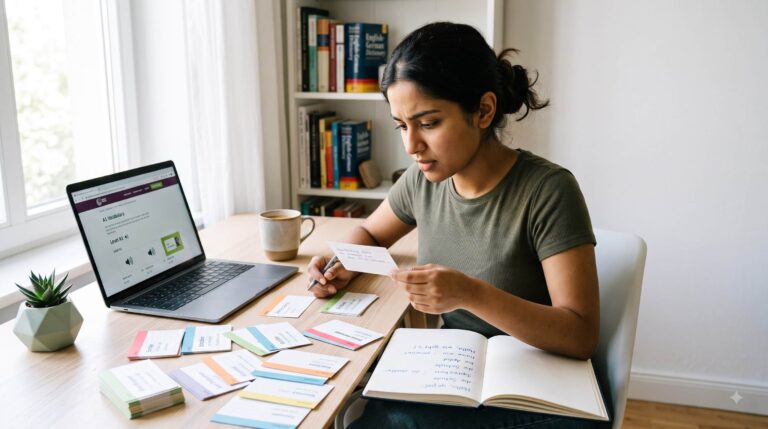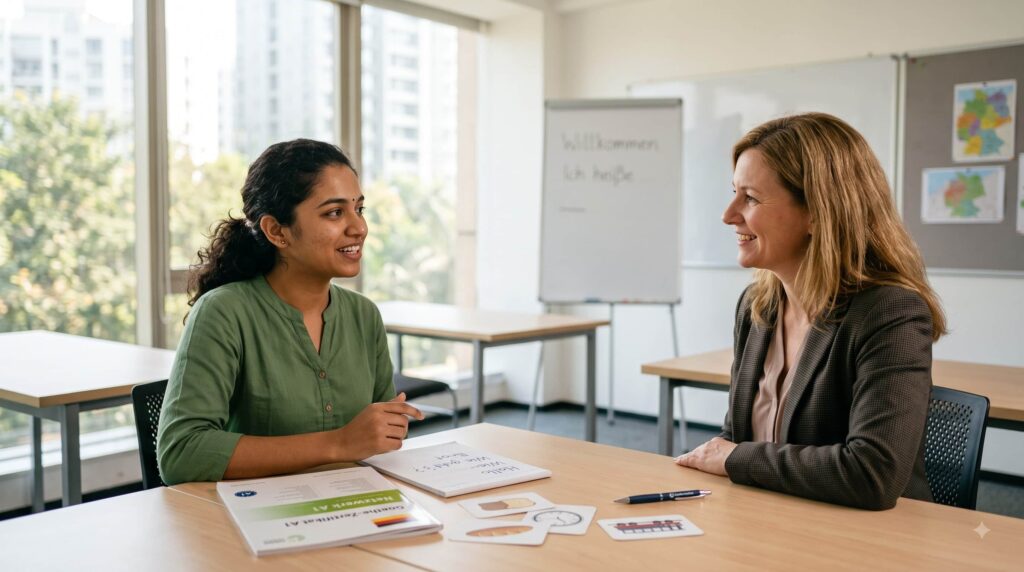
Under the heading “Most common speaking topics for the Goethe A1 Sprechen,” there are everyday topics: food and drink, shopping, leisure time, accommodation, work and studies, family, traveling and routine activities. There is nothing else to it. The examiners are not interested in complex views or impeccable grammar skills. They want to see whether you are capable of introducing yourself, asking a question and making a polite request in German.
That is why the Start Deutsch 1 speaking part is the most predictable section of the entire exam. Once you know which cards keep coming back, you can practice them until they feel normal. At Tiju’s Academy German classes in Kerala, we build our entire German A1 preparation plan around this idea. Learn the patterns, and repeat them orally until you’ve learned to speak them with your mouth.
Here is an initial response to your question.
The themes that keep recurring include the following:
- Essen und Trinken (food and drink)
- Einkaufen (shopping)
- Freizeit (free time and hobbies)
- Wohnen (home and housing)
- Arbeit und Schule (work and school)
- Familie (family and people)
- Reisen und Verkehr (travel and transport)
- Tagesablauf (daily routine)
- Small polite requests with everyday objects: pen, water, window, bill, phone
Now let us break the exam down part by part.
Understanding the Goethe A1 Sprechen Exam Format
The speaking test takes about 15 minutes for the whole group. You sit with up to three or four other candidates, and two examiners watch and score you. You speak with your partners, not only with the examiner. There are three parts, and the Goethe A1 Sprechen Teil 1 2 3 structure never changes.
| Part | What you do | Rough time | What is tested |
| Teil 1 | Sich vorstellen (introduce yourself), spell a word, say a number | 3 to 4 minutes | Basic personal information |
| Teil 2 | Draw a topic card, form a question, answer your partner | 5 to 6 minutes | W-Fragen and simple answers |
| Teil 3 | Draw a picture card, make a polite request, respond to one | 4 to 5 minutes | Bitten formulieren and reactions |
Two things surprise most students. First, you speak for a very short time in total, maybe two or three minutes each. Second, you are marked on communication, not on flawless German. A small mistake with an article will not fail you. Silence will.
Our students at Tiju’s Academy hear this in their first week. We are the best German language institute in Kerala for exam training because we start speaking on day one, not in month three. Even in our German language course A1 online batches, every class ends with a live speaking round.
Goethe A1 Sprechen Teil 1: Self-Introduction (Sich vorstellen)
In Teil 1, you get a card with seven keywords, and you build simple sentences around them. The keywords are almost always the same:
- Name (name)
- Alter (age)
- Land (country)
- Wohnort (place where you live)
- Sprachen (languages)
- Beruf (job)
- Hobby (hobby)
You speak for about a minute. Short sentences are enough. This is the easiest section on the exam because you can prepare it fully in advance.
A German A1 self-introduction template
Fill in the blanks and practice it aloud twenty times:
- Ich heiße ______. / Mein Name ist ______.
- Ich bin ______ Jahre alt.
- Ich komme aus ______.
- Ich wohne in ______.
- Ich spreche ______, ______ und ein bisschen Deutsch.
- Ich bin ______ von Beruf. / Ich bin Student.
- Mein Hobby ist ______. / Ich ______ gern.
Example: “Ich heiße Anjali. Ich bin 24 Jahre alt. Ich komme aus Indien. Ich wohne in Kochi. Ich spreche Malayalam, Englisch und ein bisschen Deutsch. Ich bin Krankenschwester von Beruf. Ich koche gern.”
The two follow-up tasks nobody should forget
After your introduction, the examiner asks you to do two small things.
- Buchstabieren (spelling). You spell your name, your city or a word from your card. So learn the German alphabet properly. The letters that confuse people are E, I, J, V, W, Y, and Z. In German, the letter “V” is pronounced as “fau,” the letter “W” is pronounced as “ve,” and “J” as “yot.”
- Nummer sagen (say a number). Usually your phone number or postcode. Say the digits slowly, one by one. German numbers flip after twenty, so 45 becomes fünfundvierzig. Practise 21 to 99 until it is automatic.
Most students lose easy marks here, not in the harder parts. In our A1 German language course, we run a short alphabet and number drill at the start of every single class. Five minutes a day for eight weeks, and it stops being a problem.
Goethe A1 Sprechen Teil 2: The Question and Answer Cards (W-Fragen)
Teil 2 is where the real topic list lives. You draw a card. On top is a Thema (topic). Below it is one word. Your job is to make a question with that word and ask another candidate. Then they answer, and later they ask you.
You usually get two cards, so you ask two questions and answer two.
The trick is knowing your W-Fragen:
- Wer (who)
- Was (what)
- Wann (when)
- Wo (where)
- Wie (how)
- Wie viel / Wie oft (how much, how often)
- Warum (why, though A1 answers stay simple)
The topic groups that appear most frequently in the Goethe A1 Sprechen cards are outlined below, along with their example sentences for you to copy:
Thema: Essen und Trinken
Common words: Frühstück, Lieblingsessen, Restaurant, Wasser, Obst, Kaffee, Abendessen.
Example questions and answers:
- Wann isst du Frühstück? / Ich esse um sieben Uhr Frühstück.
- Was ist dein Lieblingsessen? / Mein Lieblingsessen ist Biryani.
- Wie oft gehst du ins Restaurant? / Einmal pro Woche.
- Trinkst du viel Wasser? / Ja, ich trinke zwei Liter Wasser am Tag.
This is the most frequent topic in the whole test, which is why anyone searching for Goethe A1 speaking topics food and shopping should start here.
Thema: Einkaufen
Common words: Supermarkt, Kasse, Obst, Schuhe, Geld, Markt, teuer.
- Wo kaufst du Obst? / Ich kaufe Obst auf dem Markt.
- Wann gehst du in den Supermarkt? / Am Samstag.
- Wie viel kosten die Schuhe? / Die Schuhe kosten 40 Euro.
- Bezahlst du an der Kasse mit Karte? / Nein, ich bezahle bar.
Thema: Freizeit
Common words: Wochenende, Sport, Kino, Fernsehen, Musik, Buch, Urlaub.
- Was machst du am Wochenende? / Ich treffe meine Freunde.
- Machst du Sport? / Ja, ich spiele Fußball.
- Wie oft gehst du ins Kino? / Nur einmal im Monat.
- Welche Musik hörst du gern? / Ich höre gern indische Musik.
Thema: Wohnen
Common words: Balkon, Küche, Miete, Möbel, Zimmer, Garten, Wohnung.
- Hast du einen Balkon? / Ja, mein Balkon ist klein.
- Wie viele Zimmer hat deine Wohnung? / Meine Wohnung hat drei Zimmer.
- Wie hoch ist die Miete? / Die Miete ist 300 Euro.
- Kochst du gern in der Küche? / Ja, sehr gern.
Thema: Arbeit und Schule
Common words: Kollegen, Hausaufgaben, Urlaub, Pause, Chef, Computer, Deutschkurs.
- Wann machst du Pause? / Ich mache um ein Uhr Pause.
- Wie sind deine Kollegen? / Meine Kollegen sind sehr nett.
- Machst du jeden Tag Hausaufgaben? / Ja, eine Stunde.
- Wann hast du Urlaub? / Im Dezember.
Other topics that appear
Family words like “Bruder,” “Kinder” and “Eltern.” Travel words like “Zug,” “Bus,” “Auto,” and “Ferien.” Health and body words like “Arzt,” “Kopf,” and “Sport.” Common everyday activity words such as “aufstehen,” “arbeiten,” and “schlafen.”
If you have been practicing the above mentioned five categories of vocabulary, you would know that it is basically the same exercise, just with new words. This is how it is taught in our German Language Institute classrooms in Kerala. We do not give any student a vocabulary list of 400 words. We categorize vocabulary based on daily activities. Recall becomes much faster in the exam room.
Goethe A1 Sprechen Teil 3: Picture Cards and Requests (Bitten formulieren)
In Teil 3, you draw a card with a picture and no text. You look at the image and make a polite request to another candidate. Then they reply. Then someone makes a request to you, and you answer.
Two safe structures cover almost every card:
- Können Sie bitte …? or Kannst du bitte…? for a polite question
- The imperative: Geben Sie mir bitte … / Gib mir bitte …
Common picture card topics
- Im Restaurant oder Café: a cup of coffee, a menu, the bill, a glass of water. Können Sie mir bitte die Rechnung bringen?
- Im Büro: a pen, a document, a computer, a window, a telephone. Kannst du bitte das Fenster öffnen?
- Alltagsgegenstände (everyday objects): a mobile phone, a book, a bag, a jacket, keys, an umbrella. Gib mir bitte dein Handy.
- Zu Hause: a light switch, a chair, a door, the television. Können Sie bitte das Licht anmachen?
How to answer a request?
Keep two short replies ready, one positive and one negative:
- Ja, gern. / Ja, natürlich. / Ja, kein Problem.
- Es tut mir leid, das geht nicht. / Tut mir leid, ich kann nicht.
Watch the accusative case here. Masculine nouns change: “der Kuli” becomes “einen Kuli,” and “der Apfel” becomes “einen Apfel.” Feminine and neuter nouns stay the same in the accusative. Two minutes of grammar, and your Teil 3 sentences sound correct.
Our step-by-step grammar explanations follow this order on purpose. We teach only the grammar you need for the card in front of you, then we practice it in a roleplay. No long theory lectures.
5 Pro Tips to Score Higher in Your Sprechen Exam
- Learn the question patterns, not fixed sentences
If you memorise 30 full questions, one new word on a card will break your answer. If you own the W-Fragen patterns, you can build a question from any word.
- Keep two survival phrases ready.
Können Sie das bitte wiederholen? (Can you repeat that, please?) and Entschuldigung, ich habe das nicht verstanden. (Sorry, I did not understand.) Using these is not a mistake. It shows the examiner you can handle a real conversation.
- Look up and speak to the person, not the card
Eye contact, a clear voice and a normal speed cover a lot of small grammar slips. Nervous students stare at the table and mumble. That costs more marks than a wrong article.
- Answer in one clear sentence
A one-word answer is too little. A long complicated answer creates mistakes. One full sentence is the sweet spot at the A1 level.
- Practice with a real partner
Reading cards silently at home does not prepare your mouth or your nerves. You need someone across the table asking you an unexpected question.
How Tiju’s Academy Prepares You for the Goethe A1 Sprechen
We are the best German language academy in Kerala for one simple reason. Our students speak in every class, from the first day, not just before the exam. Here is how we do it.
- Dialect Studio: talk time with a German native speaker, so your ear gets used to real pronunciation and speed.
- Collocuts: colloquial German shortcuts that make your daily conversation sound natural instead of textbook-stiff.
- Off Book Learning: authentic German culture sessions by experts, covering the etiquette and small habits that matter in a real conversation.
- Germflix: German movie time, our favourite listening exercise. Native-style audio, subtitles when you need them.
- Modmaster: module mastery. Module-wise exam preparation so you clear Hören, Lesen, Schreiben and Sprechen one at a time.
- Leistung Technique: our achievement method, with clear tips and score strategies for each part of the Goethe Institut exam.
- Stressfrei: a completely stress-free zone where comfort meets concentration, because exam anxiety hurts speaking more than weak vocabulary.
- Infinite Drill: fun repetition activities that suit every kind of learner, slow or fast.
- Fluency Alchemists: our certified trainers, who take students from zero to confident German speakers.
- Bootcamp Exam Preps: intensive sessions right before your exam date to push your score up.
- Reclaim Sessions: confidence-building classes for students who freeze when they have to speak.
- ICT Technique: inner circle training, one-on-one attention on your specific weak points with your tutor.
- Einstein Intensive Technique: focused memory and recall training for vocabulary and grammar patterns.
- Pro App Assistance: professional application support so you can write your own CV and motivation letter for German admissions and visa files.
Alongside these, every batch gets beginner-friendly lessons, short structured classes, pronunciation training, real-life conversation practice, roleplays, cultural tips, progress tracking with milestones, and steady support from a teacher and a student community. Whether you join our classroom batches or the German language course A1 online option, the speaking practice stays the same.
Students often ask what makes the best German language course in Kerala different from a free video series. It is the person sitting opposite you, correcting your accusative in real time and asking you a question you did not expect.
Ready to Clear Your Goethe A1 on the First Attempt?
Topics are predictable, cards are the same, phrases are brief. What will affect your grade is how many times you would have repeated those sentences orally prior to sitting down for an exam.
Join Tiju’s Academy and get hundreds of mock Goethe A1 Sprechen cards, one-on-one speaking practice with certified trainers, native-speaker talk time, and module-wise exam drills built around the real test.
Enroll Now and start speaking German from your first class.
Frequently Asked Questions:
A: Everyday topics: food and drink, shopping, free time, housing, work and school, family, travel and daily routine. You also make small polite requests about objects like a pen, water, a window, the bill or a phone.
A: About 15 minutes for the whole group. Your own speaking time is only two or three minutes, so every sentence counts.
A: Three. Teil 1 is your self-introduction with spelling and a number. Teil 2 is the topic cards where you form questions. Teil 3 is the picture cards where you make polite requests.
A: You build short sentences around seven keywords: Name, Alter, Land, Wohnort, Sprachen, Beruf, and Hobby. One minute is enough. This part can be prepared fully in advance.
A: No. You are marked on communication, not flawless German. A small mistake with an article will not fail you. Silence will.
A: Ask politely. Say, "Können Sie das bitte wiederholen?" or Entschuldigung, ich habe das nicht verstanden. This is not a mistake, and it shows you can handle a real conversation.