The nursing job interview Germany that you will have to face in 2026 requires you to meet three criteria: a brief but confident self-introduction in the German language, good answers to the most frequent HR and clinical questions, and knowledge of German workplace culture. Most of the hospitals carry out the interview in the form of a video call for 30 to 60 minutes and check your language skills (B1/B2) rather than your practical experience. This is a straightforward summary, and the guide is about to explain everything in detail.
You passed your Goethe test. Your certificates are translated. Now there is an email in your inbox with a Zoom appointment and a date. You are either a registered nurse applying for Anerkennung (recognition of qualifications) or a student who is ready for an Ausbildung nursing interview. Let us make sure it starts.
What Actually Happens in a German Nursing Interview?
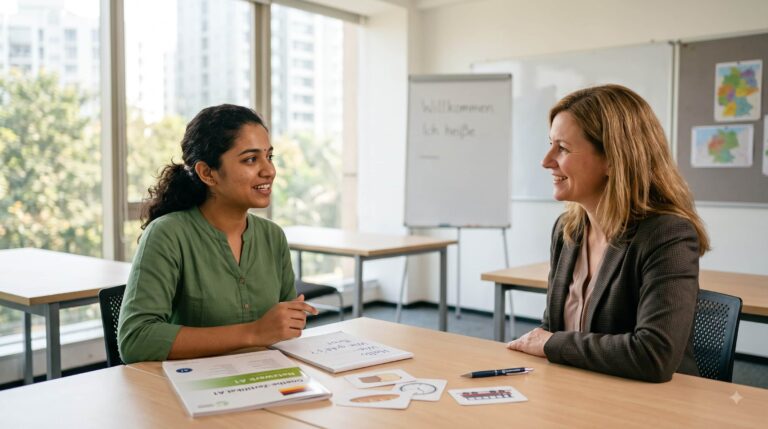
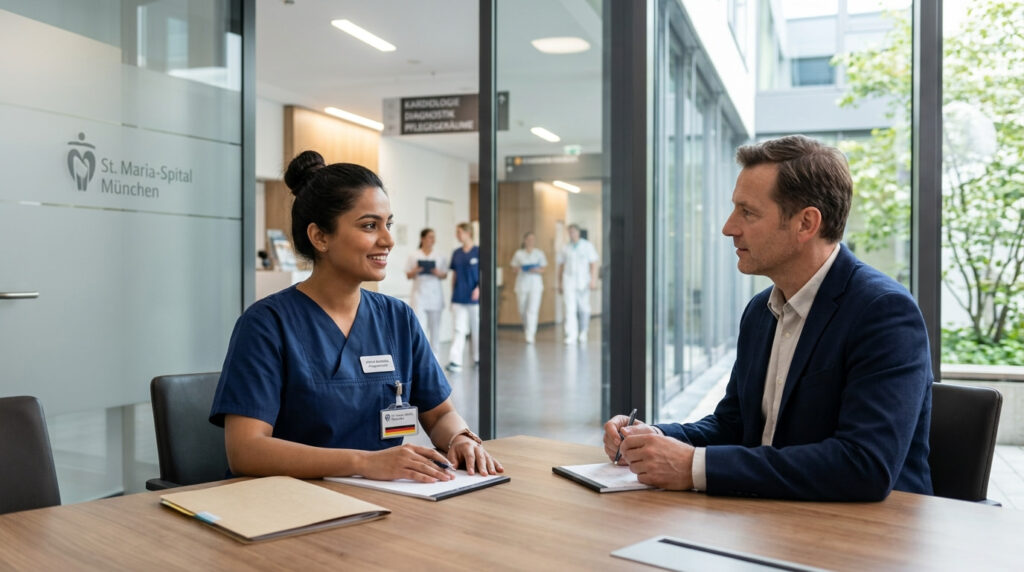
The Pflegekraft Vorstellungsgespräch is usually between two individuals, the HR manager and Pflegedienstleitung (Head of Nursing). They will already be aware that you are a foreign applicant. They have read your file. They are not sitting there waiting for perfect C1 grammar.
What they are checking is different:
- Is it possible for you to understand the question being asked and provide an answer?
- Will you endure the process of culture shock or give up after three months?
- Do you have realistic expectations concerning Schichtarbeit (working in shifts) and patient care?
- When you don’t know something, do you admit it?
German hospitals are short of staff. Seriously short. However, they have had some negative experiences with candidates who have managed to learn by heart some great answers, arrive in Germany, and leave after one season. That is why the interview is focused on testing your adaptability rather than your vocabulary size.
One piece of advice before all others. Never ever learn any robotic paragraphs. The interviewer will always know that you are reading what you have on the computer, and once the interviewer forms such an impression, he/she will ask you some spontaneous question just to confirm your knowledge. Always.
How Much German Do You Really Need in 2026?
You need functional B1/B2 German, not fluency. That is the standard across nursing in Germany requirements 2026, and it has not changed much from previous years. Most employers ask for a B2 certificate for registered nurses and B1 for Ausbildung candidates, usually from a recognized body like the Goethe Institut for German language or Telc.
Here is what B1/B2 functional level means in practice:
- You understand a question asked at normal speed, even if you miss a word or two
- You can describe your work experience in simple sentences
- You know core B1/B2 Pflege German vocabulary: medications, vital signs, handovers
- You can ask for clarification politely instead of guessing
If your language is not there yet, structured German language training for nurses fixes this faster than self-study. At Tiju’s Academy, we built our entire program around healthcare candidates, so grammar lessons, roleplays, and vocabulary all point toward one goal: getting you through this exact interview and into a German hospital. Our students in Kerala and across India join our online German-speaking classes and train with certified trainers who have taken hundreds of candidates from zero to B2. We call these trainers our Fluency Alchemists, because that is genuinely what they do. They transform beginners into confident speakers.
Your Self-Introduction (Selbstpräsentation): The 2-Minute Formula
The first question usually asked is: “Erzählen Sie uns etwas über Sie” (“Tell us something about yourself”). You must not take more than two minutes for your self-introduction. Germans value honesty, so avoid discussing your past or anything unrelated to nursing.
The four-part sequence that you must follow is as follows:
- Basic information: name, age, country of origin
- Qualifications: your nursing degree and current German level
- Experience: your clinical experience (ICU, Med-Surg, ward)
- Motivation: your motivation for being here
This is an example of a fill in the blank script that can be used:
German: “Guten Tag. Mein Name ist [Name]. Ich komme aus Indien und bin [Age] Jahre alt. Ich habe meinen Bachelor in Krankenpflege abgeschlossen und arbeite seit [Number] Jahren als Krankenschwester/Krankenpfleger. Aktuell habe ich das B2-Zertifikat in Deutsch bestanden. Ich habe mich bei Ihrem Krankenhaus beworben, weil ich meine Karriere im deutschen Gesundheitssystem weiterentwickeln möchte.”
English: “Good day. My name is [Name].” I am an Indian origin, and I am [Age] years old. I have done a bachelor’s in nursing, and I have worked for [Number] years as a nurse. I have cleared my B2 certificate in German. I have applied to your hospital since I would like to build my career in German healthcare system.”
In our Reclaim Sessions at Tiju’s Academy, students practice their introduction repeatedly in a supportive setting until the fear disappears. Confidence is a skill. It can be trained like any other.
The Most Common German Nursing Interview Questions
These three German nursing interview questions appear in almost every interview. Prepare all of them.
- Warum möchten Sie in Deutschland arbeiten? (Why Germany?)
This trap is quite clear: do not mention “because of high salary.” Everybody knows that the salary plays an important role, but putting an emphasis on it shows that you can leave at any time when offered something better.
The winning answer focuses on structure and growth:
German: “Das deutsche Gesundheitssystem ist sehr gut strukturiert. Ich schätze die Arbeitsbedingungen, die Weiterbildungsmöglichkeiten und die Work-Life-Balance in Deutschland.”
English: “Germany’s healthcare system is extremely well organized. I like the working environment, educational prospects and overall work-life balance in Germany.”
- Was sind Ihre Stärken und Schwächen? (Strengths and weaknesses?)
Stärken und Schwächen: Choose strengths that apply to nursing and one weakness that demonstrates that you are making progress:
German: “Meine Stärken sind Geduld und Teamfähigkeit. Ich bleibe in stressigen Situationen ruhig. Meine Schwäche ist, dass mein medizinisches Deutsch noch nicht perfekt ist, aber ich lerne jeden Tag, um mich zu verbessern.”
English: “My strengths are patience and teamwork. I am patient under pressure. My weakness is that my medical German is not good yet, but I am studying every day.”
This response is perfect for the situation since it is truthful, and truthfulness is highly valued by Germans.
Quick Reference: Common Interview Questions at a Glance
Keep this table at hand as you train yourself. This table explains the questions that you are most expected to get asked, their English meaning, and what the interviewer really wants to know:
| German Question | English Translation | What It Means / How to Respond |
| Stellen Sie sich bitte vor. | Please introduce yourself. | Introduce yourself and state your name, hometown, education, number of years’ experience, and departments you have been working in. Don’t exceed two minutes. |
| Warum möchten Sie in Deutschland arbeiten? | Why do you want to work in Germany? | Tell them about the organized health care structure, career development, and your commitment to your job. Never mention salary first. |
| Welche Erfahrungen haben Sie in der Pflege? | What nursing experience do you have? | Specifically, include wound care, intravenous medication administration, patient documentation, and the hospital wards in which you have worked. |
| Was sind Ihre Stärken und Schwächen? | What are your strengths and weaknesses? | Select nursing-related skills and competencies such as patience and teamwork, as well as one weakness which reflects your desire to grow. |
| Wie gehen Sie mit Stress um? | How do you handle stress? | State how you manage your priorities, remain calm, and consult your colleagues for assistance when required. |
| Sind Sie bereit für Schichtarbeit? | Are you ready for shift work? | Be fully open to it. Say that you’ve already been working in shifts at your previous workplace. |
| Haben Sie Fragen an uns? | Do you have any questions for us? | Say yes always. Inquire about the team atmosphere, patient-nurse ratio, or Einarbeitung. |
- Sind Sie bereit für Schichtarbeit? (Ready for shift work?)
German nursing runs on a strict three-shift system: Frühschicht (early), Spätschicht (late), and Nachtschicht (night). Any hesitation here can end your candidacy. Show absolute willingness:
German: “Ja, absolut. In meinem Heimatland habe ich bereits im Schichtdienst gearbeitet. Das ist für mich kein Problem.”
English: “Of course, yes. I have been on shift work in my own country before. This is no difficulty for me.”
Clinical Scenario Questions: Answering Safely Rather than Perfectionistically
Hypothetical scenarios are loved by German interviewers. Fortunately, you do not require elaborate grammar or any medical discourse at all. What they care about seeing is simply this: that you put patient safety first and that you communicate with your colleagues. Scenario 1: The Angry Patient
Question: “Ein Patient ist wütend und schreit Sie an. Was machen Sie?” (A patient is angry and yelling at you. What do you do?)
Answer: “Ich bleibe ruhig und höre dem Patienten zu. Ich versuche, das Problem zu verstehen. Wenn ich nicht helfen kann, informiere ich den Stationsarzt oder meine Kollegen.”
(I stay calm and listen to the patient. I try to understand the problem. If I cannot help, I inform the ward doctor or my colleagues.)
Scenario 2: Too Many Tasks at Once
Question: “Sie haben viele Aufgaben gleichzeitig. Wie priorisieren Sie?” (You have multiple tasks to undertake simultaneously. How do you prioritize?)
Answer: “Ich mache zuerst die Notfälle und die wichtigsten medizinischen Aufgaben, wie Medikamente geben. Danach kümmere ich mich um die Grundpflege. Ich bitte auch mein Team um Hilfe, wenn nötig.”
(I handle emergencies and the most important medical tasks first, like giving medication. Then I take care of basic care. I ask my team for help if needed.)
Notice the pattern in both answers: stay calm, act on priorities, involve the team. Short sentences, safe logic, zero panic.
Clinical Vocabulary Cheat Sheet
Drop these terms naturally during your answers. They signal real ward experience:
| German Term | English Meaning |
| Vitalzeichen messen | Taking vitals (BP, pulse, temperature) |
| Medikamente verabreichen | Administering medication |
| Die Grundpflege | Basic patient care (washing, feeding) |
| Die Übergabe | Shift handover |
| Die Patientenbetreuung | Patient care |
At Tiju’s Academy, our Collocuts sessions teach exactly this kind of colloquial and workplace German, the shortcuts and phrases nurses actually use on the ward, not just textbook sentences. It is one of the reasons our students sound natural in interviews instead of academic.
Cultural Etiquette During the Video Call
German hospital interview prep is incomplete without the cultural rules. These unspoken expectations sink more candidates than grammar mistakes do.
- Pünktlichkeit (Punctuality): Log in ten minutes prior to the meeting and wait in the lobby. It is too close to arrive precisely when you are supposed to according to German standards.
- Formal language: You must never use “Du” when addressing your interviewers. Always use “Sie” and always address them with “Herr [Last Name]” or “Frau [Last Name].”
- Appropriate dress: Professional business attire. Clean and ironed shirt or blouse. Neutral background, proper lighting, no noise around.
- Honesty over overstatement: If you do not understand the question, do not guess. Say: “Entschuldigung, könnten Sie das bitte wiederholen? Ich habe das akustisch nicht verstanden.” Asking for a repeat costs you nothing. A wrong guess costs trust.
Our off-book learning sessions at Tiju’s Academy cover exactly these cultural details. It is very important for students to be guided through real-world situations involving German work culture, since the correct usage of “Sie” and knowing when not to say anything at all is just as crucial as learning any vocabulary.
How to Prepare: Training That Actually Works
You can prepare alone with YouTube videos and flashcards. Some people manage it. But most candidates who pass on the first attempt trained with structure, feedback, and real speaking practice. That is where choosing the best online courses for German language makes the difference.
If you are searching for a German language course Kerala candidates trust or comparing German speaking classes online, here is what to look for and what we provide at Tiju’s Academy German training:
- Beginner-friendly lessons with step-by-step grammar explanations, so you never feel lost
- Real-life conversation practice like the actual interview
- Pronunciation training, because clear speech beats fast speech in an interview
- Vocabulary grouped by daily situations, including full B1/B2 Pflege German medical modules
- Listening exercises with native-style German, so the interviewer’s accent does not surprise you
- Short, structured lessons with progress tracking, so you always know where you stand
- Exam preparation aligned with the Goethe Institut syllabus, plus teacher and community support throughout
On top of the basics, we run unique techniques you will not find in a standard German language course Goethe-Institut classroom:
- Dialect Studio: Talk time with a German native speaker so your first real German conversation is not your interview.
- Germflix: German movie sessions that sharpen your listening skills while you actually enjoy yourself.
- Modmaster: Module-wise exam preparation that breaks the Goethe German language institute exams into small, crackable pieces.
- Leistung Technique: Clear tips and tricks to hit your target score in every German exam.
- Bootcamp Exam Preps: Intensive sessions before exam dates to push your score higher.
- ICT Technique: Inner Circle Training with one-on-one attention so your weak points get fixed instead of ignored.
- Infinite Drill: Fun, repeatable activities that make German stick for every type of learner.
- Stressfrei: Our promise that learning stays pressure-free. Comfort meets concentration.
- Pro App Assistance: Professional help building your CV and motivation letter, documents most candidates struggle with alone.
We believe we are the best German language institute in Kerala for nurses because everything above was built for one type of student: the healthcare professional heading to Germany. Not tourists. Not hobby learners. Nurses.
Conclusion
A hospital contract in Germany changes your life. Walking into the interview unprepared can take that opportunity away in thirty minutes. You do not have to practice alone.
At Tiju’s Academy, our expert trainers conduct rigorous, realistic mock interviews built specifically for the German healthcare sector. We correct your pronunciation, refine your Selbstpräsentation, drill your scenario answers, and build your confidence until no question can shake you. Thousands of nurses have started their journey with our online German speaking classes, and your interview can be the next success story.
Book your personalized mock interview session on our German Interview Preparation and Coaching page today. Your German career is one well-prepared conversation away.
Frequently Asked Questions:
A: Most interviews run 30 to 60 minutes as a video call. Usually two people attend, the HR manager and the Pflegedienstleitung. A Pflegekraft Vorstellungsgespräch tests your language ability and cultural fit more than your clinical knowledge.
A: Registered nurses applying for Anerkennung usually need B2, while Ausbildung nursing interview candidates often need B1. Under nursing in Germany requirements 2026, most hospitals accept certificates from the Goethe Institut for German language or telc.
A: The structure is similar, but expectations are lower on clinical experience and language. B1 is often enough for an Ausbildung nursing interview, and your motivation plus willingness to learn matter more than your years on the ward.
A: Never guess. Say: "Entschuldigung, können Sie das bitte wiederholen? Ich habe das akustisch nicht verstanden." German interviewers value honesty far more than a confident wrong answer. Asking for a repeat costs nothing, but guessing costs their trust.
A: Tiju's Academy German training is built only for healthcare candidates, which is why we call ourselves the best German language institute in Kerala for nurses. Students across India join our online German-speaking classes for medical vocabulary, roleplays, and mock interviews.
A: Yes, when they include speaking practice and feedback. The best online courses for German language combine grammar, pronunciation training, and real conversation. Our german speaking classes online add Dialect Studio talk time with native speakers so your first real conversation is not the interview.
A: Use ward terms naturally: Vitalzeichen messen, Medikamente verabreichen, die Grundpflege, die Übergabe, and Patientenbetreuung. These words signal genuine experience as a Krankenschwester or Krankenpfleger and make your answers sound practical rather than textbook.