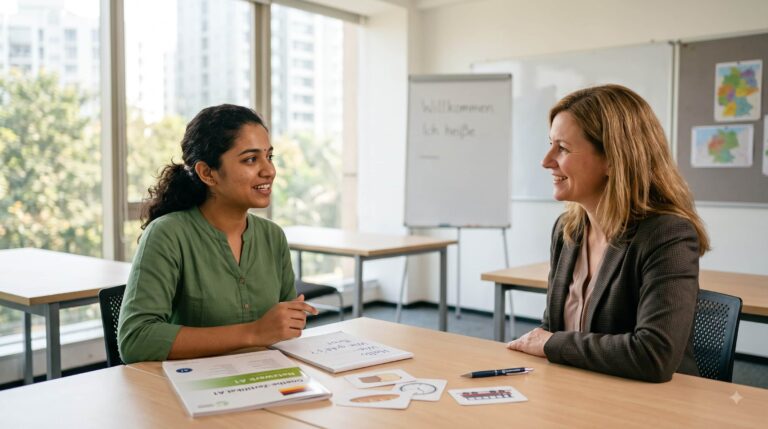
Ausbildung in Germany is a paid program of professional education provided by Germany. You acquire professional skills through work experience at a company and vocational learning in a vocational school at the same time. In other words, what is Ausbildung in Germany in simple language? The answer is that it is a 2 to 3.5-year training period, during which you get monthly wages, gain practical experience, and receive an officially recognized qualification.
Moreover, foreign students can enroll in it. Ausbildung for international students is completely legitimate, and the country encourages foreign trainees since many branches lack skilled employees. Ausbildung in Germany for Indian students is becoming more and more popular in such spheres as nursing, tourism, and mechanical professions.
This guide will help you learn more about this training process, its requirements, age limit, visa requirements, salary, and all the other details.
What Is Ausbildung?
Ausbildung (official name: Berufsausbildung) is a training course that helps you to prepare for a certain profession. The majority of the training courses use the system called dual vocational training in Germany, duale Ausbildung. It includes two places where you are trained:
- The company (Betrieb): you spend 3-4 days per week and get practice.
- The vocational school (Berufsschule): you spend 1-2 days per week or several weeks continuously and study theoretical subjects.
A trainee is an Azubi. Having received an opportunity to enter a training course (Ausbildungsplatz), you sign a training contract (Ausbildungsvertrag) with your employer. This contract determines your working schedule, number of days off, and salary per month.
Here are the main details about it:
- Duration: 3 years as a rule, although sometimes there are courses that last 2 or 3.5 years.
- The number of professions: about 320 officially acknowledged training occupations.
- The final exam: conducted by official bodies such as the IHK (Chamber of Industry and Commerce) or HWK (Chamber of Crafts).
- Cost: Dual Ausbildung is free. You do not pay tuition, and you get paid.
There is also a second type called schulische Ausbildung. It is a type of on-the-job training offered through schools and is common for disciplines such as physiotherapy and a few other health and design-related professions. For most international applicants, dual training is the better choice because it is paid vocational training Germany offers with a clear job route.
Is Ausbildung Free in Germany?
Yes, a dual Ausbildung is free. You do not pay any tuition fees, while your company pays you training allowances every month. Some school-based training programs offered in private schools incur costs.
How Much Do Ausbildung Students Earn per Month?
In German, the Ausbildung salary in Germany is referred to as the Ausbildungsvergütung, and it increases every year during the period of apprenticeship. On average, most apprentices are paid between €1,000 and €1,300 monthly.
- Apprentices in nursing and public sector professions receive some of the highest allowances.
- Technical professions such as mechatronics and electrician earn well.
- Hospitality, bakery, and retail receive lower salaries in the first year.
- Germany has a legal minimum training allowance, so no dual trainee works for free.
Just remember that you have to deduct taxes and social insurance, so your net pay will be slightly reduced.
Is There an Age Limit for Ausbildung in Germany?
There is no legal upper age limit for Ausbildung itself. Adults in their 20s, 30s, and even 40s do vocational training in Germany. However, the Ausbildung age limit Germany matters more for visas than for the training itself.
Here is what you should know:
- To start an Ausbildung with a signed contract: No official maximum age applies.
- For the visa to search for a training position in Germany: You must normally be less than 35 years old.
- Preferring age: Companies often prefer young trainees; however, shortage sectors like nursing and elderly care are very flexible about accepting older candidates.
Can I do Ausbildung at 30 or 35?
Certainly, you can. There are plenty of examples of people starting their Ausbildung when they are 30 or 35 years old, usually career shifters. You should choose a profession with good labor market demand, including such areas as nursing, senior care, logistics, hospitality, etc. It is crucial to have excellent language skills and an impressive motivation letter.
For German and EU Citizens
Both German and EU citizens can apply for an Ausbildung without a visa or work permit. Thanks to free movement within the EU, they only need to find a training place and sign the contract.
This is important to understand because non-EU applicants, including Indian students, face a few extra steps:
- If you want vocational training, you need to have a visa or residence permit
- Proof of German language skills
- Proof that they can support themselves financially
- Recognition checks on their school certificates in some cases
The good news is that these steps are clear and manageable with the right planning.
Does Your Existing Degree Affect Ausbildung?
Your existing degree does not stop you from doing an Ausbildung. In fact, many graduates choose this path to enter the German job market faster. Ausbildung in Germany eligibility mainly depends on your school education, language level, and the employer’s requirements.
Can I Do Ausbildung After a Bachelor’s Degree?
Yes, Ausbildung after graduating from university is entirely possible. Here are some things to remember:
- No formal recognition (Anerkennung) of your diploma is needed to enroll in an Ausbildung.
- A related degree can sometimes shorten your training period.
- You need to give reasons in your application why you would like to undergo vocational training following your degree. Employers will look for signs of your commitment.
- Graduates whose degrees are in unrelated fields opt for nursing, IT, or hospitality.
Ausbildung After 12th
Ausbildung after 12th is one of the most searched options among Indian students, and for good reason. The 12th pass certificate is normally enough for most courses, such as nursing. Marks in courses like English, science, and mathematics could be important for some specific professions.
There are some good things about starting after 12th, such as:
- You start earning at a young age.
- You meet visa age conditions comfortably.
- You finish with a German qualification in about 3 years.
- You have more time to build a long-term career in Germany.
Which Ausbildung Programmes Are Most Open to International Adults?
The programmes most open to international applicants are those in sectors facing a skilled worker shortage. These employers actively look abroad and are more flexible about age and background. So, can international students apply for Ausbildung in any field? Technically, yes, but some fields are far easier to enter.
These are the most required Ausbildung jobs in Germany:
- Pflegefachmann / Pflegefachfrau (Nursing): Most favored by Indians because of high demand and high salaries.
- Elderly care (Altenpflege): Very open to international trainees and career changers.
- Hospitality and hotel management: Hotel specialist and restaurant roles are in steady demand.
- IT specialist (Fachinformatiker): Good for students with a tech interest.
- Mechatronics and electrician: Strong demand in industry and construction.
- Logistics: Warehouse and logistics specialists are needed across Germany.
- Bakery and culinary: Bakers and chefs are regularly sought after.
- Retail: Sales roles are open, though language requirements are high because you speak with customers daily.
Nursing Ausbildung in Germany
Austria’s nursing education program has also gained prominence. This program takes three years to complete and qualifies you as a general nurse (Pflegefachmann or Pflegefachfrau), including hospitals, geriatrics, and pediatrics. Upon completion, you will be a qualified nurse in Germany. There is a high number of Kerala candidates who prefer this option due to the security it provides.
Which Ausbildung Is Best for International Students?
The best Ausbildung for international students is usually nursing, elderly care, hospitality, or a technical trade. These fields have the most vacancies, accept a range of ages, and offer a strong chance of a job after training. Choose based on your interest, since you will spend 3 years in this field.
Visa and Legal Eligibility for International Students
For students who come from countries other than those in the European Union, they have to get a vocational training visa in order for them to be able to enroll in an Ausbildung program in Germany. The visa is issued according to §16a AufenthG of the Residence Act.
Ausbildung Visa Requirements
The main Ausbildung visa requirements are:
- A signed training contract (Ausbildungsvertrag) with a German employer
- German language certificate, usually at B1 level
- Proof of financial support, if your training allowance does not cover living costs (often shown with a blocked account)
- Valid passport and school certificates
- Health insurance coverage
- Approval from the Federal Employment Agency
Visa for Seeking a Training Place
If you do not have a contract yet, you can apply for a visa to seek a training place. This allows you stay in Germany for a time duration of 9 months to find an Ausbildung. The usual conditions are:
- You must be under 35.
- You need German at B1 level.
- A certificate proving you have finished high school and you qualify for higher education.
- Demonstrate the ability to support yourself while in Germany.
Yet another alternative is the Chancenkarte (opportunity card), which is a points system visa for job seekers. Nevertheless, for the majority of younger applicants, the training visa would be the easier route.
What German Level Is Required for Ausbildung?
German language level required for Ausbildung is generally B1. In some disciplines, including nursing and customer-service jobs, a B2 level of German is preferred. Valid certificates may be Goethe-Zertifikat B1 or B2, telc, and ÖSD. The German language is the most difficult barrier, and hence, it is advisable to learn early.
Is IELTS Required for Ausbildung?
No, the IELTS test is not necessary for the Ausbildung program. The training takes place in German, hence the need to take a German certificate instead of the English one.
Can I Bring My Family on an Ausbildung Visa?
It is theoretically possible to bring your family along, but it is quite challenging because you must show that you have sufficient earnings and adequate housing for your family. Due to the fact that the training allowance is low, trainees generally bring their families once they complete their training.
Can I Work Part-Time During Ausbildung?
In many cases, trainees can take a side job of up to 20 hours a week, as long as it does not affect the training. Always check with your employer and local immigration office first.
Why Germany Built the Dual Ausbildung System?
Germany built the dual Ausbildung system to create a steady supply of skilled workers trained for real industry needs. The model grew out of the old craft guild tradition, where young people learned a trade under a master. It became formal law with the Vocational Training Act of 1969.
The system works well for everyone:
- Employers provide training to workers in exactly the manner required.
- Trainees get paid while they learn and are likely offered jobs after training.
- The economy reaps the rewards of a trained workforce.
Currently, there is a severe lack of skilled workers or Fachkräfte in Germany. This is the reason why Germany today accepts vocational training in Germany for foreigners.
Can I Get PR After Ausbildung in Germany?
Yes, Ausbildung can result in permanent residence. After completing your apprenticeship program, you will be able to obtain a residence permit to search for employment within 12 months. Then, when you are employed as a qualified worker, you can apply for permanent residence in Germany after some years, provided you fulfill certain requirements such as payment into the pension fund and knowledge of the German language. This path is easier compared to the EU Blue Card program, which demands a university degree and high pay.
Is Ausbildung Better Than a University Degree in Germany?
It depends on your goals. Ausbildung is better if you want to earn from day one, avoid living costs piling up, and get a job quickly. A university degree suits people aiming for research or academic careers. For a lot of Indians, the easiest path to living a secure life in Germany would be through Ausbildung.
How to Begin Your Preparation?
The best way to begin would be learning German, choosing your field, and making an impressive application. Here’s a straightforward plan on how you can go about applying for Ausbildung from India:
Choose your field. Pick an Ausbildung that matches your interest and has good demand.
- Learn German to B1 or B2. This is the most important step. Start early, since it takes several months.
- Collect your documents. Get your 10th and 12th certificates, degree (if any), passport, and translations ready.
- Compose your CV and motivation letter. There is an expected format for German employers.
- Submit your applications to the potential employers. Look for them through online job sites, company websites, or agencies.
- Have your interview. It will be conducted online and in German.
- Sign the contract and apply for your visa. Schedule your appointment at the German embassy or consulate.
Language is where most applicants get stuck. This is where proper Tiju’s Academy German training can make your journey smoother.
How Tiju’s Academy Helps You Prepare for Ausbildung?
Tiju’s Academy is known as the best German language institute in Kerala for students planning to study, train, or work in Germany. Our Tiju’s Academy German courses are designed to take you from zero to B1 or B2 with confidence. We offer both classroom and German language training online, so you can learn from anywhere.
What makes our programme the best course to learn German for Ausbildung aspirants:
- Beginner-friendly German lessons
- Step-by-step grammar explanations
- Real-life conversation practice
- Pronunciation training
- Vocabulary grouped by daily situations
- Listening exercises with native-style German
- Speaking practice and roleplays
- Cultural tips and etiquette
- Short, structured lessons
- Progress tracking with clear milestones
- Complete exam preparation
- Support from teachers and a friendly learner community
We also use a set of signature methods that you won’t find elsewhere:
- Dialect Studio: Talk time with a native German speaker, so you get used to real accents before your interview.
- Collocuts: Colloquial German shortcuts that help you understand everyday speech at work.
- Off Book Learning: Authentic German culture sessions by experts, which help you settle into workplace life.
- Germflix: German movie time to sharpen your listening skills in a fun way.
- Infinite Drill: Enjoyable activities that make learning easy for every kind of learner.
- Reclaim Sessions: Confidence-building sessions so you can speak without fear.
- ICT Technique (Inner Circle Training): One-on-one attention that targets your weak points.
- Fluency Alchemists: Our certified trainers who transform complete beginners into confident speakers.
For the exam stage, our Modmaster (Module Mastery) approach prepares you module by module, while the Leistung Technique gives you clear tips and tricks to hit your target score. Before exam day, our Bootcamp Exam Preps offer intensive practice for the Goethe, TELC, and ÖSD exams. And throughout your course, Stressfrei makes our academy a stress-free zone where comfort meets concentration.
Finally, many students find writing a German CV and motivation letter very hard. Our Pro App Assistance (Professional Application Assistance) trains you to create your own professional application, so you can apply to employers with confidence.
Conclusion
An Ausbildung is one of the smartest ways to build a career in Germany. It is free, it pays you a monthly salary, and it gives you a respected qualification with strong job prospects. International students, including Indian students, can apply as long as they meet the language, visa, and document requirements.
Your biggest step is learning German. With the right training, the rest of the journey becomes far easier.
Ready to begin? Join the best German course at Tiju’s Academy, available in Kerala and online. Message us on WhatsApp to book a free demo class and take your first step toward an Ausbildung in Germany.
Frequently Asked Questions:
A: Ausbildung is a paid vocational training programme in Germany. You learn a profession by working at a company and studying at a vocational school at the same time. It usually lasts 2 to 3.5 years and ends with an officially recognized qualification.
A: Yes, international students can apply for Ausbildung in Germany. Non-EU applicants need a signed training contract, German language skills at the B1 level, proof of financial support, and a vocational training visa under Section 16a of the Residence Act.
A: Yes, dual Ausbildung in Germany is free. You pay no tuition fees, and your employer pays you a monthly training allowance. Only some school-based training programmes at private schools charge fees.
A: Most Ausbildung students earn between €1,000 and €1,300 per month on average. The allowance increases each year of training. Nursing and public sector roles pay among the highest, while hospitality, bakery, and retail pay less in the first year.
A: No, there is no legal upper age limit for Ausbildung in Germany. However, the visa to search for a training place in Germany is usually only for applicants under 35. Shortage sectors like nursing and elderly care readily accept older candidates.
A: Yes, you can start an Ausbildung at 30 or 35. Many career changers do. Your chances are best in high-demand fields like nursing, elderly care, logistics, and hospitality, supported by strong German skills and a convincing motivation letter.
A: Yes, you can do Ausbildung after a bachelor's degree. You do not need formal recognition of your degree to enroll, and a related degree may shorten your training. You should explain clearly in your application why you want vocational training.
A: Yes, a 12th pass certificate is generally enough for most Ausbildung programmes, including nursing. Starting after 12th lets you earn at a young age, meet visa age conditions easily, and gain a German qualification in about 3 years.
A: Most Ausbildung programmes require German at B1 level. Nursing and customer-facing jobs often prefer B2. Accepted certificates include Goethe-Zertifikat B1 or B2, telc, and ÖSD.
A: No, IELTS is not required for Ausbildung. The training is conducted in German, so employers and visa offices ask for a German language certificate instead of an English one.
A: Nursing, elderly care, hospitality, and technical trades are the best Ausbildung options for international students. These fields have the most vacancies, accept a wide range of ages, and offer strong job chances after training.
A: Ausbildung in Germany usually lasts 3 years. Some programmes take 2 years, and certain technical programmes take 3.5 years. A related degree can sometimes shorten the training period.
A: The main Ausbildung visa requirements are a signed training contract, a German certificate usually at B1 level, proof of financial support, a valid passport, school certificates, health insurance, and approval from the Federal Employment Agency.
A: Bringing your family on an Ausbildung visa is possible but difficult. You must prove enough income and suitable housing. Since training allowances are modest, most trainees bring their families after finishing training and starting a full-time job.
A: Yes, Ausbildung can lead to permanent residence in Germany. After training, you get up to 12 months to find a job. Once you work as a skilled worker, you can apply for PR after a few years if you meet conditions like pension contributions and German skills.
A: Ausbildung is better if you want to earn from day one and get a job quickly. A university degree suits research or academic careers. For many Indian students, Ausbildung is the faster and more affordable path to a secure life in Germany.
A: Start by learning German to B1 or B2 level. Tiju's Academy offers German courses in Kerala and online, with exam preparation for Goethe, TELC, and ÖSD, plus Pro App Assistance to help you write a professional German CV and motivation letter.