Nearly every best German app article you will find online is written by a company that sells a German app. They review the field and then, remarkably, conclude that their own product wins. This review is different because we teach German in a classroom and do not sell an app. So here is an honest look at the best apps to learn German in 2026, what each one does well, and the thing almost none of these reviews will tell you.
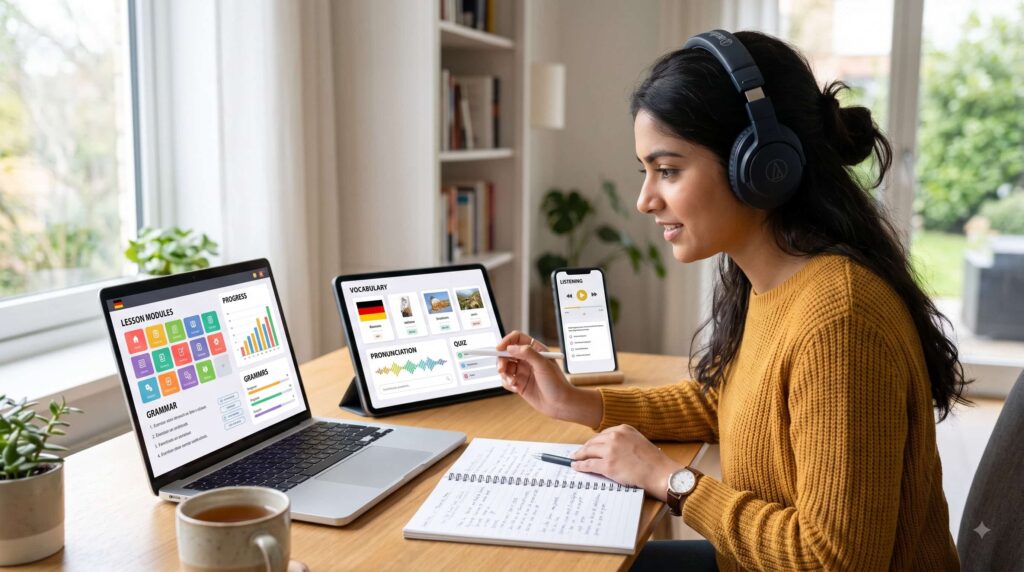
That thing is simple. German learning apps are excellent support tools. They are not a plan. Nobody has ever been handed a Goethe certificate by an app, and the students who pass are the ones who combine daily app practice with proper guidance and correction. This is where Tijus Academy, the best German training institute, plays a major role.
| App | Cost | Best for | Weakness |
| Duolingo | Free tier, Super around 12.99 dollars a month | Building a daily habit | Thin grammar, little speaking |
| Babbel | Around 9 to 18 dollars a month | Structured grammar | No free tier, tops out near B1 |
| Busuu | Premium around 70 dollars a year | CEFR-aligned course, native corrections | Free plan is a short demo |
| Nicos Weg (DW) | Completely free | A structured A1 to B1 course | No personalised feedback |
| Anki | Free on desktop and Android | Vocabulary retention | Setup takes effort |
| Pimsleur | Subscription | Audio learning while commuting | Skips reading and writing |
| Seedlang | Around 60 dollars a year | Real spoken German | Best from A2 upward |
What Makes a Great German Learning App?
The best German apps are explicit about teaching grammar, adhere to the CEFR level system, require production of the German language, not just recognition, and provide feedback. Most apps are great at some of these and simply ignore the rest.
Look for these criteria in apps:
- CEFR-aligned content, so you know whether you are working at A1, A2, or B1
- Grammar rules explained explicitly and not through pattern recognition alone
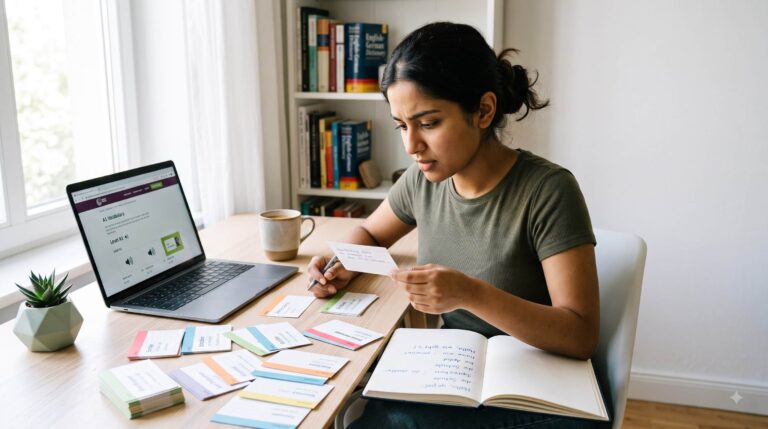
- Spaced Repetition System (SRS) to learn new vocabulary
- Active recall, whereby you are required to retrieve the word and not select it from four options
- Speech recognition or pronunciation feedback of some kind
- Offline access, which matters on a commute or with limited data
- Honest free tier, not a two-lesson demo
- Nouns taught with their article, since der, die, and das decide everything later
That last point is the quickest way to judge a German app. If it teaches you Haus instead of das Haus, walk away.
Top German Learning Apps: Detailed Reviews
- Duolingo
Useful for: true beginners and forming habits.
Duolingo is a free language learning platform that is actually fun enough to motivate you to use the app daily. For your first few weeks of German, it gives you momentum and a few hundred words.
- Strengths: free tier, short lessons, strong motivation, huge community
- Realistic ceiling: strong A1, shaky A2
Is Duolingo enough for German? For vocabulary and routine, yes. For German cases, adjective endings and word order, no. Most serious learners add something else within two or three months.
We borrow the good part of gamification without the shallowness. The Infinite drills follow the same principle of repetition but with a trainer there, which means that any errors you make will be corrected and not repeated.
- Babbel
Most suitable for: learners who want clear-cut textbooks.
Babbel is the more serious of the two big ones for Germans. It explains grammar rules directly, includes review sessions targeting your weak spots, and progresses in a clear order.
- Strengths: explicit grammar, practical dialogues, sensible lesson structure
- Cost: about 17.95 dollars per month; or 9 dollars per month on an annual contract
If you are deciding between Duolingo and Babbel for learning German, Babbel takes the lead in grammar lessons, while Duolingo does the same with cost and fun. The truth is that grammar is where people fail at learning German.
- Busuu
Suitable for: those wanting both syllabus and feedback.
Busuu divides German into well-structured CEFR-based courses from A1 to B2 and includes a community service through which native speakers correct your writings.
- Advantages: good course structure, native speaker corrections, study plan service
- Cost: Premium costs about 70 dollars per year
- Memrise
Suitable for: vocabulary practice with native speakers.
Memrise is based on spaced repetition and includes video recordings of authentic sentences pronounced by actual Germans. Useful for ear training and common phrases.
- Advantages: authentic audio recordings, mnemonics, useful phrases
- Pimsleur
Suitable for: commuters and pronunciation practice.
Pimsleur is an audio course that starts making you speak immediately starting from the first lesson. Ideal for making use of dead time on the way to work.
- Advantages: pronunciation training, listening and speaking practice starting from day one
- Comment: useless alone for written exam
- Rosetta Stone
Good for: people who like the immersion approach.
Rosetta Stone teaches German through images and context, without translation. This works well for some people but very slowly for many, especially considering that it’s a case language.
Best Free Apps to Learn German
You can reach a solid A2 without paying anything. These are the free tools worth your time.
- Nicos Weg (DW Learn German)
Is Nicos Weg free? Yes, completely. Deutsche Welle built it as a public broadcaster, so there is no paywall and no trial.
It follows a story with video, exercises and realistic situations, covering A1 to B1. It is the strongest free structured German course available anywhere, and better than most paid apps for content quality.
- Strengths: full course structure, video-based, authentic situations, no cost
- Anki
Free on desktop and Android, paid on iOS. Anki is the serious learner’s flashcard tool, using proper adaptive spaced repetition.
- Strengths: unbeatable for long-term vocabulary retention, fully customizable
Tip: always put the article in your card. Write “das Haus,” never “Haus.”
Goethe-Institut free exercises
The Goethe-Institut provides over 260 free exercises ranging from A1 to C2, as well as practice tests. In preparation for your Goethe Zertifikat, come here first to get a feel for the real test format without buying anything else.
- DeutschAkademie
Over 25,000 free grammar exercises. Not very attractive looking, but very useful for learning articles, case endings, and separable verbs.
- Seedlang
Built specifically for German, connected to the Easy German team. Lessons are short videos of real people speaking naturally. About a third of the content is free, with Pro at roughly 60 dollars a year.
Best from A2 upward, once you can follow most of a clip.
Specialized German Learning Apps
General apps cover everything shallowly. These do one job properly.
- For grammar: DeutschAkademie, Grammatikly and Der, Die, Das. German grammar is conducive to problem-solving, not scrolling. This is precisely what goes on in our Albert Einstein’s sessions, in which students solve case and word order exercises until they understand the logic.
- For vocabulary: Anki, Quizlet and Clozemaster. Clozemaster is useful when you already know approximately a thousand words, because it practices words in full sentences.
- For practice in speaking: Tandem and HelloTalk provide language exchange with native speakers. These apps are good and free, but the problem is that they provide you with random and informal conversations that usually go nowhere. In our Dialect Studio, students have structured speaking sessions with a native speaker of German.
- For listening: Easy German on YouTube, the Slow German podcast and Seedlang. Listening is where most learners are weakest, because reading hundertfünfundsechzig is easy and hearing it is not. Our Germflix sessions use German films for the same purpose, with a trainer pausing to explain what you missed.
- For dictionaries: Linguee, dict.cc and DeepL. Linguee is better than a plain dictionary because it shows words inside real sentences.
- For everyday spoken German: no app really covers this well. Apps teach textbook German, and Germans do not speak textbook German. That gap is what our Collocuts sessions fill, collecting the colloquial shortcuts that make you sound natural rather than correct but odd.
- For culture: the Ankommen app from the German federal migration office is free and practical. Culture questions also come up constantly in exam speaking tasks, which is why our Off book learning sessions cover authentic German customs, festivals and etiquette with expert trainers.
Apps for Goethe Exam Preparation
Several apps now target the Goethe exams directly, including Migii Goethe, Prep Goethe and GPP Goethe Prep. They offer exam-style questions, level-tagged content from A1 to C1, and exam simulator-style mock tests.
They are useful for one thing: getting familiar with the question format. What they cannot do is mark your writing or assess your speaking, which are the two modules where candidates actually lose their score.
- Reading and listening: apps can help you practise
- Writing: needs a human to correct it
- Speaking: needs a human to talk to
This is why our Modmaster approach teaches one exam module at a time rather than everything at once, and why Bootcamp exam preps run intensive sessions on the parts that decide your result as the exam date approaches. Leistung method then offers students practical techniques on how to reach their target score, which is different from just understanding the German language.
Can You Learn German With an App Alone?
You can reach roughly A2 with an app alone, and some disciplined learners get near B1. You cannot reliably pass a Goethe, ÖSD, or Telc exam that way, because two of the four modules need a human.
Here is what apps are genuinely good at:
- Vocabulary building and retention
- Daily habit and consistency
- Reading practice
- Listening at a beginner level
- Learning at your own pace, offline, on a commute
And here is what they cannot do:
- Correct the specific mistakes you personally keep making
- Hold a real conversation that goes off script
- Mark your written letter or email against exam criteria
- Explain why your sentence is wrong when you cannot see it
- Push you when your motivation drops in month three
- Prepare a CV or motivation letter for a German employer or university
That first point matters most. In a group class or an app, small errors survive because nobody notices them. Our ICT technique, or inner circle training, exists for that reason, giving each student one-to-one attention on their own weak points so the same mistake is not repeated for six months.
The intermediate plateau is the classic app problem. Learners arrive at our door after a year of streaks, able to recognize German easily but unable to produce it under pressure. They know the words and freeze when a person is standing in front of them. That gap is not a knowledge problem. It is a practice problem, and it needs speaking with correction. Our Reclaim sessions are built for exactly this, rebuilding confidence until students speak without fear of being wrong.
Our trainers are certified and experienced, and we call them Fluency alchemists because their job is taking students from zero to speaking properly, which is the part most people believe is impossible for them.
The Best App Combinations
No single app wins. Pick two or three that cover different gaps.
- The free stack (cost: nothing)
- Nicos Weg for structure
- Anki for vocabulary
- Easy German on YouTube for listening
- Goethe-Institut free exercises before the exam
- The busy professional stack
- Pimsleur during your commute
- Babbel for grammar in the evening
- Anki for ten minutes of vocabulary
- The exam stack
- Babbel or Busuu as the main course
- A Goethe prep app for question format
- Official Goethe practice tests
- Classroom sessions for writing and speaking, which no app covers
- The plateau breaker
- Seedlang for real spoken German
- Clozemaster for words in context
- Weekly speaking practice with a trainer
How to Use Apps Alongside a Proper Course?
- The good students treat these apps as homework, not the class itself. Here is how a sensible schedule would be arranged:
- 15 to 20 minutes per day using the app vocabulary
- Class sessions for grammar explanation, speaking and correction
- App listening practice on your commute
- Written work corrected by a trainer weekly
- Mock tests under timed conditions before the exam
The order matters. Learn a grammar point properly in class, then drill it in the app. Doing it the other way round means drilling something you half understood.
Anxiety is the quiet factor nobody plans for. Students who feel judged stop speaking, and students who stop speaking stop improving. We keep our classroom a stress-free space where comfort meets concentration, because a relaxed learner asks the question that fixes the mistake.
Learning German in Kerala
Most people learning German here have a deadline and a purpose. Nurses need German B1 for Ausbildung and hospital placements. Students need A1 or A2 for university admission and visa paperwork. An app will help you revise. It will not sign your certificate.
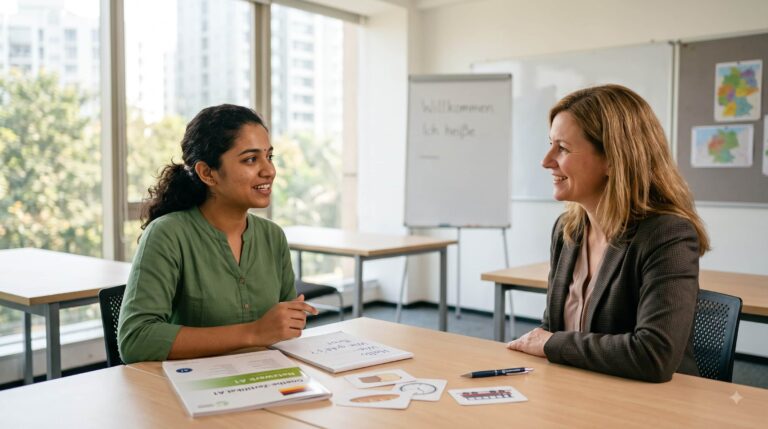
Tiju’s Academy German training is built for that reality. We provide the best course to learn German in the region, running from A1 to C1 with preparation for the Goethe, ÖSD and telc exams, at our Thiruvalla and Mavelikara branches and through German language training online for students who cannot travel.
What Tiju’s Academy German Courses Include:
- Beginner-friendly lessons that assume no prior knowledge
- Step-by-step grammar explanations taught in stages
- Real-life conversation practice in every session
- Pronunciation training from the first week
- Vocabulary grouped by daily situations such as shopping, appointments and travel
- Listening exercises using native-style German
- Speaking practice and roleplays
- Cultural tips and etiquette for life in Germany
- Short, structured lessons with clear milestones and progress tracking
- Ongoing support from trainers and a student community
We also run Pro App Assistance sessions, where students learn to write their own professional CV and motivation letter for German admissions and job applications. No language app on this list does that, and it is often the document that decides whether an application moves forward.
Students from across Kerala and the Gulf train with us, which is why we are known as the best German language institute in Kerala.
Start With One App and a Plan
Download Nicos Weg tonight, because it is free, and it is genuinely the best structured course you can get without paying. Add Anki for vocabulary. Then be honest about the gap, which is speaking and written correction, and fill it with a real course.
An app plus a plan beats an app alone every time. If you want that plan, our next batch at Tiju’s Academy German training is open, and we run a free beginner German course for anyone starting at zero. Message us and we will suggest the right level for you.
Frequently Asked Questions:
A: For vocabulary and building a daily habit, yes. For German cases, adjective endings, and word order, no. Its realistic ceiling is strong A1 and shaky A2, and most serious learners add something else within two or three months.
A: Yes, completely. Deutsche Welle built it as a public broadcaster, so there's no paywall and no trial. It follows a story with video, exercises, and realistic situations from A1 to B1, and it's arguably the strongest free structured German course anywhere better than most paid apps for content quality.
A: Babbel takes the lead on grammar: it explains rules directly, reviews your weak spots, and progresses in a clear order. Duolingo wins on cost and fun. Since grammar is where most people actually fail at German, Babbel is the stronger pick for structured learning.
A: You can reach a solid A2 without paying anything. The tools worth your time are Nicos Weg (DW) for structure, Anki for vocabulary, the Goethe-Institut's free exercises before an exam, and DeutschAkademie's 25,000+ grammar exercises for articles and case endings.
A: The quickest test: check whether it teaches nouns with their article. If it gives you "Haus" instead of "das Haus," walk away, because der, die, and das decide everything later. Beyond that, look for CEFR-aligned levels, grammar explained explicitly, spaced repetition, active recall (retrieving a word, not picking from four options), pronunciation feedback, offline access, and an honest free tier.
A: That's the classic intermediate plateau. You can recognise German easily but can't produce it under pressure, you know the words and freeze when a person is standing in front of you. It isn't a knowledge problem, it's a practice problem, and it needs speaking with correction.