Why German has three genders? The reason for the existence of three genders in German is that these gender categories have been retained in German from its old form; English has lost gender gradually. All nouns in the German language belong to one of the gender groups and can be identified based on the use of “der, die, das.” However, there are some rules for German noun genders.
How to memorise German genders easily? You do not have to remember all of the nouns randomly. Thanks to some rules, proper memorisation techniques, and constant practice, ‘der’, ‘die’, and ‘das’ will become your best friends.
This article reveals the origins of the genders, the working rules, the most popular exceptions, and memorisation techniques.
Why German Noun Gender Is Hard?
Gender classification of German nouns is problematic, as it is grammatically based, rather than logical. In most instances, there is no connection between gender and the distinction between an object and the living entity of either sex. Therefore, the gender of a table is masculine, that of a newspaper is feminine, and that of a girl is neuter.
Grammatical Gender vs Natural Gender
Gender in German grammar is a classification of words, but not a reflection of the truth of life. The natural gender reflects male and female individuals. Sometimes both coincide (der Mann, die Frau), but often times not.
Take an example of well-known objects found in the kitchen:
- der Löffel (the spoon): masculine gender
- die Gabel (the fork): feminine gender
- das Messer (the knife): neuter gender
Three objects, sitting on the same table, but all three have different genders. There is nothing of the meaning “male or female.”
Why Is “Das Mädchen” Neuter?
The word “das Mädchen” is neuter because of the ending “-chen.” This ending means that the noun is little and cute. All nouns ending in “-chen” are neuter. The noun “Mädchen” comes from an old noun that meant a young woman with the ending “-chen.”
So, from just one example, we can say that in German, gender depends on the ending of the noun.
Why Does German Have Three Genders?
German genders were adopted from Proto-Indo-European, the language that forms the basis of many languages in Europe and India. Old High German, Latin, and even Old English had grammatical genders.
Then why don’t we have them in English? As part of language evolution through the ages, English lost almost all of its affixes, including genders. German still has affixes, thus keeping its genders. What’s fascinating is that people who speak Hindi and Malayalam already have some kind of an idea about grammatical gender.
The Extra Challenge: Articles Change With Case
Gender itself would not be too difficult, but German articles can also vary depending upon the function of the noun within the sentence. This is known as declension, and there are four cases, which include nominative, accusative, dative, and genitive. Thus, “der” becomes “den,” “dem,” and “des.”
This is why it is very important to learn the right gender right from the start. Once you have learnt the gender, the rest follows easily.
The Three Genders: Der, Die, Das
German has three German definite articles, one for each gender. This is the heart of masculine feminine neuter German:
- der for masculine nouns (maskulin): der Tisch (table), der Mond (moon)
- die for feminine nouns (feminine): die Zeitung (newspaper), die Sonne (sun)
- das for neuter nouns (neutral): das Kind (child), das Auto (car)
German also has indefinite articles, meaning “a” or “an”:
- ein for masculine and neuter nouns: ein Tisch, ein Kind
- eine for feminine nouns: eine Zeitung
Why Is the Plural Always “Die” in German?
In relation to the nominative case, there isn’t really anything one needs to worry about in respect to plurality. This is because no matter what the gender of the noun is, the form will always remain the same, which is ‘die.’ For example, ‘der Tisch’ becomes ‘die Tische’ while ‘das Kind’ changes to ‘die Kinder.’
German Articles Chart
Below is a straightforward table of the German articles showing how the definite articles vary with the four cases:
| Case | Masculine | Feminine | Neuter | Plural |
| Nominative | der | die | das | die |
| Accusative | den | die | das | die |
| Dative | dem | der | dem | den |
| Genitive | des | der | des | der |
Don’t try to memorise this whole table in one day. For German articles for beginners, start with the nominative row. The other cases come naturally at the CEFR A1 and A2 levels.
This is what we do in our German language classes at Tiju’s Academy by teaching you grammar in steps and dealing with each case separately.
Is Gender a Factor in German Adjective Endings?
Certainly, gender makes an impact on adjective endings. The adjective takes forms according to the gender of the noun:
- ein großer Hund (a big dog, masculine)
- eine große Katze (a big cat, feminine)
- ein großes Haus (a big house, neuter)
Therefore, if you misidentify the gender of a noun, the gender ending will often be incorrect as well. This adds one more good reason to learn German noun genders at the very beginning.
Learn German Noun Genders Easier, Not Harder
By far the best method to learn genders is by recognizing patterns. Instead of asking, “Is there a rule for der/die/das?” there is not one rule, but many different “rules” of German nouns’ genders, and most are determined by noun endings. After learning them, you’ll be able to guess the gender of numerous new words.
Which German Noun Endings Are Always Feminine?
Here are the most reliable patterns of German noun genders. Nouns ending in these ways are always feminine (die):
- -ung: die Zeitung, die Wohnung
- -heit: die Freiheit, die Gesundheit
- -keit: die Möglichkeit, die Freundlichkeit
- -schaft: die Freundschaft, die Mannschaft
- -ion: die Information, die Nation
- -tät: die Universität, die Qualität
- -ik: die Musik, die Politik
- -ie: die Familie, die Biologie
- -ei: die Bäckerei, die Polizei
- -in (for female people): die Lehrerin, die Ärztin
These are the best rules. If you have to choose just one set of rules, pick these rules.
Which German Nouns Have Masculine Endings?
Masculine nouns usually end like this:
- -er for people and tools: der Lehrer, der Computer
- -ling: der Frühling, der Schmetterling
- -ismus: der Tourismus, der Journalismus
- -ist: der Tourist, der Polizist
- Days of the week: der Montag, der Freitag
- Months: der Januar, der Mai
- Seasons: der Sommer, der Winter
- Weather: der Regen, der Schnee
- Directions: der Norden, der Süden
- Car brands: der BMW, der Audi
Which Nouns Are Neuter in German?
Neuter nouns (das) often follow these patterns:
- -chen and -lein (small things): das Mädchen, das Fräulein
- -ment: das Dokument, das Instrument
- -um: das Museum, das Zentrum
- -nis (mostly): das Ergebnis, das Zeugnis
- Infinitives used as nouns: das Essen, das Schwimmen
- Colours as nouns: das Blau, das Rot
- Most metals: das Gold, das Silber
- Hotels, cafés, and cinemas: das Hotel, das Café, das Kino
German Gender Rules Cheat Sheet
Here’s a quick summary you can save:
| Der (Masculine) | Die (Feminine) | Das (Neuter) |
| -ling, -ismus, -ist | -ung, -heit, -keit | -chen, -lein |
| -er (people, tools) | -schaft, -ion, -tät | -ment, -um |
| Days, months, seasons | -ik, -ie, -ei | Infinitives as nouns |
| Weather, directions | -in (female people) | Colours, most metals |
| Car brands | Hotels, cafés, cinemas |
What Gender Are Compound Nouns in German?
In compound nouns, the last word determines the gender. The German language is famous for combining words, and this makes long words simple:
- das Kinderzimmer (children’s room): Zimmer is neuter, so the whole word is neuter.
- der Hausschlüssel (house key): Schlüssel is masculine, so the whole word is masculine.
No matter how long the word gets, just look at the final part.
German Noun Gender Exceptions
Every rule has a few German noun gender exceptions, so treat these rules as strong guides, not guarantees. Some examples:
- die Mutter and die Butter end in -er but are feminine.
- das Fenster and das Messer end in -er but are neuter.
- die Erlaubnis and die Kenntnis end in -nis but are feminine.
- der Stahl (steel) is masculine, even though most metals are neuter.
The rules still cover a large share of everyday nouns. For the exceptions, the memory tricks in the next section help a lot.
Practical Strategies for Remembering Gender
The simplest way of learning der, die, and das is learning all nouns along with their articles. These are useful tips that can be used even by experienced students as well as beginners to learn German articles.
- Always Learn Nouns With Their Articles
This is the golden rule. Never write “Tisch” in your notebook. Write “der Tisch.” Your brain should store the article and noun as one unit. To learn German vocabulary with articles, say them together every time: “der Tisch,” not just “Tisch.”
- Use Colour Coding
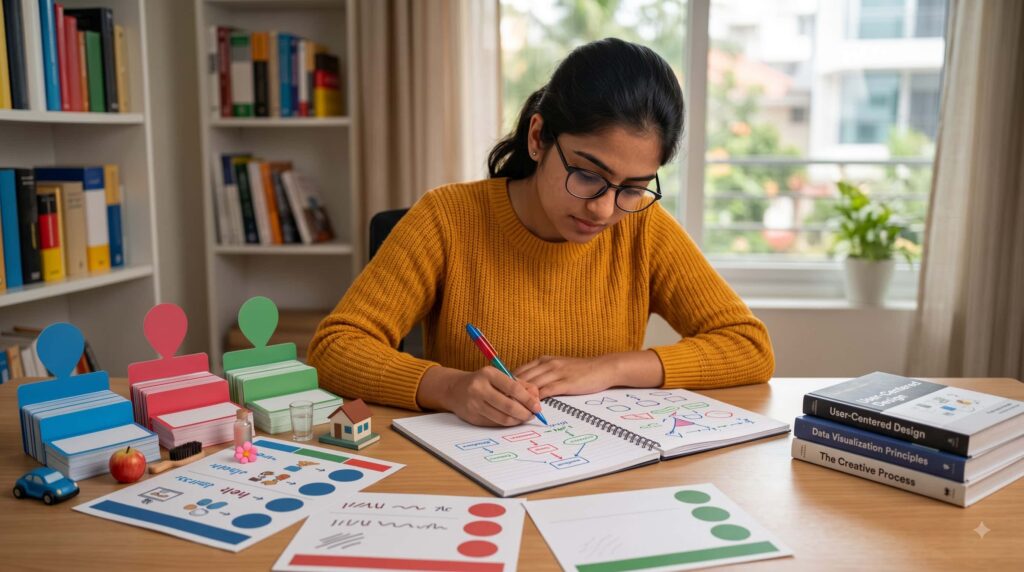
Colour coding is one of the most popular German gender tricks:
- Blue for der (masculine)
- Red for die (feminine)
- Green for das (neuter)
Use these colours in your notebook, on flashcards, or on sticky notes around your home. Over time, you’ll “see” the colour when you think of a word.
- Create Gender Mnemonics and Visual Associations
Gender mnemonics turn grammar into pictures. Give each gender a character:
- Der: imagine a strong lion
- Die: imagine a queen
- Das: imagine a small baby
Then picture the object with that character. For “der Löffel,” picture a lion eating with a spoon. For “die Gabel,” picture a queen holding a fork. The stranger the image, the better you’ll remember it.
- Build Gender Stories or a Memory Palace
Take this further with gender stories. Connect a few nouns of the same gender within one joke. You can also apply a technique called a memory palace wherein each room within your house is assigned to either gender and place nouns accordingly.
- Employ Flashcards and Spaced Repetition
Spaced repetition flashcards work wonders. They help review words just before you forget them.
Is There an App to Learn Der Die Das?
Sure, there are some applications that can help you practise ‘der’, ‘die’, and ‘das’. Anki is one of the most popular free flashcard applications, which employs the method of spaced repetition. Also, there are some applications based on the quiz principle, focusing specifically on genders.
- Learn in Chunks, Not Single Words
Chunking means learning short phrases instead of single words. “Ich lese die Zeitung” sticks better than “die Zeitung” alone.
This is where our Collocuts sessions at Tiju’s Academy come in. We teach colloquial German shortcuts and natural phrase chunks, so articles come along automatically in real speech.
- Read Aloud and Listen Often
Reading aloud trains your ear. When you hear “der Tisch” many times, “die Tisch” starts to sound wrong. Listening builds that instinct.
Our Germflix sessions help here too. Watching German movies lets you hear articles used naturally in context. Combined with listening exercises in native-style German, your ear starts correcting gender for you.
- Practise With Fun Drills
Repetition doesn’t have to be boring. Our Infinite Drill activities turn gender practice into games and quick challenges for every kind of learner. Students remember far more when they’re enjoying themselves.
- Speak, Make Mistakes, and Get Corrected
Speaking is where gender really sticks. Use the words in real conversations, and let someone correct you.
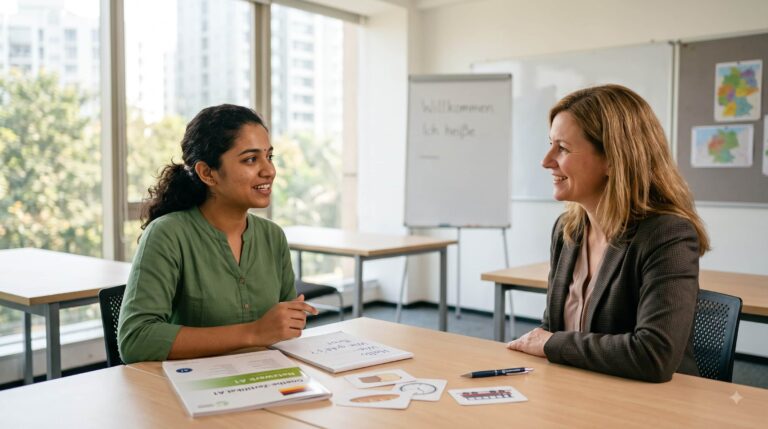
At Tiju’s Academy, Dialect Studio gives students talk time with native German speakers, along with speaking practice and roleplays in class. For learners who worry about getting articles wrong, our Reclaim Sessions build the confidence to speak without fear. And if one area keeps causing trouble, our ICT Technique (Inner Circle Training) offers one-on-one attention, so your tutor can focus on the exact nouns and cases that confuse you.
Does the Wrong Article Really Matter?
While using the wrong article is unlikely to prevent people from comprehending you, it will give your German an unnatural feel and result in point deductions on tests. It is important to get it right, although not so much that you should be overly worried about it.
What Happens If I Use the Wrong Article in German?
In real-world situations, most Germans will understand what you mean regardless. The difference between saying “die Tisch” and “der Tisch” may be obvious, but the message will be conveyed nonetheless. In a rare instance, the change in gender alters meaning entirely:
- der See means lake, die See means sea
- der Band means volume (book), die Band means music band
Do Germans Ever Get Der Die Das Wrong?
Yes, occasionally. Native speakers are very accurate with common words, but some nouns have more than one accepted gender. “Der Joghurt” and “das Joghurt” are both correct, and people in different regions say “die Cola” or “das Cola.” So even native speakers pause sometimes.
Does the Wrong Article Cost Marks in the Goethe Exam?
Yes, it can. In the Goethe and Telc exams, wrong articles count as grammar mistakes in the writing and speaking sections, under criteria like Strukturen (grammar). One or two mistakes won’t fail you, but many repeated errors can lower your score.
For exam learners, our Modmaster (Module Mastery) preparation works on grammar accuracy module by module, and the Leistung Technique shows exactly where students lose marks. Before the exam, Bootcamp Exam Preps give intensive timed practice. Correct articles also matter beyond exams. Our Pro App Assistance helps students write their own German CV and motivation letter, where clean grammar makes a strong first impression.
How Long Does It Take to Learn German Genders?
Learners usually get used to the genders of common nouns after a few months of continuous study on levels A1 and A2. Gender improves continuously along with the expansion of your vocabulary. You never finish learning gender; you only acquire it as a native speaker does over time.
That is what makes the process quicker:
- Learning every noun with its article from day one
- Knowing the ending rules
- Daily listening and speaking practice
- Regular review with flashcards
- Feedback from a teacher
How Tiju’s Academy Makes German Genders Easy?
Learning German grammar for beginners goes much faster with the right structure and support. Our Tiju’s Academy German Courses are built around exactly that. Whether you join in person or choose our German language training online, you get:
- Beginner-friendly German lessons
- Step-by-step grammar explanations
- Real-life conversation practice
- Pronunciation training
- Vocabulary grouped by daily situations
- Listening exercises with native-style German
- Speaking practice and roleplays
- Cultural tips and etiquette
- Short, structured lessons
- Progress tracking with clear milestones
- Exam preparation for Goethe, telc, and ÖSD
- Support from teachers and a friendly learner community
Our Off Book Learning sessions add authentic German culture from experts, so words like das Café, der Bahnhof, and die Bäckerei connect to real places and real situations. And through it all, Stressfrei keeps our academy a stress-free zone where comfort meets concentration. That relaxed, structured approach is why many students call us the best German institute in Kerala for beginners.
Conclusion
The German language has three genders since it retained an old grammatical system which was abandoned by the English language. Though ‘der’, ‘die’ and ‘das’ may seem arbitrary, there are many regular nouns in the language which have distinct endings.
Here is a brief review of “how to learn German articles”:
- Always learn nouns with their articles.
- Use the ending rules (-ung is die, -chen is das, -ling is der).
- Remember that the last word decides gender in compound nouns.
- Color code your study, use mnemonic devices and make flashcards.
- Do as much listening as speaking and reading aloud.
- Consider exceptions as exceptions and keep revisiting them.
It takes time, but if you approach this topic in the right way, “German articles der die das” won’t be the problem anymore; rather, they will come to you intuitively. Many students have already passed this path under the guidance of our Fluency Alchemists at Tiju’s Academy. It’s one reason students see us as the best German language institute in Kerala.
Ready to master der, die, and das? Join the best German course at Tiju’s Academy. Our German language course is available in Kerala and online. Message us on WhatsApp to book a free demo class today.
Frequently Asked Questions:
A: German has three genders because it kept an old grammatical system inherited from Proto-Indo-European. English lost its genders over time as it dropped most word endings, but German kept its endings and, with them, its genders.
A: Der, die and das are the German definite articles, all meaning "the." Der is used for masculine nouns, die for feminine nouns and das for neuter nouns.
A: Grammatical gender is a word category, not a reflection of real life. Natural gender refers to male and female beings. Sometimes they match, like der Mann and die Frau, but often they don't, like das Messer (knife).
A: Das Mädchen is neuter because it ends in -chen. All nouns ending in -chen are neuter, regardless of meaning. In German, the ending often decides the gender.
A: There is no single rule, but there are many reliable patterns, mostly based on noun endings. Learning these endings helps you guess the gender of many new words correctly.
A: Nouns ending in -ung, -heit, -keit, -schaft, -ion, -tät, -ik, -ie, -ei and -in (for female people) are feminine. Examples include die Zeitung, die Freiheit and die Universität.
A: Nouns ending in -ling, -ismus and -ist, and many ending in -er for people and tools, are usually masculine. Days, months, seasons, weather, directions and car brands are also masculine.
A: Nouns ending in -chen, -lein, -ment and -um are usually neuter, and most ending in -nis. Infinitives used as nouns, colours as nouns, most metals, and hotels, cafés and cinemas are also neuter.
A: The last word decides the gender. For example, das Kinderzimmer is neuter because Zimmer is neuter, and der Hausschlüssel is masculine because Schlüssel is masculine.
A: In the nominative case, all plural nouns use "die," whatever their gender. For example, der Tisch becomes die Tische, and das Kind becomes die Kinder.
A: Yes. German has four cases: nominative, accusative, dative and genitive. Articles change with each case, so "der" can become "den," "dem" or "des." Beginners should start with the nominative case.
A: Yes. Adjective endings change with the noun's gender, for example ein großer Hund, eine große Katze and ein großes Haus. A wrong gender usually leads to a wrong adjective ending too.
A: Always learn nouns with their articles. Use ending rules, colour coding, mnemonics, flashcards with spaced repetition and phrase chunks. Daily listening, reading aloud and speaking practice also help.
A: Yes. Anki is a popular free flashcard app that uses spaced repetition. There are also quiz-based apps that focus specifically on German genders.
A: Most Germans will still understand you, but your German will sound unnatural. In rare cases, the meaning changes, like der See (lake) and die See (sea).
A: Yes. In Goethe and telc exams, wrong articles count as grammar mistakes in writing and speaking. One or two errors won't fail you, but repeated mistakes can lower your score.
A: Most learners get comfortable with the genders of common nouns after a few months of steady study at A1 and A2 levels. Gender keeps improving as your vocabulary grows.
A: Tiju's Academy teaches grammar step by step, with Collocuts for natural phrase chunks, Germflix for listening, Infinite Drill games, Dialect Studio speaking practice and one-on-one ICT sessions. Classes are available in Kerala and online.