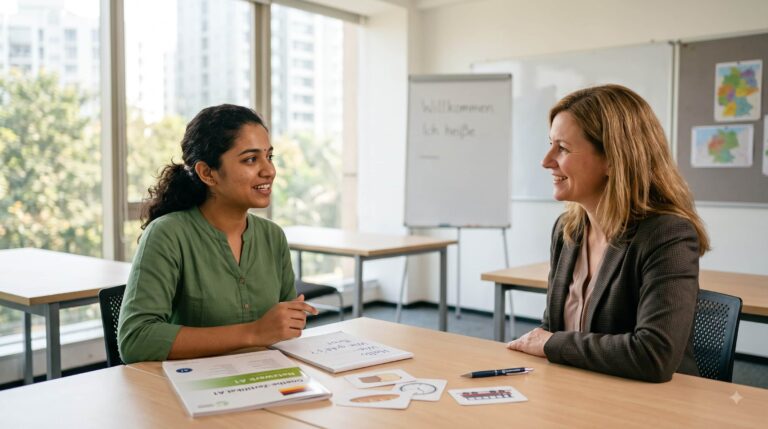

Want to speak German fluently, you should learn about German modal verbs. They are one of the most common words in German and they will be used in every single conversation in German that you will have. Below is your quick solution. The German modal verbs are auxiliary verbs that give an added meaning to the main verb. Some of the concepts that they convey are possibility, permission, obligation, and desire.
There are six basic modal verbs: können, müssen, wollen, dürfen, sollen, and mögen. In this lesson, we will learn how to use modal verbs in German along with their conjugations and everything else.
Getting Started With German Modal Verbs
What are modal verbs in German? Modal verbs are unique helping verbs that combine with the principal verb in order to convey a sense.
Take this example:
- Ich spreche Deutsch. (I speak German.)
- Ich kann Deutsch sprechen. (I can speak German.)
The word “kann” adds the idea of ability. “Sprechen,” the main verb, shifts to the end. And that’s what distinguishes modal verbs from other verbs and becomes the essence of modal verb formation. Why are they so important?
Here are just a few reasons:
- They appear in daily speech far more than most other verbs.
- They let you sound polite, which is key in German culture.
- They are essential for learn German A1 A2 level exams and real conversation.
This is exactly the kind of core grammar we focus on early. At Tiju’s Academy, we provide beginner-friendly German lessons that build these foundations step by step, which is one reason we are known as the best German language institute in Kerala.
The 6 Core German Modal Verbs
In the German language, there are six modal verbs, and all of them have different meanings. Here is the list of all the German modal verbs, their meanings, and examples.
- “Können” means “can” or “to be able to.” It expresses ability.
Ich kann schwimmen. (I can swim.)
- “müssen” means “must” or “to have to.” It expresses obligation or necessity.
Ich muss arbeiten. (I have to work.)
- “Wollen” means “to want.” It expresses a strong wish or intention.
Ich will Deutsch lernen. (I want to learn German.)
- “dürfen” means “may” or “to be allowed to.” It expresses permission.
Ich darf hier parken. (I am allowed to park here.)
- “sollen” means “should” or “to be supposed to.” It expresses a duty, advice, or an instruction from someone else.
Ich soll mehr Wasser trinken. (I should drink more water.)
- “mögen” means “to like.” It expresses a preference.
Ich mag Kaffee. (I like coffee.)
Observe how these six verbs cover the ability, permission, obligation, and desire categories, concepts that you use on an everyday basis. The dürfen, sollen, and mögen set is sometimes less frequently used than the previous three but is equally important in terms of speaking naturally.
It is also useful to master one particular form in this section. möchten, which means “would like,” is the polite version of mögen and will be used frequently in stores and restaurants.
Ich möchte einen Tee, bitte. (I would like a tea, please.)
Our vocabulary grouped by daily situations helps you learn these verbs in the exact settings where you will use them, from ordering food to asking for directions. That practical focus is what makes our German language classes so effective.
German Modal Verb Conjugation
Now to the part most learners find tricky. Conjugation of German modal verbs cannot be considered regular, so you will need to learn them carefully. However, there is one good thing about them: all six have a similar irregularity in conjugation.
This is what makes them unique. In the first-person singular form and third-person singular form, which are known as Präsens, the verb stems change for five of the six verbs. This vowel change in the stem is the part beginners forget most.
This table shows the full conjugation across all personal pronouns.
| Pronoun | können | müssen | wollen | dürfen | sollen | mögen |
| ich | kann | muss | will | darf | soll | mag |
| du | kannst | musst | willst | darfst | sollst | magst |
| er/sie/es | kann | muss | will | darf | soll | mag |
| wir | können | müssen | wollen | dürfen | sollen | mögen |
| ihr | könnt | müsst | wollt | dürft | sollt | mögt |
| sie/Sie | können | müssen | wollen | dürfen | sollen | mögen |
Look closely and you will spot the pattern:
- The ich and er/sie/es forms are identical, with no ending added.
- Five verbs lose or change their Umlaut in the singular. For instance, können changes to kann, müssen changes to muss, and dürfen changes to darf.
- Sollen is the only one whose vowel doesn’t change at all, which makes it the easiest to learn. The wir, sie, and Sie forms look just like the infinitive.
This irregular conjugation is where a good teacher saves you weeks of confusion. Our step-by-step grammar explanations break this table down slowly, and our Infinite Drill activities turn boring memorizing into fun practice for every kind of learner.
Word Order With Modal Verbs
When employing modal verbs in the German language, there is one sole word-order rule. This might seem difficult at first but it is not really hard. The modal verb is placed in the second position while the main verb is moved all the way to the end of the sentence in infinitive form.
Where does the second verb go with a modal verb? It goes to the end of the clause, unchanged, in its basic infinitive form. Here is the pattern in action:
- Ich muss heute früh aufstehen. (I have to get up early today.)
- Wir wollen am Wochenende nach Berlin fahren. (We want to go to Berlin at the weekend.)
- Kannst du mir bitte helfen? (Can you help me please?)
Notice that the modal verb occupies the second position, whereas the main verb lingers until the end of the clause. In German, such a sentence pattern is called the V2 rule or the verb-second construction. It is a key part of German grammar.
Now here is the brief overview of the rule:
- The conjugated modal verb goes in position two of a main clause, called the Hauptsatz.
- The main verb goes to the end as an infinitive.
- In questions, the modal verb moves to the front.
Things shift slightly in a subordinate clause, called a Nebensatz. There, the modal verb moves all the way to the end, after the main verb.
Ich weiß, dass ich mehr üben muss. (I know that I have to practise more.)
Notice how “muss” comes last in that clause. This mix of modal verbs sentence structure, German, and clause rules can feel like a puzzle at first. These sentence constructions can be formed orally using our real-life conversation practice.
Use of Modal Verbs in Various Tenses
Modal verbs can be used in any tense, and their formations are systematic. Once one knows how to use the present tenses, forming the past tenses becomes very easy. Here is how to handle German modal verbs in past tense and beyond.
- Present tense (Präsens)
You already saw this above. The modal verb is conjugated and the main verb sits at the end.
Ich kann gut kochen. (I can cook well.)
- Simple past (Präteritum)
With the past, the modal verbs are always used with the simple past or the Präteritum. This is very significant, since it is used more often than the perfect tense. The umlaut gets lost in these forms.
- “Können” becomes “konnte.”
Ich konnte gestern nicht kommen. (I could not come yesterday.)
- “Müssen” becomes “musste.”
Wir mussten lange warten. (We had to wait a long time.)
- “Wollen” becomes “wollte.”
Er wollte ein Auto kaufen. (He wanted to buy a car.)
This Präteritum form is what you will use most in speech and writing when talking about the past, so it is worth drilling well.
Present perfect (Perfekt)
The perfect tense (Perfekt), although not very frequent, can be used with modal verbs. The specific construction in question is the so-called double infinitive, which consists of two infinitives at the end of the sentence.
- Ich habe nicht kommen können. (I have not been able to come.)
Since this construction with the double infinitive in the perfect tense is rather difficult, most instructors recommend to beginners that they just use the Präteritum in the past tense. In our Germflix lessons where we watch German movies, you can listen to how native speakers actually use these tenses in practice.
Common Errors with German Modal Verbs
- Even enthusiastic students make some errors with the use of modal verbs. So pay attention to these errors because most of them are easily corrected, and their correction will make your German much more correct.
- Failing to make the stem-vowel shift. “Ich könne” instead of “ich kann” is a classical mistake. Remember the stem vowel shift in the singular forms.
- The main verb is incorrectly positioned. The main verb has to go to the end. “Ich kann sprechen Deutsch” is incorrect. It should be “Ich kann Deutsch sprechen.”
- Conjugation of the second verb. The main verb stays as an infinitive. Do not add an ending to it.
- Adding an ending to ich and er forms. These forms take no ending, so “ich musse” is wrong. It is just “ich muss.”
- Mixing up können and dürfen. This can be very confusing for many students, so let us make it clear.
What is the difference between können and dürfen? The former is used when you are capable of doing something. The latter means that you have the right or permission to do something. Ich kann schwimmen. (I can swim, I have the skill.)
Ich darf schwimmen. (I am allowed to swim, I have permission.)
What is the difference between müssen and sollen? müssen is a strong personal need or obligation. Sollen is a softer duty, advice, or something another person expects of you.
Ich muss zum Arzt gehen. (I must go to the doctor, it is necessary.)
Ich soll mehr schlafen. (I should sleep more, the doctor advised it.)
It is this very aspect that differentiates a tentative learner from an eloquent speaker. The colloquial tricks used by natives are exactly the lessons we provide during our Collocuts, and our Fluency Alchemists, who are nothing but our certified trainers, have the reputation of making students go from zero to hero. With precise corrections and a tranquil environment, minor mistakes quickly vanish, and hence, the reason we handle your German language course.
How Tiju’s Academy Helps You Master German?
Learning modal verbs is one step, but real fluency needs a full plan, steady support, and lots of practice. That is what we build for every student. As a leading choice for the best German coaching in Kerala, we make German simple, structured, and even fun.
Here is what you get with us:
- Short, structured lessons that fit a busy schedule
- Pronunciation training so you are understood clearly
- Listening exercises with native-style German
- Speaking practice and roleplays that build real confidence
- Cultural tips and etiquette for life and work in Germany
- Progress tracking and clear milestones so you always know where you stand
- Exam preparation for every level
- Support from a friendly teacher and learning community
On top of the basics, we provide our own signature methods you will not find elsewhere:
- Dialect Studio: alk with a German native speaker, helps improve fluency and build confidence
- Modmaster: module mastery with module-wise exam prep to crack tests easily
- Leistung Technique: clear tips and tricks to hit your target exam score
- Stressfrei: a complete stress free zone where comfort meets concentration
- Bootcamp Exam Preps: sessions perticulary focused on strates to lift your score
- Reclaim Sessions: programm built to gain confidence in speaking
- ICT Technique: one-on-one personalized correction and guidance
- Pro App Assistance: guidance to create a CV and motivation letter
Whether you prefer in-person German language classes or flexible German language training online, we shape the course around you. From your first word to all “German grammar for beginners” and further, we will guide you through all of it, and it is our approach to speech that helps us make you “speak German fluently.”
Conclusion
Modal verbs are the secret to speaking naturally in German, but they aren’t as difficult as you think. Make use of the verbs kann, muss, will, darf, soll, and mag to denote ability, need, desire, permission, obligation, and preference respectively. Just remember the stem vowel shift in the singular, place the modal second, and place the main verb in the end as an infinitive form. Learn the conjugation chart and tenses and avoid making the typical mistakes.
As the best german language institute in Kerala, we provide focused German courses, flexible training, and complete support from your very first lesson. We are the best partner to take you from beginner to confident speaker.
Ready to start? Visit our website today.
Frequently Asked Questions:
A: Modal verbs in German are helper verbs that combine with a main verb to add meaning. They express ideas like ability, permission, obligation, and desire. For example, "Ich kann Deutsch sprechen" means "I can speak German," where "kann" adds the sense of ability.
A: The six German modal verbs are können, müssen, wollen, dürfen, sollen, and mögen. They mean can, must, want, may, should, and like. Together they cover ability, obligation, desire, permission, duty, and preference.
A: Modal verbs are irregular in the present tense. The ich and er/sie/es forms are identical and take no ending, and five of the six verbs have a stem-vowel change in the singular. For example, können becomes "ich kann" and müssen becomes "ich muss."
A: Sollen is the easiest, because its vowel does not change at all across the forms. The other five lose or change their umlaut in the singular, such as können becoming kann and dürfen becoming darf.
A: The main verb goes to the end of the clause in its infinitive form, while the modal verb sits in second position. For example, "Ich muss heute früh aufstehen" means "I have to get up early today," with the modal second and the infinitive last.
A: Können is about ability, meaning you are able to do something, while dürfen is about permission, meaning you are allowed to do something. "Ich kann schwimmen" means you have the skill, and "Ich darf schwimmen" means you have permission.
A: Müssen is a strong personal need or obligation, while sollen is a softer duty, advice, or something another person expects of you. "Ich muss zum Arzt gehen" means it is necessary, and "Ich soll mehr schlafen" means it was advised.
A: Use the simple past, or Präteritum, since it is far more common than the perfect tense with modal verbs. The umlaut disappears in these forms, so können becomes konnte, müssen becomes musste, and wollen becomes wollte.
A: Möchten means "would like" and is the polite form of mögen. You will hear it often in shops and restaurants, for example "Ich möchte einen Tee, bitte," meaning "I would like a tea, please."
A: A very common mistake is forgetting the stem-vowel change, such as saying "ich könne" instead of "ich kann." Others include putting the main verb in the wrong place and adding an ending to the ich and er forms.