
To learn German fast, one should pick a definite target level, study a bit every day, and begin speaking right from the first week instead of postponing it till perfection of grammar. People following this methodology usually manage to get A2 in three-four months and B1 in one year of full-time learning. If you ask yourself, “How to learn German” for a nursing position, a place in Ausbildung or university courses, the information provided here will show what needs to be done, how long it will take, and how many words are required.
Many people from Kerala take up German every year, as Germany hires nurses, technicians, and trainees in huge numbers. Quite a few of them choose Tiju’s Academy that is considered to be the best German language institute in Kerala, providing German language classes in Kerala offline as well as online via our Thiruvalla center. Below are the tips based on the methodology of Tiju’s Academy instructors teaching complete beginners.
How to Learn German Fast?
Learning German quickly involves focusing on four components simultaneously: pronunciation, vocabulary per day, proper sequence of grammar, and conversation.
Learning the CEFR Levels and Choosing Your Level Goal
German can be learned in six different CEFR levels: A1, A2, B1, B2, C1 and C2. In most cases, learners will only need German A1 to B2 levels. This depends on what you want to achieve.
- A1 and A2: basic phrases, greetings, shopping, directions
- B1: everyday conversation, simple work emails, most Ausbildung entry
- B2: confident conversation, professional use, nursing licence recognition
- C1: university study and specialist work
Start With the German Alphabet and Pronunciation
German Alphabet and Pronunciation is more systematic than the English language. If one knows the rules about how to pronounce umlauts (ä, ö, ü), the “ch” sound, and combinations of letters, he will be able to pronounce any word. Spend your first week on it. It makes every later lesson easier because you can hear and say what you read.
Build Vocabulary Every Day
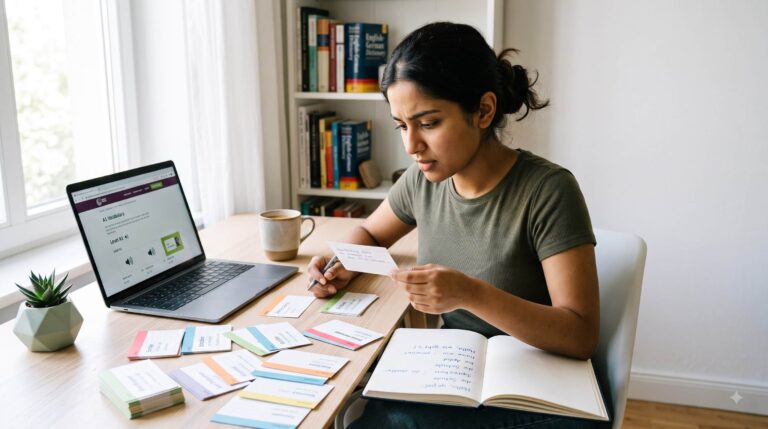
German vocabulary acquisition is most effective in small, daily portions. Acquire 10 to 15 new words a day through spaced repetition and flashcards, and make sure you acquire each noun along with its corresponding article. “Tisch” alone is useless. “Der Tisch” is a word you can use.
Tiju’s Academy gives students the Mnemomap system for this, which is detailed notes built on mnemonic techniques for fast retention and easy recall. Gender, plurals, and irregular verbs will be remembered with the help of a mnemonic device rather than just by rote learning.
Learn Grammar in the Right Order
German grammar basics feel heavy only when they are taught in the wrong order. A good sequence is:
- Noun genders (der, die, das) with every new word
- Conjugation of present tense verbs for regular and common irregular verbs
- Basic sentence structure, especially the verb in second position
- The cases (nominative, accusative, and dative) one at a time
- Separable verbs, modal verbs, and past tense
Do not try to learn all four cases in one week. Learn accusative, use it in speaking for ten days, then move to dative.
Speak From Week One
German-speaking practice should begin on day three, not month three. State your name, occupation, place of residence, and hobbies. It is normal and valuable to make mistakes in the first month. People who delay their speaking until “they know enough” never do.
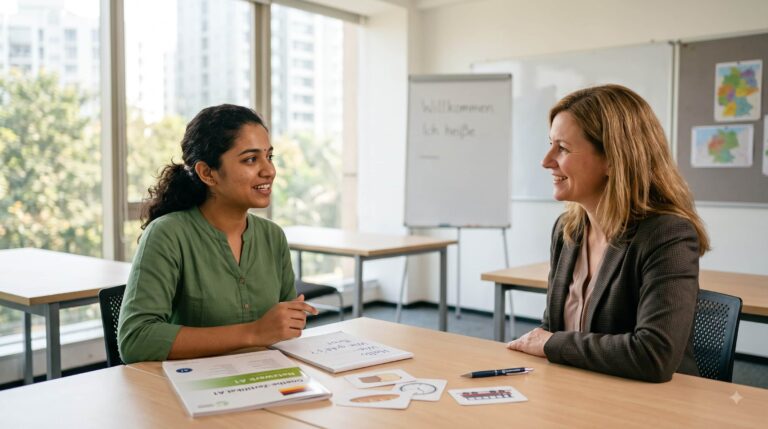
Use Trainer-Led Classes
Self-study will get you to level A1. After that, you’ll most probably require classes from a teacher to fix pronunciation problems and grammatical exceptions and to hold yourself accountable. That is why Tiju’s Academy German classes are usually referred to as “the best course to learn German” in the state.
What Is the Difference Between A1, A2, B1 and B2 in German?
The distinctions among A1, A2, B1, and B2 are based on the degree to which one can act independently. A1 and A2 levels are survival levels. B1 implies that one can deal with all aspects of everyday life. B2 implies that one can work and defend his/her opinion in German.
- A1: greetings, numbers, simple questions, filling in forms
- A2: routine activities, conversations about family, work and shopping
- B1: traveling independently, speaking about one’s experiences, sending simple letters, comprehending the main information of spoken language
- B2: understanding complex texts, communicating fluently with native speakers, dealing with discussions at work
There is a separate language certificate for each of the levels. The most popular is Goethe-Zertifikat, but TELC and ÖSD German Exam are considered equally valid for employers and embassies in Germany.
Is It Hard to Learn German?
The difficulty of German language for Indians is moderate and comparable to the difficulty of English language for them, although in different areas.
German Difficulty Features
- Three noun genders without any pattern
- Four grammatical cases that require changing of articles and adjective endings
- Complicated compound words such as “Krankenversicherung” (health insurance)
- Verbs which can be separated and placed at the end of the sentence
Why It Is Easier Than You Think?
- Most words are spelled as they are pronounced
- About 40 percent of basic words in German have the same roots as those in English language (Haus, Wasser, Mutter, trinken)
- Compounds consist of known elements; thus, the rate of vocabulary expansion increases after reaching level A2
- The grammar system is consistent so there are no surprises for the learner
Is German Harder Than English?
German will not pose greater difficulty for you as a speaker of Malayalam compared to English as it is the case since English presents difficulties in terms of spelling and pronunciation, but in German, the grammatical aspect poses the challenge, which can take only a few months.
Is German an Easy Language for Malayalam Speakers?
Malayalam language speakers enjoy two main benefits. First, the use of verb endings and case ending in the Malayalam language prepares you for this task. Second, the Malayalam language has sounds similar to the German “ö” and “ü” sounds, which are difficult for the English speaking people to learn. You only need to change your word order which is taken care of by the training experts at Tiju’s Academy using Opticortex Lectures.
How Long Does It Take to Learn German?
German B2 takes about 600 to 800 hours of learning, says the Goethe Institute. If you learn one hour per day, this means two years of studying. In case of three hours per day, this equals to eight months.
Approximate hours per level:
- A1: 80 to 150 hours (six to eight weeks in case of 2 hours per day of studying)
- A2: 150 to 250 more hours (two to three months)
- B1: 300 to 400 more hours (four to five months)
- B2: 250 to 300 more hours (three to four months)
Can I Learn German in 3 Months?
You will be able to achieve A2 level in three months, learning two to three hours per day. B1 level achievement in three months is possible only if you dedicate yourself to studying five to six hours a day and practice speaking all the time. Achieving B2 in three months is unrealistic for most people.
How Many Hours a Day Should I Study German?
For those with a regular nine-to-five job, study for an hour to two hours daily. In case you are studying for exams full-time, set aside between three to four hours daily. It is better to be consistent than work in long periods.
For working nurses and professionals, Tiju’s Academy runs its Flexi-Chrono schedule with flexible morning and evening batches in online mode and offline evening batches at Thiruvalla for those who come after duty. All online classes are recorded to be reviewed repeatedly; therefore, missing classes will not interrupt your daily schedule.
What German Level Is Needed for Nursing in Germany?
Nurses need B2 German for full licence recognition in Germany. Many Germany nursing recruitment agencies accept B1 for the initial visa and contract, with B2 completed after arrival. In the case of someone taking up the Ausbildung programme, a B1 certificate will be required at the start, while a B2 certificate would be required in order to complete the program.
The language requirements depend on visa category too. The APS certificate, blocked bank account, and admission confirmation from either the DAAD or the university would be necessary for students. For nurses, a language certificate, recognition of their degrees, and an employment offer are required. The trainers of Tiju’s Academy will inform about all of these along with the language course, and hence it is regarded as the best German Institute in Kerala.
How Many Words should I Learn to Be Fluent in German?
You need about 2,500-3,000 words to carry out routine conversations in German and 5,000 words to work comfortably at B2 level. Native vocabulary is much more extensive, but you don’t need it to become fluent.
Approximate vocabulary ranges:
- 500 words: basic survival phrases and sentences (A1)
- 1,000 to 1,300 words: routine conversation (A2)
- 2,500 to 3,000 words: independent living (B1)
- 4,500 to 5,000 words: working fluency (B2)
There are three reasons why the above-mentioned target vocabulary is smaller than you think. Firstly, the 1,000 most frequent words comprise around 80% of all spoken vocabulary; therefore, it makes sense to learn it from a frequency list rather than from a random dictionary. Secondly, compound words enable you to form new words from already known roots, which means that knowing 3,000 words enables you to understand significantly more vocabulary. Finally, there are common German phrases like “Ich hätte gern…” or “Können Sie mir helfen?” are ready-to-use word blocks.
7 Useful Tips to Learn German
Seven hints listed below show how to move from level A1 to B2 according to what really works in Tiju’s Academy classes.
- Study Daily Even if Only for 20 Minutes
A daily lesson helps to keep the language fresh in memory. Schedule the time for lessons and stick to that time everyday. A simple way to schedule your study would be: 10 minutes vocabulary + 10 minutes grammar + 10 minutes listening.
- Always Learn the Noun With Its Article
It is impossible to miss out on ‘der,’ ‘die,’ or ‘das’ when writing the noun down. Color code all three genders in your notebook. This one hint will help you avoid the most frequent mistake in B1 and B2 exams.
- Practice Listening Everyday
Listening skills can only improve with practice. Slow German news podcasts will work at levels A1 and A2; switch to regular German radio and movies with German subtitles at B1 level.
- Speak With a Partner or Trainer
Find a speaking partner or join a class where speaking is compulsory. Answer questions aloud, describe your day, argue about a topic. Tiju’s Academy pairs its German-speaking practice sessions with a Vigil-Desk service that gives 24×7 doubt-clearing support, so a grammar question at night gets answered before the next class.
- A Little Reading Every Day
Reading practice on your level will make you learn vocabulary faster than using lists of words. Good sources include graded readers, children’s books, and easy-to-read news websites. Read the same short text three times: one time for comprehension, another for grammar, and lastly aloud.
- Take Mock Exams From A1 Onwards
Exams like the Goethe and TELC have a fixed pattern. Practising that pattern early removes exam-day fear. Students at Tiju’s Academy get access to Centurion-200, a bank of 200+ mock tests covering listening, reading, writing and speaking modules, each set to the real exam format for time and accuracy management. Every paper is followed by Stem-Dissect, a tutor-assisted question paper discussion with a full question explanation for each answer, so students see exactly why they lost marks.
- Join a Structured Course
The best way to learn German at home for the majority would be an online course with a trainer using language applications to revise daily. Learning through apps alone would hardly help anyone to progress beyond A1 level. An organized “German language course” will provide a learner with a curriculum, deadlines, and feedback, which are the three things that are missing in self-study.
How Tiju’s Academy German Training Works?
Tiju’s Academy provides German language training online in Kerala and offline at its Thiruvalla branch, offering courses from A1 to B2 levels and exam preparation for Goethe, TELC and ÖSD certificates.
- Delivery Mode
Online and offline interactive lessons. For online learners, classes are taken live from any part of Kerala and the Gulf and are recorded. Offline learners study at the Thiruvalla branch in morning or evening classes.
- Course Duration
Each level runs as a 50-day comprehensive programme under the Heptadeca-50 format, covering all grammar modules, vocabulary, and the four exam skills. Students who already hold a level and need to clear an exam quickly take the Heptadeca-15, a 15-day intensive crash course built entirely around mock tests and exam strategy.
- Exam Alignment
The content is designed for the Goethe examinations as well as TELC and ÖSD requirements, including special courses for nurses and Ausbildung students learning German. The students of nursing, for instance, are taught medical terminology, conversation with patients, and documentation from level B1 on.
- Support
Personalised mentorship runs through the course. Trainers track each student’s mock scores, adjust the revision plan, and stay available through the Vigil-Desk for continuous doubt clearing.
- German Language Course Fees
German language course fees in Kerala vary by level and mode. Tiju’s Academy keeps its fees per level with no hidden exam-coaching charges, and offers combined A1 to B2 packages for nursing and Ausbildung candidates. Contact the academy for the current fee sheet, since it changes with batch timing and mode.
Many students who need a language score for the Gulf or the UK also take OET or IELTS at Tiju’s Academy, so both plans can be compared in one counselling session.
Conclusion
The acquisition of the language can be done within months rather than years when one sets up a goal for themselves, studies each day, acquires nouns together with their articles, and starts speaking before one feels ready. A2 is possible within three months, while B1 will take one year, and B2 can be acquired in around 18 months for a person who works professionally. The grammar seems too difficult at first glance, but the rules are stable, and the vocabulary develops rapidly after one begins using compound words.
The people who are able to acquire a B2 level of proficiency are seldom the brightest ones.
Planning to work, study or start an Ausbildung in Germany?
Join Tiju’s Academy, the best German language institute in Kerala, for German language classes from A1 to B2 with Goethe, TELC and ÖSD exam coaching. Join us online from any part of the world or offline at our Thiruvalla branch, select your convenient time slots of morning or evening classes, and enjoy mnemonic technique-based study materials, video classes, 200+ mock tests, and 24*7 doubt clearance support. Avail a free counseling session now at tijusacademy.com.