Nursing Ausbildung in Germany is a paid, three-year training programme that turns you into a fully qualified registered nurse. You learn in a classroom but work in a real hospital all at once while being paid a monthly stipend by the hospital throughout the program. There is a shortage of 200,000-plus nurses in Germany, and hence hospitals are trying to recruit individuals from India and other countries.
For a nurse and a Plus Two graduate from Kerala, the nursing ausbildung in Germany is perhaps the most straightforward way of building a successful career in Europe. The only factor that determines your entry into this program is your German language proficiency and hence requires prior preparation.
This guide will take you through the basics of the nursing Ausbildung program, including its benefits, salary, language requirements, and long-term stay-back options.
What Is Ausbildung in Germany?
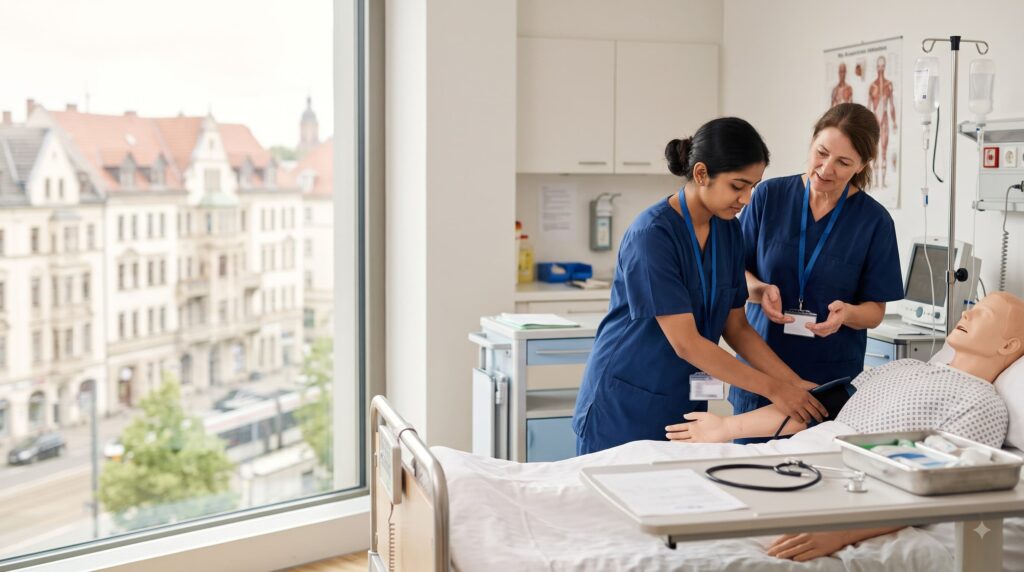
What is ausbildung in germany? It is the country’s system of paid vocational training, where you learn a profession by actually doing it instead of only reading about it. Germany runs what people call a dual training system. Some part of your week will be spent in a nursing school where you will be taught theory, while other part of the week will be spent on a hospital ward where you will gain practical experience under supervision.
The qualification you get for nursing is Pflegefachmann for males and Pflegefachfrau for females. Since 2020, there has been only one kind of training offered in Germany generalistische Pflegeausbildung that trains you in taking care of adult, child, and elder patients all together in one training. Thus, your qualification becomes flexible and recognized in all of the EU after your studies are over.
Your education begins with the language, and the language education begins from scratch for most people. This is why Tiju’s Academy builds its beginner batches around beginner-friendly German lessons and a Stressfrei approach, a stress-free zone where comfort meets concentration, so nurses who have never spoken a word of German do not panic in the first week.
What is nursing Ausbildung in Germany for Indian students?
Nursing Ausbildung can be seen as a solution for Indian students wishing to become nurses in Germany without having to bear high university expenses, typically after passing Class 12. Rather than investing hundreds of thousands of rupees for your college degree, you undergo training, get a monthly allowance, and come out with a job-ready certification. It is more suited for individuals desiring a practical career with a secure future abroad, particularly in Kerala where there are many relatives involved in nursing.
How long is nursing Ausbildung in Germany?
The three-year programme is the standard. It runs full-time and mixes classroom plus hospital training across all three years, with your hours on the ward increasing as you get more capable. Some candidates who already have nursing experience follow a shorter recognition route instead, which is explained further down.
Is nursing Ausbildung free in Germany?
Yes, in the sense that matters most. The training itself carries no tuition fee, and on top of that the hospital pays you a training allowance (Ausbildungsvergütung) every month. You still cover your own rent, food, and the general cost of living, but you are earning while you learn rather than draining your savings. A lot of Kerala parents are surprised to hear that their child can train as a nurse abroad and get paid for it at the same time.
Why Nursing Ausbildung Is Worth It?
Worthwhile nursing Ausbildung? It’s definitely worthwhile, especially for most individuals. You will be working while studying; you will not have to pay any tuition fees; your qualification will be recognized in all European countries, and you will enter into the labor market where nurses are in great demand.
Here is why so many nurses from Kerala choose it:
- You get a monthly nursing ausbildung salary/stipend during training, so you are not sitting idle without income.
- There is no university tuition fee to pay.
- Your hospital placement is arranged before you arrive, so you are not job hunting blind.
- The license is EU-recognized, which ensures that you can work in any other country within the EU.
- It provides a clear way to acquire residency and eventually citizenship in Germany as a nurse.
The application itself trips up a lot of good candidates, because a German hospital expects a proper German-style CV and a genuine motivation letter, not a copy-paste template. Students almost always find this part hard. Tiju’s Academy runs Pro App Assistance, professional application assistance, where trainers help you build your own CV and motivation letter for admission so your file actually gets read.
How much do Ausbildung nurses earn per month?
The nursing Ausbildung stipend during the 3-year education period ranges between 1,100 and 1,400 euros per month and increases year by year, the first year being the lowest and the third year being the highest. However, after successfully completing the education period and gaining employment as a registered nurse, the increase is significant. A newly graduated nurse in Germany typically receives an income between 3,000 and 4,000 euros per month gross.
| Stage | Rough monthly pay (before tax) |
| Ausbildung, year 1 | around €1,100 to €1,200 |
| Ausbildung, year 2 | around €1,200 to €1,300 |
| Ausbildung, year 3 | around €1,300 to €1,400 |
| After you qualify | around €3,000 to €4,000+ |
The figures change over time and vary from hospital to hospital, so consider them guidelines and check the latest figures before implementing them.
Ausbildung vs. Anerkennung (recognition) route
This is where a lot of confusion sits, so here is the plain difference. Ausbildung vs Anerkennung (recognition) route comes down to whether you already hold a nursing qualification. Ausbildung is for people starting fresh, usually straight after Class 12. Anerkennung (recognition) is for people who have already finished a nursing course in India and want their existing degree accepted in Germany rather than repeating three years of training.
If you go the recognition way, the German authorities compare your Indian syllabus with theirs and look for gaps. To close those gaps, you either pass a Kenntnisprüfung, which is a knowledge test, or complete an Anpassungslehrgang, an adaptation period at a German hospital that runs for several months up to a year.
Can GNM nurses apply for Ausbildung in Germany?
Yes, GNM and BSc nurses can apply for Ausbildung, but the recognition route often makes more sense for them, because there is little point in redoing three years of training when your degree can simply be recognised. But there are those who prefer the “Ausbildung” route, as it helps them start afresh with a German certification. It all depends on your individual agenda.
BSc nursing vs Ausbildung in Germany
BSc nursing vs ausbildung in Germany is really academic versus practical. A BSc is a university degree, heavy on theory and classroom study. Ausbildung is vocational, built around doing the job on a real ward from early on. Both lead to a nursing career in Germany. If you learn best by doing, Ausbildung tends to fit better. If you want an academic degree and possibly research or teaching later, the university path may suit you more.
Career and Stay-Back Opportunity
Once you finish, you can work as a registered nurse anywhere in Germany, and because of that EU-wide recognition, your qualification travels across the continent. There is a well marked path from your first job to permanent residency and eventually a pathway to citizenship. This is the part that makes the whole effort pay off.
Demand is the big story here. With an aging population and a serious nursing shortage in Germany, there is genuine high demand for trained nurses, and large hospital networks run dedicated hiring teams for international candidates. Nursing jobs in Germany after Ausbildung are not hard to find once you are qualified and your German is solid.
A few things worth knowing about the wider system:
- Those who qualify as nurses may now apply for the EU Blue Card even without having a university education due to changes in regulations recently made.
- Introduction of the Opportunity Card (Chancenkarte) that came in June 2024 allows skilled individuals to enter Germany in search of employment without a prearranged job.
- The skilled worker visa introduced through the Fachkräfteeinwanderungsgesetz (Skilled Immigration Act) is the primary legal channel after you get your qualification recognized.
- Government-backed schemes like the Triple Win programme also place nurses from partner countries into German hospitals.
Career growth does not stop at ward nurse. After some experience, you can take a Fachweiterbildung, a further specialisation in areas like intensive care, anaesthesia, or paediatrics, and move into higher-paid roles. Some nurses go on to become a ward manager (Stationsleitung) or step into nursing management. To move up, you usually have to clear German exams along the way, and Tiju’s Academy prepares students for exactly that through its Leistung technique, an achievement method of clear tips and tricks to hit the score you need.
Can I settle permanently in Germany after nursing Ausbildung?
Yes. After you qualify and work for a few years with steady tax and social contributions and good German, you can apply for a settlement permit (Niederlassungserlaubnis), which is permanent residency. Stay longer and citizenship becomes possible. Family reunification is allowed too, so your spouse and children can join you once you meet the income and housing conditions. Timelines depend on your language level and your contributions, so check the current rules for your situation.
What jobs can I take after Ausbildung?
Plenty of doors open once you hold the Pflegefachfrau or Pflegefachmann title:
- Hospital ward nurse across general and specialist departments
- Elderly care and long-term care roles, which are in constant demand
- Intensive care, theatre, or paediatric nursing after a Fachweiterbildung
- Ward management and team lead positions with more experience
- Roles in other EU countries, since your qualification is recognised there
German Language Requirements for Nursing Ausbildung
You need at least B1 German to begin most nursing Ausbildung programmes, and B2 to work as a fully recognised nurse or to take the recognition route. The german language requirements for nursing Ausbildung are strict because there is a very good reason behind it. If a nurse does not understand the patient’s language or even the medication chart, it will be dangerous for him/her on the ward.
Do I need B1 or B2 to start nursing Ausbildung?
B1 vs B2 German for nurses works like this. B1 is usually enough to start the Ausbildung, and some hospitals will accept a strong A2 candidate who promises to reach B1 within a few months of arriving. B2 is non-negotiable for recognition as a registered nurse and for the Fachsprachprüfung, the medical German exam that checks whether you can handle real hospital communication. In practice, you should plan to reach B2, because that is the level where you can talk to patients, follow doctors, and write accurate medical documentation without freezing.
So the honest answer to “Do I need B1 or B2 to start nursing ausbildung?” B1 to begin, B2 to truly succeed and stay.
Which certificate do I need?
Germany accepts certificates from recognised bodies, mainly the Goethe-Institut certificate, TELC, and ÖSD. All three are trusted by employers and immigration authorities. TELC even has a medical German version aimed at nurses, which is worth taking once you reach the right level. Whatever you choose, proper exam preparation decides whether you pass on the first try or waste months and money on retakes.
How Tiju’s Academy prepares you from A1 to B2?
Getting from zero to B2 is the hard part, and that is where coaching earns its keep. As one of the options for the best German language institute in Kerala, Tiju’s Academy runs German classes in Mavelikara and Thiruvalla, along with German language training online for students who cannot travel. The Tiju’s Academy German training method is built to get nurses actually speaking, not just collecting a certificate.
A typical course covers:
- Step-by-step grammar explanations that build in a logical order
- Vocabulary grouped by daily situations, including hospital and patient words
- Listening exercises with native-style German so real speech does not shock you
- Speaking practice and roleplays, including mock patient conversations
- Pronunciation training not only to attain the desired score but also to build confidence
- Cultural tips for life and work for students moving to germany
- Short, structured lessons that fit around study and shift work
- Progress tracking to know where you stand
- Support from a teacher and community whenever you get stuck
How to Apply for Nursing Ausbildung From Kerala?
How to apply for nursing Ausbildung from Kerala follows a fairly clear order, and the earlier you start the language, the smoother it goes:
- Begin learning German from A1 as soon as you decide. This is the step people delay and regret.
- Reach B1 or B2 and pass the recogonized exam
- Prepare your documents, including your Class 12 certificate, a German-style CV, and a motivation letter.
- Apply to hospitals or nursing schools directly, or through a scheme like the Triple Win programme.
- Receive and sign your training contract (Ausbildungsvertrag).
- Apply for the visa from the German mission along with your contract and documents.
- Travel to Germany and start your training.
Because the CV and motivation letter decide whether a hospital even replies, this is where Pro App Assistance at Tiju’s Academy helps you put together documents that look professional and honest.
What documents are needed for nursing Ausbildung visa?
- A valid passport
- Class 12 certificate, ideally Class 12 with Biology (PCB)
- A German language certificate
- A CV in the German format
- A motivation letter
- Proof of your training contract
- A medical fitness certificate confirming you are fit for the work
- Sometimes an APS certificate and proof of finances, such as a blocked account
Always confirm the current requirements with the German mission before you submit, since these details change.
What is the age limit for nursing Ausbildung?
There is no age limit for nursing Ausbildung, all that matters is your language. Most applicants are under 30, mainly because the training is physically and mentally demanding, but older candidates who are fit and motivated do get in.
Can I bring my family during Ausbildung?
Family reunification is possible during Ausbildung, but there are income and housing conditions to meet, and the training allowance is modest. For that reason many nurses bring their family across a little later, once they qualify and move onto a full monthly salary. It is a personal call based on your finances.
Conclusion and Next Step
Nursing Ausbildung in Germany gives you paid training, no tuition, an EU recognised qualification, and a real path to permanent residency, all in a country that badly needs nurses. The pathway is genuinely open for Kerala students. The only thing standing between you and a training contract is your German, and that is a problem you can start solving today.
If you are ready to begin, this is where a solid language foundation counts. Tiju’s Academy, the best German institute in Kerala, coaches nurses from A1 to B2 in Mavelikara and Thiruvalla, with exam preparation for Goethe, TELC, and ÖSD, plus full help with your CV and motivation letter.
Frequently Asked Questions:
A: Nursing Ausbildung in Germany is a paid, three-year training programme that makes you a fully qualified registered nurse. You learn in a nursing school and work in a real hospital at the same time, and the hospital pays you a monthly stipend throughout.
A: Ausbildung is Germany's system of paid vocational training, where you learn a profession by doing it instead of only studying it. Part of your week is spent in a school learning theory and the rest on a hospital ward gaining supervised practice.
A: The training carries no tuition fee, and the hospital pays you a monthly training allowance while you learn. You still cover your own rent, food, and living costs, but you earn money instead of draining your savings.
A: Three years. It runs full time and combines classroom study with hospital training across all three years, with your hours on the ward increasing as you get more capable.
A: The stipend during training is usually around 1,100 to 1,400 euros a month and rises each year. Once you qualify and work as a registered nurse, pay jumps to roughly 3,000 to 4,000 euros a month gross.
A: Yes for most people. You earn while you train, pay no tuition, gain a qualification recognised across the EU, and enter a job market with a serious shortage of nurses.
A: B1 is usually enough to start the Ausbildung. B2 is required to be recognised as a registered nurse and to pass the Fachsprachprüfung, the medical German exam, so plan to reach B2.
A: Germany accepts certificates from Goethe-Institut, TELC, and ÖSD. All three are trusted by employers and immigration authorities, and TELC has a medical German version aimed at nurses.
A: Yes, but the recognition (Anerkennung) route often makes more sense, since there is little point repeating three years of training when your existing degree can be recognised. Some still choose Ausbildung for a fully German qualification.
A: Ausbildung is for people starting fresh, usually after Class 12. Anerkennung is for those who already finished a nursing course in India and want their existing degree accepted in Germany rather than training again.
A: There is no age limit. Most applicants are under 30 because the work is physically and mentally demanding, but fit and motivated older candidates do get in. Your German matters more than your age.
A: Yes. After you qualify and work for a few years with good German and steady tax contributions, you can apply for a settlement permit (permanent residency), and citizenship becomes possible later.
A: Family reunification is possible, but you must meet income and housing conditions, and the training allowance is modest. Many nurses bring family over later, once they qualify and earn a full salary.
A: Start learning German from A1, reach B1 or B2, and pass a recognised exam, prepare your documents and German-style CV, apply to hospitals or through the Triple Win programme, sign your training contract, then apply for your visa.
A: A valid passport, Class 12 certificate (Biology preferred), a German language certificate, a German-format CV, a motivation letter, proof of your training contract, and a medical fitness certificate. Some cases also need an APS certificate and proof of finances.