As you may know if you have been trying to figure out which is the best film institute in Kerala, the first problem that arises in trying to make that choice is the sheer number of places that will claim to be that institution. What’s worse, very few of them explain how you can make the choice in the first place. This article outlines some important aspects of a media school education, some things to check before paying any fees, and how you can find the right media school, whether it is Tiju’s Media School or elsewhere.
In just a few years, the film and media industry of Kerala has seen tremendous growth. Films produced in Malayalam are now being recognized throughout India, online platforms are hiring content creators from Kerala, and small film production companies have started emerging in cities such as Kochi and Thiruvananthapuram and even in smaller cities. All of that has resulted in numerous new media schools being established in the region. And yet, not all of those are worth your time or money.
What Is a Media School?
A media school is not the same as a regular arts or science college that happens to offer a media paper. A proper media school in Kerala focuses entirely on mass communication education, with hands-on training in the actual tools and workflows used on real film sets and production houses.
Major types of media schools:
- Degree programs: 3-year curriculum taught in universities and include theoretical aspects like journalism, media and communications
- Diploma programs: usually from 6 months to 2 years and more practical, include particular skills like editing, directing and shooting
- Certificate courses: very short-term program usually lasts from 1 to 3 months and useful in learning particular software or technology
The major disciplines that you can be sure to learn in almost any decent film institute in Kerala include:
- Script writing and direction: screenwriting and working with actors
- Cinematography and still photography: learning to handle camera and lightening
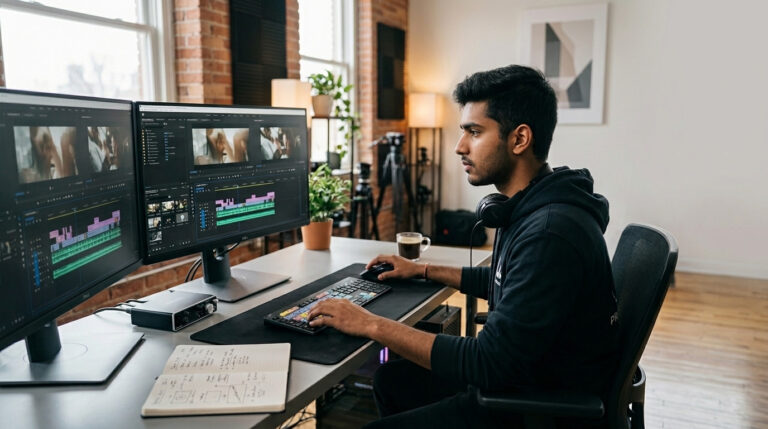
- Editing and color grading: learning to use post-production software and how to pace films
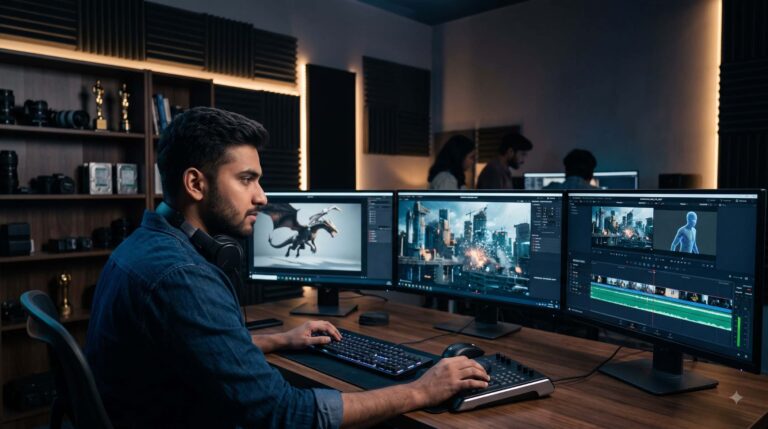
- VFX and motion graphics: learning compositing, animating and applying visual effects
The most popular mistake that future students make is about which option to choose regarding practical vs. theoretical film education. A degree college will give you knowledge about the history of cinema and the theory of mass communications, while a diploma-focused film institute in Kerala will throw you straight away on the set with a camera in your hands.
A media studies course makes much more sense if you want to land a job in the government sector, pursue a career in research, or even teach. On the other hand, if you wish to be on the film sets, work as an editor for a YouTube channel, or even work as a producer at a production house in one or two years, then a diploma in film making Kerala course is definitely a more suitable option.
That is precisely why film-making training has become more popular among students in the past few years. It is not a question of a certificate; it is about a showreel.
Why Kerala Has Become a Hub for Film and Media Careers?
The rise of Kerala as a media destination was not immediate but happened due to certain factors.
Today, Malayalam films are gaining popularity in different parts of India as well as internationally, and therefore there are higher production budgets along with an increased number of roles on set. In addition, OTT players such as Amazon Prime, Netflix, and others are commissioning Malayalam content, thus requiring more editors, colorists, and specialists in visual effects who work with the latest digital formats.
Moreover, YouTube channels from around Kerala, ad agencies, and event production companies require specialists who know how to work with short videos and motion graphics. This is one of the reasons why there has been a rise in the number of queries about best film making institute in Kerala over the years. There is more than a diploma students want to get, they look for the opportunity to work in the media industry after graduation.
How to Choose the Right Media School: Step-by-Step?
This is what most blogs tend to miss out on. Anyone can make a list of institutions. But very few talk about comparing them. This is the step-by-step guide that one must follow before making a shortlist of the best film schools in Kerala.
- Review the Curriculum & Specializations
First thing first, ask yourself if this institution teaches what you want to learn. Many institutes claim to provide “film courses” without even going into details of what it comprises.
Here is what your curriculum should comprise:
- Script writing and direction course offerings, if storytelling is your interest
- Cinematography course modules with camera and lighting practicals
- Editing and color grading course training on industry-standard software
- Specific modules for visual effects, motion graphics, or sound design if you are interested in those disciplines
When an institution cannot provide a syllabus or at least an idea of what takes place in the program on a weekly basis, then that is a warning sign. A serious film institute in Kerala will have this ready before you even ask.
- Look at Faculty Experience
This one matters more than most students realize. Someone who has only taught film theory in their career cannot train you for the actual set. You need experienced professors, which means those who have worked on sets before and not merely a person with a degree in media who teaches in class.
Here are some direct questions to ask:
- Has the faculty worked on actual film or television projects?
- Are they still active in the industry or have they retired completely to teach?
- Do they use actual industry case studies or only textbooks for examples?
- Evaluate Infrastructure and Equipment
Learning cinematography requires hands-on work with a camera, and learning editing requires up-to-date editing software. Before selecting the best film schools in Kerala, make sure you visit the campus and see the following:
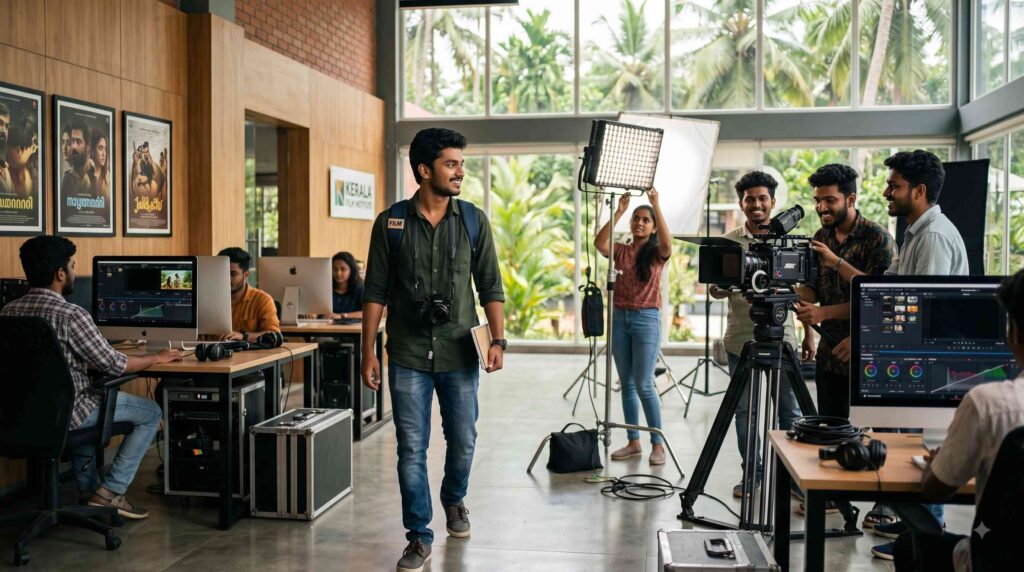
- The film production equipment and studio availability: cameras, lights, editing facilities
- Whether the equipment is used by too many students and therefore creating delays
- The software licenses for editing, color correction, and VFX software
- A proper studio or shooting space, not just classrooms
- Placement Support and Industry Connections
A certificate is useless unless there is something at the end of it. Find out directly about placement assistance, and never accept generic statements like ‘we place our students in jobs.’ Get the facts.
- What is the percentage of placement within six months of last year’s batch?
- Is there any alumni network within the Malayalam film industry?
- Are there collaborations with production houses, advertising firms, or OTT content creators?
- Do they provide any internship opportunities during the course, not just after completion?
- Industry connect and mentoring through the course are far more important than the placement cell because that is where the industry contacts are made, which helps in bagging the first break.
- Course duration, Fees and Flexibility
Compare the cost with what you get in return. There are affordable film courses in Kerala, but cheap does not necessarily imply good, and expensive does not mean better either.
Verify:
- Cost vs. what you get (software, equipment, etc.)
- Whether the course duration matches your career timeline
- Payment plans or installment options, since many families budget this carefully
- Any hidden costs for equipment rental, software, or final project production
- Location and Learning Mode
However, everyone may not be able to move to a metro city for a course. Find out if the training takes place online.
- Portfolio Development
Any decent diploma course will ensure that you leave the institution with a portfolio for filmmaking. Ensure that the course provides the following:
- Short film-making projects as part of the curriculum
- Guidance on building a personal showreel
- Opportunities to submit work to film festival opportunities for students
- Real criticism about your performance through professionals who actually work in the field rather than scores
Media School vs. Film Institute: What is the Practical Difference?
These two phrases are generally used interchangeably by students, but there does exist a difference between them, which needs to be known when comparing media school vs. film institute.
While a media school will have a wide area of studies, including journalism, TV, digital media, and even advertising, besides filmmaking, a film institute will only concentrate on filmmaking in any of its forms.
Neither is automatically better. If you want a broad understanding of media and communication with the option to specialize later, a media school fits. If you already know you want to work specifically in film production, a focused film institute in Kerala will get you industry-ready faster, because every module is built around that one goal.
Careers You Can Build After Film School
Before you commit to any course, it helps to know where it actually leads. A career in film industry Kerala roles now spans far more than “becoming a director.” The following is a realistic outline of the routes graduates from a diploma course may take:
- Cinematography careers: starting as camera assistants, becoming DOPs in short films, advertisements, or feature films
- Film editing careers: working in post-production studios, OTT filmmaking companies, freelance film editing
- Careers in VFX and motion graphics: compositing studios, ad agencies, gaming and animation houses
- Careers in scriptwriting and direction: assistant director roles, writing for web series, freelance scripting
Another emerging rift is that of freelance vs. studio career paths. The former provides a steady path with defined progression levels while the latter provides more flexibility, and after establishing oneself, income comes faster. Both career paths are not wrong, but it’s best to be aware of which career path you are preparing yourself for because of the skills you learn in the course.
OTT and digital content careers deserve a special mention here. A large chunk of hiring right now is not for feature films at all. It is for web series, YouTube content, branded videos, and short-form social content. If your course only trains you for traditional film sets and ignores this side, you may be missing out on where most of the actual job openings are right now.
Why Tiju’s Media School Is Worth Considering?
Tiju’s Academy has built its reputation over the years training students for competitive exams like OET and IELTS, and that same discipline and structured teaching approach carries into Tiju’s Media School Film Course offerings.
We provide diploma programs across the four core areas that matter most in today’s industry:
- Diploma in Script Writing and Direction
- Diploma in Cinematography and Still Photography
- Diploma in Editing and Color Grading
- Diploma in VFX and Motion Graphics
We are the best film institute in Kerala for those students who look forward to learning through practical training as opposed to theoretical lectures, which do not help them acquire any skill. The above checklist is the basis of our courses, just like yours.
We provide flexible offline learning based in Mavelikara, with a branch in Thiruvalla, which makes us a genuinely accessible media school Mavelikara option for students across central and southern Kerala who don’t want the added cost and disruption of relocating to a bigger city. Combined with our track record in exam coaching and student mentorship, Tiju’s Academy brings the same discipline and personal attention to its media courses that it is already known for.
Conclusion
The choice of an appropriate media school can be made by answering a few simple questions. Is the program aligned with your goals? Are the teachers themselves active participants of the industry? Will you leave with a portfolio, not just a certificate? And does the institute’s location and cost genuinely work for your life, not just look good in a brochure?
Film schools in Kerala are plentiful in number, and each claims to be the best. The important thing is to choose an institute that will give serious consideration to your requirements, be they direction, cinematography, editing, or visual effects.
At Tiju’s Media School, we built our media programs around exactly this kind of practical, honest training. If you are ready to take the next step, reach out to us to learn more about our diploma programs, meet our faculty, and see our facilities in person before you decide. Inquire now to book a free counselling session and find out if Tiju’s Media School is the right fit for your 2026 admission.
Frequently Asked Questions:
A: There isn't one single "best" institute for everyone. The right choice depends on your goals, budget, and location, but a strong film institute should offer practical training, experienced faculty, real equipment access, and placement support. Tiju's Media School is built around exactly this checklist.
A: A media school is a specialized institution focused on mass communication education, offering hands-on training in the tools and workflows used on real film sets and in production houses, unlike a regular arts or science college that only offers a media paper.
A: Most film institutes in Kerala offer courses in script writing and direction, cinematography and still photography, editing and color grading, and VFX and motion graphics, each focused on hands-on, industry-relevant skills.
A: A diploma is better if you want to work on film sets, edit content, or join a production house within a year or two. A degree suits students aiming for government jobs, research, or teaching, since it focuses more on theory.
A: Kerala's media industry has grown due to the rising popularity of Malayalam cinema, increased OTT content commissioning by platforms like Amazon Prime and Netflix, and demand from local YouTube channels, ad agencies, and event production companies.
A: Before enrolling, check the curriculum and specializations, faculty industry experience, equipment and studio access, placement support and alumni network, course fees and duration, and whether the course helps you build a real portfolio.
A: A media school covers a broad range of fields like journalism, TV, and digital media alongside filmmaking. A film institute focuses specifically on filmmaking disciplines such as direction, cinematography, editing, and VFX.
A: Graduates can work as camera assistants or DOPs, post-production editors, VFX and motion graphics artists, or assistant directors and scriptwriters, across film sets, OTT platforms, ad agencies, and freelance projects.
A: It depends on your priorities. A studio career offers steady progression and stability, while freelancing offers more flexibility and faster income once you're established. Your course should help build skills matching your chosen path.
A: Tiju's Media School offers diploma programs in script writing and direction, cinematography, editing and color grading, and VFX and motion graphics, taught with the same structured, practical approach the academy is known for in its exam coaching programs.
A: Tiju's Media School is based in Mavelikara, with an additional branch in Thiruvalla, making it an accessible option for students across central and southern Kerala who want to avoid relocating to a bigger city.
A: Yes, the courses are built around practical training, including short film-making projects and hands-on production work, which helps students leave with a real portfolio rather than just a certificate.