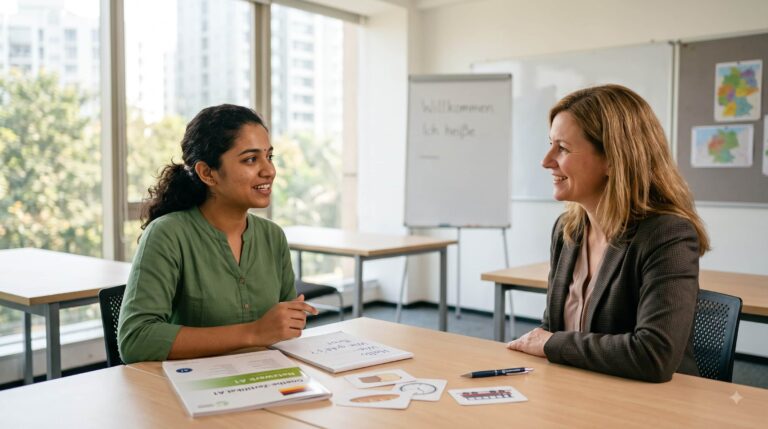
The conjugation of verbs in the German language is altering the ending according to who does the action and the time the action takes place. In the German language, the person first starts by using the infinitive form of the verb and then alters it accordingly. The whole thing may sound difficult, but it will be helpful to know that there are certain rules of conjugating verbs that can be easily learned in a few minutes. The following paper includes the conjugation of verbs in the Präsens, Perfekt, and Präteritum tenses.
Let us look at it in detail.
What Are German Verb Conjugations?
Verb Conjugations in German refer to the different ways in which the verb is used according to the person and the time. The infinitive form of every verb is basically the dictionary form of the verb, which in this case includes “machen (to do)” and “spielen (to play).”
This is how it works:
- The infinitive is the root form, which normally ends with -en, e.g. lernen (to learn).
- The part before the ending is the verb stem, like lern-.
- You add a personal ending to the stem to match the subject, like “lerne,” “lernst,” and “lernt.”
So conjugation is simply stem plus ending. So the main thing is, when you know the endings, you can conjugate thousands of verbs. These German verb conjugation rules are the foundation of every sentence you will build, which is why we start here with every learner in our Tiju’s Academy German classes.
Is German Verb Conjugation Hard?
German verb conjugation can be easily done once you learn how to conjugate one verb because all the verbs are in the same pattern. This is due to the fact that there are repetitive endings.
So, is German verb conjugation hard? Here is the honest answer:
- Regular verbs are easy. They all take the same endings.
- Irregular verbs need a little memory work, but there are not that many common ones.
- For the most part, the verb endings remain the same throughout tenses, allowing your efforts to bear fruit quickly.
It all comes down to learning the pattern and practicing the few exceptions afterwards. The learners who attempt to memorize each verb separately get confused. The learners who recognize the pattern do things efficiently. This is precisely how we teach and why we can proudly call ourselves the best German language institute in Kerala.
Imagine it in this way. Modifications also take place in English. You say “play” and “plays,” where ‘s’ is for the third-person singular verb. German does it a little more frequently, adding some more endings. Thus, it is not anything revolutionary, but rather a different type of ending to learn. Once you understand that the ending changes depending on the subject, the system becomes logical, not scary. So daily practice is what’s necessary.
How Many Verb Conjugations Are There in German?
German has six basic tenses and some moods, from which you have all possibilities of verb formation. As a beginner, however, you don’t have to know many of them to speak German fluently.
Main ones you’ll have to know are:
- Präsens: present tense, which is used when you describe the action taking place at the very moment.
- Perfekt: present perfect, the most commonly used past form in speaking.
- Präteritum: simple past, which is used mostly in written language and some commonly used verbs.
- Futur: future tense.
- Konjunktiv: subjunctive.
- Imperative: for giving commands.
German conversation takes place in the indicative mood in just three tenses, which are the present, Perfekt, and Präteritum. It is important to learn these first. The rest can wait until A2 and B1 level.
There is another way people count conjugations. Each individual tense offers you one set of personal endings for one verb in that tense. When you consider the Sie-form separately from the sie-form, you end up with approximately eight endings for each verb in that particular tense. It might seem like an excessive number to learn, but in reality two of these endings will be alike in most cases because of the similar ending of wir, sie and the Sie-form. In other words, you have to learn only several forms of the ending and use them with regular verbs.
German Verbs: Basic Rules of Conjugation in Present Tense
In order to conjugate a German verb into present tense, one should simply take the stem of the verb and add an appropriate personal ending depending on the subject. It is the best feature of the German language grammar system, and, therefore, we have to make it perfectly clear.
Here is how one should “conjugate a verb in German”:
- Take the infinitive form of the verb, for example, “spielen” (to play).
- Remove the -en ending to get the stem: spiel-.
- Add the personal ending for the subject.
The German verb endings in the present tense are:
- ich (I): -e
- du (you, informal): -st
- er, sie, es (he, she, it): -t
- wir (we): -en
- ihr (you all): -t
- sie, Sie (they, formal you): -en
This leads to: ich spiele, du spielst, er spielt, wir spielen, ihr spielt, sie spielen. And that is what subject-verb agreement is all about. Just remember these six endings, and the German verb conjugation present tense is yours for almost all regular verbs.
German vs English Pronouns
You would require the German pronouns for proper conjugation, as it is dependent upon the ending that you use, depending upon the subject. The good news is that German pronouns are actually quite close to English pronouns.
These are the German personal pronouns along with their corresponding English pronoun:
| German | English | Person |
| ich | I | first person singular |
| du | you (informal) | second person singular |
| er / sie / es | he / she / it | third person singular |
| wir | we | first person plural |
| ihr | you all (informal) | second person plural |
| sie | they | third person plural |
| Sie | you (formal) | formal address |
One difference trips up beginners. There are three forms of the pronoun “you” in the German language. You use du when addressing friends or family members, ihr when talking to your friends collectively, and Sie when you are being polite and talking to a stranger or someone you need to show respect to at work. Which form to use is a part of good German manners, and our German tutors help you learn it with the help of roleplay exercises.
How Do You Conjugate a German Verb? Regular Verbs
The regular verbs or weak verbs always follow the same pattern without any exceptions. As soon as you memorize the endings, you will be able to conjugate all regular verbs using the same pattern. That is what makes verb conjugation for beginners simple.
Here is a neat chart of the conjugation of a regular German verb machen (to do/make):
| Pronoun | Form |
| ich | mache |
| du | machst |
| er / sie / es | macht |
| wir | machen |
| ihr | macht |
| sie / Sie | machen |
Other regular verbs in German work the exact same way. Try it with these common ones:
- lernen (to learn): ich lerne, du lernst, er lernt.
- wohnen (to live): ich wohne, du wohnst, er wohnt.
- spielen (to play): ich spiele, du spielst, er spielt.
See the pattern? Same stem, same endings, every time. Once this clicks, you can conjugate hundreds of regular verbs without a table. We drill this until it becomes automatic in our Tiju’s Academy German training.
Irregular German Verbs
Irregular verbs, also known as strong verbs, modify their stem vowel in certain conjugations, and therefore it is difficult to depend solely on the rule. Although there are very few common verbs in this category, they keep repeating themselves and hence need to be memorized at an early stage.
The two most common irregular verbs in German are sein (to be) and haben (to have). These are:
sein (to be)
- ich bin, du bist, er ist, wir sind, ihr seid, sie sind.
haben (to have)
- ich habe, du hast, er hat, wir haben, ihr habt, sie haben.
Many irregular verbs only change in the “du” and “er” forms through a stem-vowel change. For example:
- fahren (to drive): ich fahre, but du fährst, er fährt.
- essen (to eat): ich esse, but du isst, er isst.
- sprechen (to speak): ich spreche, but du sprichst, er spricht.
- lesen (to read): ich lese, but du liest, er liest.
But the endings remain unchanged. All that changes is the vowel in the stem. Study the basic verbs, such as sein, haben, gehen, and fahren, and you will have learned the majority of what you need to know at an A1 level of German.
What Are the 3 Forms of Verbs in German?
There are three main forms of the verb in German, which you must learn in combination: the infinitive, the simple past, and the past participle.
The 3 forms of German verbs are the following:
- Infinitive: the base form, like gehen (to go).
- Simple past (Präteritum) stem: like ging (went).
- Past participle: like gegangen (gone), often starting with the “ge-” prefix.
For example, “machen” gives you “machen,” “machte,” and “gemacht.” And “sein” gives you “sein,” “war,” and “gewesen.” Whenever you learn a new verb, learn all three of them together. It will save you hours later on. And this is an integral part of our step-by-step approach to grammar.
German Verb Conjugation in Present, Perfekt and Präteritum
There are three tenses that you will be using in German the most often the present, the Perfekt and the Präteritum. Learn how it works here, and travel from present into past easily. German verb conjugation present, Perfekt, Präteritum in one easy lesson.
Present tense (Präsens)
Used for what is happening now or generally true.
- Ich spiele Fußball. (I play football.)
Present perfect (Perfekt)
The main past tense in spoken German. You build it with an auxiliary verb (haben or sein) plus the past participle.
- Ich habe Fußball gespielt. (I played football.)
- Ich bin nach Hause gegangen. (I went home.)
Most verbs use haben. Movement or change verbs such as “gehen” and “fahren” take “sein.” Perfekt – the past tense German people use every day, so master it.
Simple past (Präteritum)
Used mainly in writing and by some common verbs.
Ich spielte Fußball. (I played football.)
- Ich war müde. (I was tired.)
And here is the basic guideline that most students are seeking. Use Perfekt for the past in all cases of spoken German. For written German, and in combination with sein, haben, and modal verbs, use Präteritum, the German simple past. We make this Perfekt versus Präteritum choice easy with clear side-by-side practice.
How Should German Verb Conjugations Be Memorized?
The most effective approach for memorizing German verb conjugations involves learning the patterns and then using spaced repetition to memorize the common verbs. One should never try to memorize all verbs at once. Build from the most useful ones outward.
Here is how to memorize German verb conjugations without the stress:
- Learn the endings as a set. The six present-tense endings cover most verbs.
- Start with common verbs first. Master sein, haben, machen, and gehen before rare ones.
- Use flashcards and spaced repetition. Apps like Anki show verbs right before you forget them.
- Learn all three forms together. Infinitive, simple past, and participle in one go.
- Use mnemonics. Link tricky irregular verbs to a small mental picture.
- The trick is to do things small and frequent. Ten minutes daily of intense focus is better than an hour-long exhausting session. This is the approach our certified instructors, the so-called Fluency Alchemists by our students, take to get beginners to fluency.
German Verb Conjugation Exercises
The only sure way to remember your verb conjugation is through practice rather than memorization. You have to say and write the verbs. Here are some easy German verb conjugation exercises for you to begin immediately.
- Conjugation: Select any one verb and recite its six forms in the present tense.
- Sentence creation: Write three sentences with each newly learned verb in present and Perfekt tenses.
- Oral practice: Talk about your day with your friend using the past tense verbs.
- Fill in the blanks: Leave the verb in the sentence blank and fill it with its correct form.
- Quizzes: Take mock tests every week involving both regular and irregular verbs.
Try this quick drill now. Conjugate lernen in the present tense: ich lerne, du lernst, er lernt, wir lernen, ihr lernt, sie lernen. Then put it in Perfekt: ich habe gelernt. That is real practice in under a minute.
Here is a second drill to try with an irregular verb. Take sprechen (to speak) and say each form out loud, watching for the vowel change: ich spreche, du sprichst, er spricht, wir sprechen, ihr sprecht, sie sprechen. Notice how only the du and er forms shift the vowel from e to i, while the endings stay the same as always. Doing one regular verb and one irregular verb like this each day builds real speed without any stress. A good routine is three new verbs a day, each in the present and the Perfekt, spoken aloud and then written once. We give students fresh drills and a full German verb conjugation table set every week so practice never gets dull.
How Tiju’s Academy Helps You Master German Verbs?
Charts and rules get you started, but they will not carry you to fluency on their own. You need real practice, live feedback, and a clear plan. That is the gap we fill. As the best German language institute in Kerala, we turn confusing grammar like verb conjugation into something simple and repeatable.
Our lessons are built for real progress, and we provide a full system, not just theory:
- Beginner-friendly German lessons that start from zero.
- Step-by-step grammar explanations so nothing feels rushed.
- Real-life conversation practice and speaking roleplays.
- Pronunciation and listening practice.
- German vocabulary grouped by daily situations for faster recall.
- Short, structured lessons with progress tracking and milestones.
- Cultural tips, etiquette, and full exam preparation.
- Support from a teacher and a friendly learner community.
We also teach a set of signature methods you will not find anywhere else, and they make our Tiju’s Academy German courses different. Our Dialect Studio gives you talk time with a German native speaker, while Collocuts teaches the colloquial shortcuts that make you sound natural in real life. Through Off Book Learning and Germflix, our German movie sessions, you soak up authentic culture and sharpen your listening at the same time. For grammar and vocabulary, our Infinite Drill turns practice into fun activities for every kind of learner.
When exams come close, our system shifts into high gear. Modmaster breaks the course into modules for easy, module-wise exam prep, the Leistung technique gives you clear tips to hit your target score, and our Bootcamp Exam Preps run intensive sessions before the big day. Our certified Fluency Alchemists guide the whole journey, supported by the Einstein technique, our intensive deep-focus method for tricky topics.
We also care about how you feel while you learn. Stressfrei keeps our classroom a calm, stress free zone where comfort meets concentration, and our Reclaim Sessions build the confidence to speak without fear. With the ICT technique, our inner circle training, you get one to one attention on your weak points and direct time with your tutor.
On top of language skills, our Pro App Assistance helps you write your own professional CV and motivation letter for study and admission abroad. No matter whether you study with us face-to-face or take German language lessons online, this is why so many students describe our course as the best one for learning German.
Conclusion
It is not about learning long lists of conjugations but rather learning a few definite patterns such as the present tense endings, irregular verbs, and rules for the Perfekt and Präteritum. Practice every day, and soon it will be effortless for you.
If you want expert teachers, live feedback, and a proven plan, learn with us. As the best German language institute in Kerala, we offer the best course for beginners and beyond, with clear grammar training both in class and through German language training online.
Ready to start? Book a free demo class and see how simple German grammar can feel. Join Tiju’s Academy German training today, and let our trainers take you from your first verb ending to real, confident German.
Frequently Asked Questions:
A: Verb conjugation in German is changing a verb's ending to match the subject and the tense. You take the verb stem and add a personal ending, like "ich spiele" and "du spielst."
A: Remove the -en from the infinitive to get the stem, then add the ending for the subject. For example, "spielen" becomes "ich spiele," "du spielst," and "er spielt."
A: No, it is easier than it looks. Most verbs are regular and share the same endings, so once you learn one pattern, you can conjugate hundreds of verbs.
A: German has six main tenses plus a few moods. For everyday speaking, you mainly need three: present, Perfekt, and Präteritum.
A: The endings are -e (ich), -st (du), -t (er, sie, es), -en (wir), -t (ihr), and -en (sie, Sie). These six endings work for almost every regular verb.
A: They are ich, du, er, sie, es, wir, ihr, sie, and Sie. German has three words for "you": du for friends, ihr for a group, and Sie for formal, polite address.
A: Regular verbs, or weak verbs, follow one fixed ending pattern. Irregular verbs, or strong verbs, change their stem vowel in some forms, like fahren becoming du fährst.
A: The three forms are the infinitive, the simple past, and the past participle. For example, machen, machte, gemacht. Learn all three together for each verb.
A: Both are past tenses. Perfekt is the main spoken past and uses haben or sein plus a past participle, while Präteritum is the simple past used mostly in writing.
A: Use Perfekt in everyday conversation for the past. Use the Präteritum in writing and in speech for common verbs like "sein," "haben," and modal verbs.