Being an Indian nurse planning to practice in Germany, there is only one thing that you should never miss: Anerkennung. The Anerkennung process for Indian nurses is the official procedure through which your Indian nursing qualification is compared to the German equivalent, thus providing you with the legal permission to practice as a nurse in Germany.
In simple terms, Anerkennung converts your BSc nursing/GNM qualification into a recognized German nursing license. This guide helps you navigate the entire process for 2026, including the documents, the required German level, the two paths through the examinations, the actual costs involved, and the new faster ways available due to the latest changes in Germany’s immigration policy.
Every year, thousands of nurses from Kerala and all over India initiate this process. The nurses who progress the quickest are usually those who did everything correctly when getting their German.
What Is the Anerkennung Process for Indian Nurses?
Anerkennung is nothing but “recognition” in the German language. For nurses, it means that your training will be reviewed officially by a German authority and evaluated if it is equal to a German nursing qualification. The nursing profession is regulated in Germany, and you cannot practice as a nurse unless your qualification is recognized.
An equivalence assessment (Gleichwertigkeitsprüfung) will be performed by the appropriate authority within your chosen Bundesland. There are 16 Bundeslands in Germany and each conducts its own recognition office. That’s why regulations, fees, and time frames differ from one another.
Why should Germany bother about all that? Two main reasons. Patient safety is the number one priority, and only qualified nurses can have a protected designation, “Pflegefachperson.” Another reason is that there is a severe shortage of nurses in Germany and the Fachkräfteeinwanderungsgesetz (Skilled Immigration Act) is aimed at attracting trained nurses.
There are three possible results of your application:
- Full equivalence: your training is accepted as equal. Once you show the required German level, you get your license, which means full licensure.
- Partial recognition: the authority finds some gaps and issues a Defizitbescheid (deficit notice). You then complete a top-up.
- No equivalence: rare for standard Indian degrees, and it only happens when the differences are too large to bridge with one measure.
Most Indian nurses fall into the partial recognition group. That is completely normal and not a problem. It just means you finish one short step before full nursing recognition in Germany.
This is exactly why strong German is the foundation of the whole process and why Tiju’s Academy is trusted as the best German language institute in Kerala for nurses heading to Germany.
Anerkennung Process for Indian Nurses: Step by Step
Here is the Anerkennung process step by step, so you can see the full path from India to a German ward. If you have been searching for how to get nursing license in Germany from India, these eight steps are the honest answer.
- Choose your state and ideally an employer. Your target Bundesland decides which Zeugnisanerkennungsstelle (recognition office) handles your file. A German employer or agency can also sponsor and speed things up.
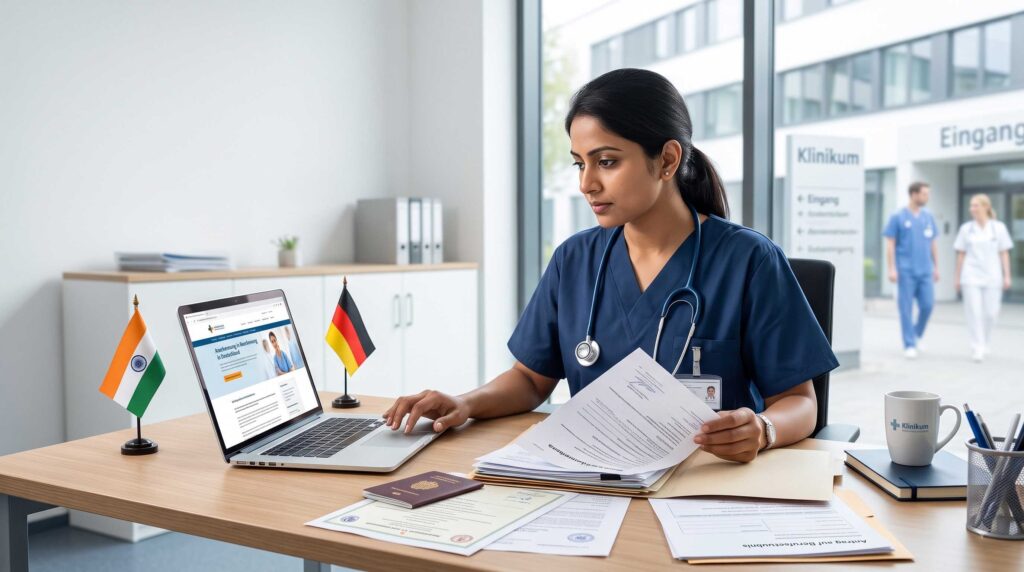
- Collect your documents. The standard documents required for Anerkennung nurses are your passport, nursing degree and mark sheets, nursing council registration, a detailed syllabus or curriculum, proof of work experience, your CV, and later your German certificate.
- Get certified translations. The documents must be certified translated to German by a notary translator and stamped.
- Send the application and make the payment. You submit everything to the competent body in the respective state.
- Get the decision. Either you receive the Anerkennungsbescheid for complete recognition or Defizitbescheid listing your deficiencies.
- Complete a top-up if asked. This is called an Ausgleichsmaßnahme (compensatory measure). It is either an adaptation course or a knowledge exam, both explained in the next section.
- Reach the required German level. Most states want B2 German for nurses, proven with a Goethe-Zertifikat B1/B2. A Goethe B2 in nursing is the usual target.
- Get your license. With a Berufserlaubnis (permit to work), you will be able to begin work. Once you complete all tasks, you get the Berufszulassung/Berufsurkunde (license), allowing you to use the protected title of nurse.
How long does all of this take? For most nurses it runs about 12 to 18 months from start to full recognition of Indian nursing degree in Germany, depending on your state and how quickly you clear German.
The step that slows most people down is not the paperwork. It is the language. That is where Tiju’s Academy german Courses come in. We take nurses from zero to exam-ready with a syllabus built around hospital and ward vocabulary, so your German grows in the exact direction the job needs.
Kenntnisprüfung or Anpassungslehrgang: Choosing Your Compensation Route
If you receive a Defizitbescheid, you close the gaps with one of two routes, and in most cases you get to choose. This is the well-known Kenntnisprüfung vs. Anpassungslehrgang decision, and both roads lead to the same place: full recognition.
Anpassungslehrgang (adaptation course)
The Anpassungslehrgang for nurses (adaptation course) is a supervised practical placement inside a German hospital or care home.
- It usually lasts about 6 to 12 months, and sometimes up to 18, based on the gaps in your notice.
- You work in the exact areas your Defizitbescheid flagged, under supervision.
- You earn a regular salary while you complete it.
- It suits nurses who learn best by doing and want hands-on ward time.
Kenntnisprüfung (knowledge exam)
The Kenntnisprüfung for nurses (knowledge exam) is a single test that replaces the placement.
- It has a written part and a practical or oral part.
- Nurses normally go through preparation for three to six months prior to taking the test.
- The pass rate of highly prepared candidates is normally between 60% and 80%.
- It is recommended for nurses who are good at taking examinations and wish to complete it early.
Not sure which one fits you? A quick way to decide:
- Want a salary while you finish, and prefer real-world practice? Lean toward the Anpassungslehrgang.
- Are you comfortable with exams and want the faster finish? Lean toward the Kenntnisprüfung.
Both routes still demand solid German, so your best course to learn German should train medical vocabulary and exam technique together, not just grammar. Our Modmaster module mastery and Bootcamp exam preps are built for exactly this kind of pressure.
How Much Does the Anerkennung Process for Indian Nurses Cost?
The official recognition fee usually falls between €170 and €845, depending on your state and profession. That is only the government charge, so it helps to plan for the full picture instead of just one line.
Here is where the money actually goes:
- Recognition authority fee: roughly €170 to €845. This is the core Anerkennung fee paid to the state office.
- Certified translation of documents: priced per page, so it depends on how many pages you have.
- Compensatory measure: either a Kenntnisprüfung prep course or an Anpassungslehrgang placement. The placement is usually paid, so it can offset your costs rather than add to them.
- German language training: your biggest and most useful investment, because B2 is not optional.
- Exam fees: Goethe exams and the Kenntnisprüfung fee if you take that route.
- Visa, flights, and living costs: once you actually move to Germany.
So the real Anerkennung process cost is a mix of several parts, and the fee charged by the authority is only one of them.
One smart way to keep costs down is to clear German the first time, without repeats. Our German language training online lets nurses across India study from home with the same trainers, materials, and mock exams as our classroom batches. That way you are not paying twice to relearn the same modules.
Understanding the Anerkennung Process in 2026: New and Faster Routes
The Germans have modified their criteria to accelerate the process for nursing students, and 2026 sees the introduction of two new changes that must be kept in mind when applying.
- Recognition Partnership (Anerkennungspartnerschaft): Through this process, you will be able to join Germany at a lower German level such as A2 or B1, begin working, and complete your recognition and language program while in Germany. This is a big shift, because earlier you had to complete much more from India first. It is a real answer to nurses who cannot wait years before moving.
- “Digital First” processing: German authorities now aim to review the equivalence check within about 60 days when your documents are submitted digitally through the federal portal. This is a target rather than a guarantee, but it signals shorter waits than the old paper-based system.
There is also a practical point about working while you wait. Before full recognition, you can often work as a Pflegehilfskraft (nursing assistant) with B1 German and then move up to full Pflegefachkraft status once you are recognized. That is the day-to-day reality of Pflegefachkraft recognition for foreign nurses.
It pays to clarify a point of confusion. A Berufserlaubnis allows temporary employment until you fulfill the rest of your requirements. Once you have full recognition, it means you can use your title permanently, and as time goes by, you will find yourself on the road to Niederlassungserlaubnis.
These faster routes only work if your German keeps moving without long breaks. That is why nurses choose Tiju’s Academy German classes to stay on track from A1 to B2 at a steady pace.
How Tiju’s Academy Helps Indian Nurses Pass German for Anerkennung?
German is the deciding factor in the entire nursing recognition in Germany process, and we built our whole program around healthcare nurses. We are the best German language institute in Kerala for nurses because every lesson points at one goal: a confident Goethe B2 and a spot in a German hospital.
Here is what you get when you learn with us:
- Beginner-friendly German lessons starting from A1
- Step-by-step grammar explanations
- Real-life conversation practice and roleplays
- Pronunciation training that helps you sound natural
- Vocabulary grouped by daily life and ward situations
- Listening exercises with native-style German
- Cultural tips and workplace etiquette for German hospitals
- Short, structured lessons with clear progress milestones
- Exam preparation, plus support from a teacher and a learner community
On top of the basics, we run our own methods that nurses genuinely enjoy:
- Dialect Studio: talk time with a German native speaker
- Collocuts: colloquial German shortcuts for real-life speaking
- Off Book Learning: authentic German culture sessions led by experts
- Germflix: German movie time to sharpen your listening
- Modmaster: module mastery with module-wise exam preparation
- Leistung technique: clear tips and tricks to hit your target score
- Stressfrei: a calm, stress-free zone where comfort meets concentration
- Infinite Drill: fun, effective drills for every kind of learner
- Fluency Alchemists: certified trainers who take students from zero to hero
- Bootcamp exam preps: intensive sessions to lift your exam score
- Reclaim Sessions: confidence sessions so you speak without fear
- ICT technique: inner circle training, with one-on-one attention on your weak points
- Albert Einstein’s intense techniques: focused, intensive methods for deep learning
- Pro App Assistance: professional help to build your own CV and motivation letter for admission
Whether you join our classroom batch in Mavelikara and Thiruvalla or our German language training online, the trainers, materials, and mock exams stay the same. For nurses who want the best course to learn German with a clear finish line, one demo class is usually enough to make the decision.
Common Mistakes Indian Nurses Make in the Anerkennung Process
A few avoidable errors slow nurses down every year. Keep an eye on these:
- Leaving German for last. German is the longest part of the process, not the paperwork. Start your B2 German for nurses early, ideally before you even apply.
- Applying to the wrong state. Fees and waiting times change by Bundesland, so research your target state before you send a single document.
- Weak or missing documents. An incomplete file or a poor certified translation is one of the main reasons a Defizitbescheid takes longer to resolve.
- Panicking over a deficit notice. A Defizitbescheid is normal for Indian nurses. Pick your route, either the Kenntnisprüfung or the Anpassungslehrgang, and keep moving.
- Studying German without a plan. General classes are not enough for this exam. You need ward vocabulary and real exam technique, which is exactly what our nurse-focused Tiju’s Academy German courses are built to give you.
Avoid these five, and the recognition of Indian nursing degree in Germany becomes far smoother from start to finish.
Conclusion
Anerkennung process for Indian nurses is not a barrier. It is an open process and very predictable. Sort out your documents, clear the German language at the B2 level, undertake a top-up course in case the authority demands, and begin your career as a recognized nurse in Germany. When you know the process, the result will be within your reach.
By controlling this process, you have full power over German language proficiency, and this is where we assist you. Enroll yourself in Tiju’s Academy German classes either online or at our academies situated in Mavelikara and Thiruvalla and be ready to get solid German language knowledge from our expert tutors till Goethe B2.
Frequently Asked Questions:
A: Anerkennung is the official German process that compares your Indian nursing qualification with the German standard and gives you legal permission to work as a nurse in Germany. In short, it converts your BSc Nursing or GNM degree into a recognized German nursing license.
A: For most nurses, the Anerkennung process takes about 12 to 18 months to reach full recognition. The exact time depends on your chosen Bundesland (state) and how quickly you clear B2 German.
A: The official recognition fee is usually €170 to €845, depending on your state and profession. On top of that, budget for certified document translation, German classes, exam fees, and visa and living costs after you move.
A: No, a Defizitbescheid is not a rejection. It is a deficit notice that lists the gaps between your training and the German standard. You close those gaps with a top-up, either the Kenntnisprüfung or the Anpassungslehrgang.
A: Choose the Anpassungslehrgang if you prefer a paid, supervised hospital placement (around 6 to 12 months) and learning by doing. Choose the Kenntnisprüfung if you are confident in exams and want to finish faster with a single test. Both routes lead to full recognition.
A: Yes, most German states require B2 German for full recognition, usually proven with a Goethe-Zertifikat B2. Some routes let you enter Germany earlier at A2 or B1, but working as a fully recognized nurse needs B2.
A: Yes, in a limited way. With B1 German you can often work as a Pflegehilfskraft (nursing assistant) or on a Berufserlaubnis (temporary work permit) while you finish. Full nurse status, however, needs complete recognition and B2 German.
A: Yes, through the Anerkennungspartnerschaft (recognition partnership). This route lets you enter Germany at a lower level such as A2 or B1, start working, and complete your recognition and language study inside Germany.
A: You need your passport, nursing degree and mark sheets, nursing council registration, a detailed syllabus, proof of work experience, your CV, and your German certificate. All documents must have certified German translations.
A: A Berufserlaubnis is a temporary work permit that lets you work while you finish the remaining steps. Full recognition (your Berufsurkunde) is permanent, lets you use the protected nurse title, and over time opens a path to permanent residence (Niederlassungserlaubnis).