German is the official language for six countries, and in forty countries German is spoken by small communities of people. The countries where German is spoken are Germany, Austria, Switzerland, Liechtenstein, Luxembourg, and Belgium. In this blog article, we will discuss each one of them, followed by an explanation of the question “Why learn German?” and how a “German language course” can be started for learners in Kerala.
The German-Speaking Countries, in One Look
German-speaking countries refer to nations where the German language is either an official or recognised one. In total, six nations consider it an official national language. Others consider it a regional or minority language.
The term “DACH” will be used very often. It is basically a combination of the country codes. The codes for Germany, Austria, and Switzerland are D, A, and CH, respectively. Despite the different dialects people speak, the three use the same standard form of the German language.
The following is the list of German-speaking countries:
- Germany, Austria and Liechtenstein: German is the sole official language
- Switzerland: one of four official languages
- Luxembourg and Belgium: one of three official languages
- Italy’s South Tyrol: official at the regional level, not national
That’s the answer to which countries speak German officially. Short list. The rest of this article fills in the where and the why.
How Many Countries Speak German?
The number of nations where German is spoken will depend on the definition used. Six nations speak German as an official national language. If we use minority languages in our definition, the number will be in the range of 15 to 20 nations. However, including any country that has even one German-speaking group, the number exceeds 40.
For anyone actually planning to study or work abroad, the six official ones are what matter. This will be your place of residence and the German you learn in a German course in Germany.
Countries Where German Is the Official Language
The nations whose official language is German are Germany, Austria, Switzerland, Liechtenstein, Luxembourg, and Belgium. All six of them are situated on the continent of Europe. Five of them have common borders with at least one of them.
Germany
Germany is the country with the largest number of German speakers, about 83 million. There is only one official language here, which is German and is spoken everywhere – in schools, courts, offices, etc.
This is also the reason why half of the population of Kerala is learning German these days. Germany is in need of nurses, engineers, healthcare workers, and IT specialists and recruits them directly from India. Almost all these positions require getting a B1 or B2 certificate first. This is the reason why there are so many German language courses in Kerala now.
Austria
The nine million inhabitants of Austria basically speak German. The language used in Austria is different from that used in Germany in that it uses distinct vocabulary and is softer to the ear, but the writing is the same as in Germany. Another reason for many Indians to study in Vienna is that public universities there charge very little in fees.
Switzerland
The languages used in Switzerland include German, French, Italian and Romansh. The majority of people speak German, which makes up about 62 percent of the total population in cities like Zurich, Bern and Basel.
Here’s the part that trips learners up. The Swiss speak Swiss German at home, and honestly it barely sounds like the German you’ll study. But they write in Standard German and switch to it with outsiders. So your textbook German still works fine. A proper German-speaking course just trains your ear early so the accent doesn’t throw you later.
Liechtenstein
Liechtenstein is a highly miniature nation of about 40,000 people, located between Switzerland and Austria. The sole official language of Liechtenstein is German, but there is also a native dialect of German.
Luxembourg
The three languages of Luxembourg are Luxembourgish, French, and German. Even though Luxembourgish is used at home, German is extensively used in print media, education, and government paperwork, and it is easily comprehended by the natives.
Belgium
However, everyone is familiar with Dutch and French in Belgium. The latter is the silent one, that is German. German is spoken in the eastern region of the country near Germany, and it comprises some 77,000 speakers. Less than one percent of the country’s population speaks this language.
German-Speaking Countries in Europe Other Than the Big Six
There are some countries in Europe where the population speaks German, but it is not the official language of that country. There is always a reason for such a situation, which could be either war-related or connected with settlers who spoke German a long time ago.
- Italy: The South Tyrol area has about 300,000 German speakers, and German has official status along with Italian there. Signs, schools, and government offices use both languages.
- Poland: about 100,000 in the Opole area, and there are bilingual signs in some towns there.
- France: Alsace-Lorraine has a German heritage. The old people speak Alsatian; however, it is French that reigns supreme here now.
- Denmark, Hungary, Romania, the Czech Republic, and Slovakia: they all possess small numbers of Germans who have schools and newspapers of their own.
- Russia and Kazakhstan: Volga Germans.
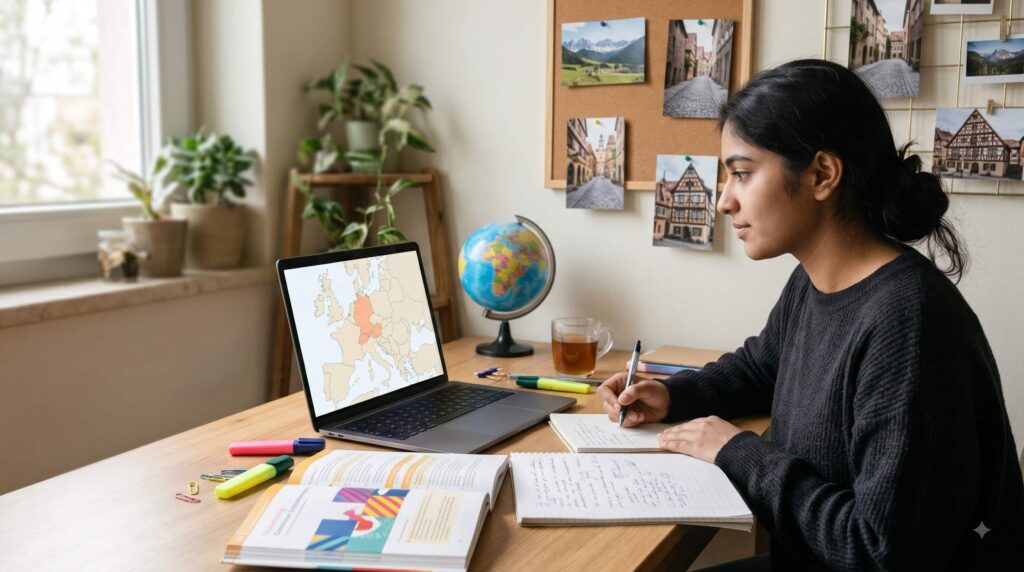
Draw a map of Europe showing where the German-speaking countries are, and the pattern is clear. There’s a block of German countries in the middle and a narrow band around the edge. The band marks the history.
For an Indian learner, this matters more than it sounds. Standard German is understood across the whole region, so one certificate travels everywhere on that map. It’s also why people search for the best German language institute in Kerala instead of just any nearby tuition centre. Clean Standard German holds its value.
German-Speaking Countries Outside Europe
German-speaking countries outside Europe exist because people left. During the time from the 1700s through the 1900s, there were millions of German people who settled in the Americas, Africa, and Australia and kept their language alive in rural farming communities and churches.
Namibia is exceptional. Namibia was a German colony until 1915. The German language is still one of the official languages of Namibia, and the number of German speakers there is between 20,000 and 30,000. Namibia’s capital, Windhoek, has German place names, German bakeries, and even a German newspaper. Nothing like that exists anywhere in all of Africa.
The largest German-speaking community in South America is located in Southern Brazil. Germans founded towns such as Blumenau and Pomerode in the 1800s, and from one to three million people in Brazil still speak German, mainly in the form of old dialects. A few local councils have even made it co-official.
There’s more scattered around. Argentina and Paraguay have sizeable communities, including Mennonite colonies that still use a dialect called Plautdietsch every single day. German was once the second most common language in the United States, and about a million Americans still speak it at home, including the Amish with their Pennsylvania Dutch. Canada and Australia have their own pockets too, from Manitoba to the Barossa Valley.
Students sometimes worry the German they learn in Kerala won’t match all this. It will. E each and every one of these groups speaks Standard German in all formal situations, which is precisely what you get when you enroll in good German language training online or classroom-style.
How Many People Speak German in the World?
How many speak German in the world? Around 95-100 million speak it as their native language. If you include those who speak it as their second or foreign language, then it would amount to around 130-155 million.
Here are some interesting facts:
German is the most spoken native language in the European Union, ahead of French and Italian.
- It’s one of the EU’s 24 official languages and a main working language of the European Commission.
- Roughly 15 million people are learning it worldwide right now, according to Germany’s Federal Foreign Office.
India is one of the fastest-growing markets for it, and Kerala drives a big chunk of that, mostly on the back of nursing recruitment. Plenty of those students begin with Tiju’s Academy German courses, precisely because the training is shaped around the certificate levels German employers actually check for.
Why Learn German?
Why learn German? Because it’s one of the few languages that leads straight to jobs, cheap education, and a real shot at settling in a wealthy, stable part of the world. For Kerala especially, the maths works out better than almost any other foreign language.
The benefits of learning German worth caring about:
- Nursing jobs: Germany hires thousands of nurses a year. A B2 certificate gets Indian nurses recognised and working, with proper salaries and residence rights.
- Ausbildung: Germany’s dual training system pays you a stipend while you learn a trade. Most programmes want B1 or B2. A good route if a full degree isn’t the plan.
- Nearly free university: Public universities charge little or no tuition, even for international students.
- Engineering and IT: Home to Bosch, Siemens, BMW and SAP. German lifts both your odds and your pay.
- The whole DACH region on one language. Germany, Austria and Switzerland, all three.
- Easier than people fear. English and German share roots. Haus, Wasser, Mutter and Freund need no translation. Grammar is the grind, but vocabulary comes quick.
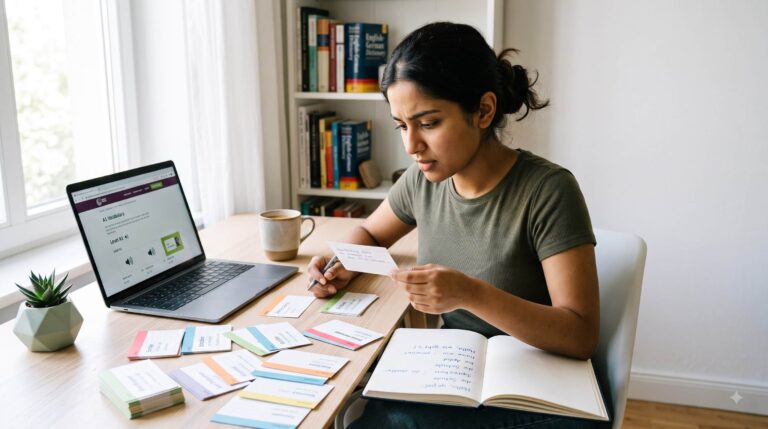
The one condition running through all of this is the certificate, usually from the Goethe-Institut, ÖSD, or telc. Self-study rarely gets anyone to B2 in decent time, which is why the best course to learn German beats the cheapest one every time. Structure and exam practice save you months.
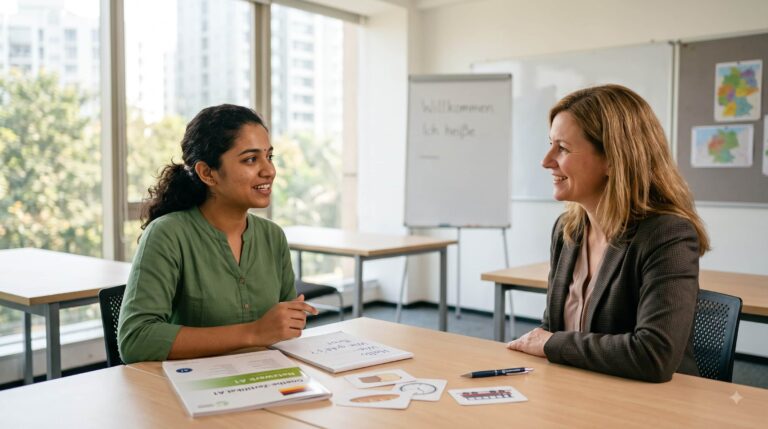
Tiju’s Academy runs its German language course along the CEFR levels from A1 upward, with classroom batches in Kerala and live online sessions for everyone else. Speaking starts in week one, since that’s where most Indian learners lose marks in the oral exam. If you’re comparing places, ask two blunt questions: what’s the exam pass rate, and how much speaking practice do you get each week. The best German course is simply the one that answers both honestly.
Where Is German Spoken, and Where Should You Start?
So where is German spoken? Officially in six European nations, regionally in South Tyrol and Namibia, and in cultural enclaves scattered from Brazil to Pennsylvania. Overall, there are around 130 million people who speak the language, making up the largest indigenous population in the EU.
For Kerala, the takeaway is short. One language opens nursing jobs, paid training, tuition-free universities and careers across three of Europe’s strongest economies. The only real gate is a recognised certificate, and that starts with the right training.
Tiju’s Academy runs German language classes in Kerala and online, taking students from A1 to the B2 level employers and universities ask for. Small batches, early speaking practice, exams built into the plan from the start. If you’ve been circling the idea, this is the point to stop reading about countries that speak German and start becoming someone who speaks it.
Book a free counselling session with Tiju’s Academy and find a batch that fits your week.
Frequently Asked Questions:
A: German is the official language of six countries: Germany, Austria, Switzerland, Liechtenstein, Luxembourg and Belgium. Smaller German-speaking communities also live in more than 40 other countries around the world.
A: Six countries speak German as an official national language. If you include countries where German is a minority language, the number rises to between 15 and 20. Counting every country with even one German-speaking community pushes it past 40.
A: Germany, Austria, Liechtenstein, Luxembourg, Switzerland and Belgium all have German as an official language. In Germany, Austria and Liechtenstein it is the only official language. In Switzerland, Luxembourg and Belgium it is one of several.
A: Yes. German is one of Switzerland's four official languages, alongside French, Italian and Romansh. About 62 percent of the population speaks it, mainly in cities like Zurich, Bern and Basel.
A: Yes. Austria's roughly nine million people speak German, and it is the country's only official language. Austrian German uses some different vocabulary and sounds softer, but the written form is the same as in Germany.
A: German is the only official language of Liechtenstein, a small country of about 40,000 people between Switzerland and Austria. Locals also speak a native German dialect.
A: Yes. German is one of Belgium's three official languages. It is spoken in the eastern part of the country near Germany by around 77,000 people, which is under one percent of the population.
A: Yes. Namibia recognises German as a national language, with 20,000 to 30,000 native speakers. Large German-speaking communities also live in southern Brazil, Argentina, Paraguay, the United States, Canada and Australia.
A: Yes. Namibia was a German colony until 1915, and German is still one of its recognised languages. Its capital, Windhoek, has German place names, German bakeries and a German newspaper.
A: Around 95 to 100 million people speak German as their native language. Including second-language and foreign speakers, the total reaches roughly 130 to 155 million. German is the most spoken native language in the European Union.
A: DACH is a term made from the country codes of Germany (D), Austria (A) and Switzerland (CH). These three countries use the same standard written German, even though people speak different dialects at home.
A: Learning German opens the door to nursing jobs, paid vocational training, nearly free university education, and careers across Germany, Austria and Switzerland. For learners in Kerala, it is one of the most practical foreign languages for working or studying abroad.
A: German is manageable for Indian learners. The grammar takes time, but pronunciation is regular and many words resemble English, like 'Haus', 'Wasser' and 'Mutter'. With a structured course and steady practice, most learners make quick progress on vocabulary.
A: Most jobs in Germany ask for a B1 or B2 certificate from the Goethe-Institut, ÖSD or telc. Nursing roles usually require B2, which lets Indian nurses get recognised and start working with proper salaries and residence rights.
A: Tiju's Academy offers German language classes in Kerala and online, taking students from A1 up to B2. Batches are small, speaking practice starts early, and the course is built around the exam formats employers and universities ask for.