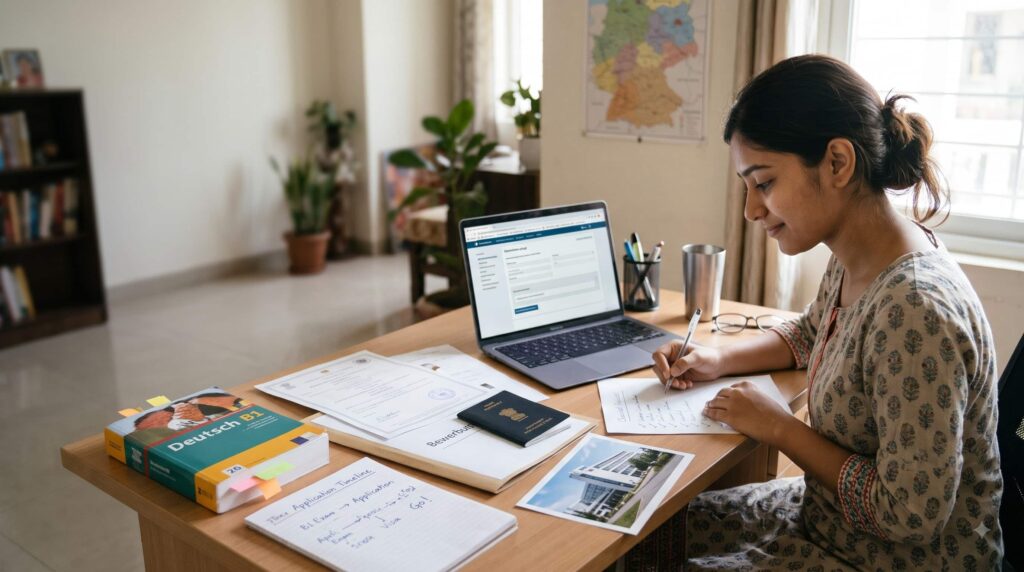
Nursing Ausbildung in Germany requires a 12th pass certificate, German language certification (B1 level for the visa, B2 level for the majority of hospitals’ contracts), a signed contract from any German hospital or nursing home, and a visa of Section 16a vocational training visa. The whole process will take around 12 to 18 months, starting from your first day of learning the German language until you arrive in Germany.
If you have been looking for “how to apply for nursing Ausbildung in Germany,” you will get all the answers here. You will know about the “nursing ausbildung requirements,” the actual application process, the visa documents, the salary offered, and the common mistakes leading to rejection of applications. In addition, we have included some useful tips from the trainers of Tiju’s Academy, who have sent hundreds of Kerala students to Germany through this program.
Let us begin with the basic information.
What Is Nursing Ausbildung in Germany?
Nursing Ausbildung in Germany is a three-year course that gives you a professional license to be a Pflegefachfrau (woman) or Pflegefachmann (man), which basically means that you become a general registered nurse. You get a monthly payment starting from day one of your training; you pay no tuition, and your qualification will be valid throughout all of Europe.
Ausbildung means training. In Germany, most occupations with special skills are acquired through this dual education system rather than a university program. Here is how this particular one works:
- Theory is acquired through a school of nursing (Pflegeschule or Berufsschule) where about 2,100 hours are spent over three years.
- Practice is carried out at your workplace, which could be either a hospital or a care home and amounts to about 2,500 hours.
- You are considered an employee who enters into a training contract and gets paid for the same.
- After completing your training, you get a state exam (Staatsexamen) which makes you a fully trained nurse.
As of 2020, there have been changes in Germany’s nursing education whereby all of the existing three nursing streams (allgemeine Pflege, pädiatrische Pflege, and altenpflege) have been integrated into one general stream of nursing as per the Pflegeberufegesetz (PflBG).
Why is Germany hiring so many foreign nurses?
The shortage of nurses in Germany is a reality, which is becoming more serious each day. The nation has an ageing population but lacks young German citizens in the field. It is for that reason that nowadays hospitals and care institutions hire young nurses from India, the Philippines, Vietnam and many other countries.
As far as Kerala residents are concerned, the profession of nursing is quite prestigious there. This means that one of the easiest ways for Indian students to move to Europe is through this program. We receive many first inquiries from families whose relatives are nurses in Germany.
Nursing Ausbildung Requirements: Are You Eligible?
The main requirements under the Ausbildung Nursing Germany eligibility criteria are easy to understand: You must have an equivalent of a German Class 10th or 12th school-leaving certificate, a German language proficiency certificate, a police clearance certificate, and good physical fitness. Here are all the detailed requirements:
Educational qualification
- Ausbildung in Germany after 12th is possible. A 12th pass in any stream is the minimum for nursing training. Science students have a small advantage, but it is not compulsory.
- After GNM or BSc Nursing: You can still apply for Ausbildung. Many Indian nurses choose this route because direct recognition (Anerkennung) of an Indian nursing degree can be slow. Some employers may shorten your training period if your existing qualification is assessed as partly equivalent.
- 10th pass plus a completed vocational course is accepted in some German states, but options are fewer.
German language requirement for Ausbildung
The German language requirement for Ausbildung in nursing works on two levels:
- B1 is the minimum for the visa application at the German embassy.
- B2 is what most hospitals ask for before they sign a contract with you, because you will be speaking with patients and doctors from your first week.
The certificate must be issued by an officially recognized testing body like Goethe-Institut, telc, or ÖSD. The certificates issued by some local institutions are not considered valid.
This is where most Indian applicants lose time. Reaching B2 from zero usually takes 8 to 12 months of serious study. Picking the best German course early matters more than anything else in the process. At Tiju’s Academy, our German language course is built around the specific vocabulary nurses need, with vocabulary grouped by daily situations such as patient handover, medication, and ward routines, so you are not just passing an exam but preparing for real work.
What is the Age limit for Ausbildung?
There is no age restriction to an Ausbildung in Germany. In practice, employers look for applicants aged between 18 and 35 years. However, an applicant aged more than 35 years may apply but will be required to have a convincing letter of motivation and healthcare experience.
Other requirements
- Valid passport having 12 months of validity
- Medical fitness certificate
- Police clearance certificate
- Vaccination records (Hepatitis B, MMR, and others as requested)
No IELTS is needed. Nursing Ausbildung in Germany without IELTS is the standard route. Germany only cares about your German level.
How to Apply for Nursing Ausbildung in Germany: Step by Step?
Here is the complete process in the correct order.
Step 1: Learn German to B1 or B2 level
This is where everything begins. No language certificate means no contract or visa, hence, you must join a proper German language course at the earliest.
- What to check while learning German language online or offline?
- Beginner German lessons without assuming any previous knowledge
- Grammar lessons explained in a language you can comprehend
- Listening exercises with native-style German, because the B2 listening section is where many students fail
- Exam preparation built into the course, not sold separately
At Tiju’s Academy, we run two programmes that students find especially useful in the early months. Infinite Drill uses short, game-style activities so that grammar sticks without feeling like a chore. Germflix is our German movie session, where students watch films and series with guided listening tasks to train their ear for natural speech.
Step 2: Collect and translate your documents
While you are studying, start preparing your paperwork. Every document must be translated into German by a sworn translator and attested.
- 10th and 12th mark sheets and certificates
- Degree or diploma certificates (if any)
- Passport copy
- Birth certificate
- APS certificate (required for Indian applicants since 2022 for academic verification; check the current rule for vocational visas at the time of application)
Step 3: Write your German CV and motivation letter
The format that German companies seek is very clear. It means that the Lebenslauf, which is a German CV, must be written on one to two pages in reverse chronological order with a professional photograph. In the Motivationsschreiben, also known as a motivation letter, candidates need to mention why they want to become a nurse and why they want to join Germany and this particular company.
It is the part that causes the most difficulty for students. That is why we founded the service Pro App Assistance within the Tiju’s Academy to train students to write their own CV and motivation letter.
Step 4: Find an employer and apply
You can apply directly to hospitals and care homes through their career pages, through portals like the Federal Employment Agency’s Ausbildung listings, or through a recognised placement partner. Send your application to several companies simultaneously. The response times may range between one week and two months.
Useful tips:
- Send your application 6-9 months in advance, before the common start dates of April, August, September, and October.
- The smaller cities will be less competitive than Berlin or Munich.
Care homes often reply faster than large hospitals.
Step 5: Clear the interview
The interviews typically take place online and in German and will last between 20 to 40 minutes. The questions asked will include questions about your experience, reasons for choosing nursing, dealing with stress and other basic situation questions.
Our students are prepared for this through our Dialect Studio program that gives them practice talking in German with a native German speaker and through our Reclaim Sessions that instill confidence. Hearing real German at real speed before your interview makes a big difference.
Step 6: Sign the Ausbildungsvertrag
Once selected, the employer sends you the training contract. Check it for:
- Start date and duration (three years)
- Monthly stipend for each year
- Working hours and holiday entitlement
- Name of the partner nursing school
Just sign it and retain the original as well as a scanned copy of it. This is the most significant piece of paper in your visa application.
Step 7: Applying for the Ausbildung visa
Make a booking for an interview at the German Embassy, New Delhi, or German Consulates in Chennai, Mumbai, Bengaluru, or Kolkata. The people of Kerala usually apply from Chennai/Bengaluru.
Step 8: Travel, register, and start
After landing, within two weeks you must register your address at the local Einwohnermeldeamt (residents’ office), open a bank account, and confirm your health insurance (Krankenversicherung), which your employer usually arranges. Then your training begins.
Documents Required for Ausbildung Visa Germany
Documents needed for Ausbildung visa Germany include the training agreement, certificate at level B1 or B2, proof of finance, health insurance, and documents related to education and identification. The following is the complete list for Section 16a visa:
- Fully completed national visa application form (in two copies)
- Valid passport and two biometric photos
- Signed Ausbildungsvertrag
- German language certification (Goethe, telc, or ÖSD)
Financial proof: either you have a blocked bank account (Sperrkonto) or a letter from your employer stating that your scholarship is sufficient for supporting yourself. Since nurses get paid more than the minimum requirement, a blocked bank account is not usually necessary.
- Travel health insurance for the first months
- Educational certificates with German translations
- CV and motivation letter
- Accommodation proof in Germany (provided by the employer)
- Application fee (75 euros)
How long will it take to receive an Ausbildung visa in Germany?
In general, it takes between 4 and 12 weeks to get an Ausbildung visa in Germany starting from the time of your appointment. Applications supported by a funding statement from the employer and all documents are processed quickly. The missing translation and outdated language certificate are the most frequent causes of processing delays.
Nursing Ausbildung Germany Salary: How Much Does It Pay?
The salary for nurse education in Germany is between 1,340 to 1,500 euros per month during education and 2,800 to 3,800 euros per month when qualified. This amounts to approximately 1.2 to 1.4 lakh rupees per month in case of training and 2.5 to 3.5 lakh rupees per month after qualification.
| Training year | Approximate monthly stipend (gross) |
| Year 1 | 1,340 euros |
| Year 2 | 1,400 euros |
| Year 3 | 1,500 euros |
| After Staatsexamen | 2,800 to 3,800 euros |
A few things to know about the training stipend (Ausbildungsvergütung):
- Public hospitals pay according to a collective agreement, so the figures are fairly fixed.
- Private care homes may pay slightly less but often provide cheaper staff accommodation.
- Night shifts, weekends, and public holidays carry extra pay even during training.
- Around 20 to 25 percent goes to tax and social insurance, which also gives you pension and health cover.
Is nursing Ausbildung in Germany free?
Yes. Nursing Ausbildung in Germany is free of tuition fees. You are paid to learn. The only costs you carry are before you leave India: your German course, exam fees, document translation, the visa fee, and your flight. Most students invest 2 to 4 lakh rupees, and much of it goes into the language classes; this is why selecting an economical and effective German language course becomes so important.
Ausbildung in Germany for Indian Nurses: What Happens After Three Years?
After passing your Staatsexamen, you become a licensed Pflegefachfrau/Pflegefachmann and can work wherever you like in Germany. Most hospitals will give you a permanent position because they have invested three years in you.
Your longer-term options:
- PR after Ausbildung: You can apply for permanent residence (Niederlassungserlaubnis) after just two years of qualified work following your training, provided you have B1 German and have paid into the pension system. That is one of the fastest PR routes in Germany.
- Specialisation: Intensive care, anaesthesia, paediatrics or oncology, each with a pay increase.
- Further study: Nursing management or a bachelor’s degree in nursing science.
- Family reunification: Once you are a qualified nurse with a stable income, your spouse and children can join you.
This is why Ausbildung in Germany for Indian nurses has become more popular than direct recruitment for many young graduates. You arrive earlier, you learn the German system from the inside, and your qualification never needs separate recognition.
Ausbildung in Germany from Kerala: Why Language Training Decides Everything
Students from Kerala have a strong record in the German nursing sector. Hospitals in Germany know the reputation of Kerala nurses in Germany, and that goodwill helps at the interview stage. But the same hospitals reject dozens of Malayali applicants every month for one reason: weak spoken German.
That is the gap Tiju’s Academy German training is built to close. We are widely regarded as the best German language institute in Kerala for Ausbildung aspirants, and here is what makes our approach different from a standard classroom:
- Fluency Alchemists: Our certified trainers take students from zero to fluent, with real-life conversation practice and speaking practice and role-plays from the very first month.
- Collocuts: Colloquial German shortcuts that teach how Germans actually speak, not just textbook sentences.
- Off Book Learning: Authentic German culture sessions led by experts, covering cultural tips and etiquette you will need on a German ward.
- Modmaster: Module-wise exam preparation so you master each section of the Goethe or telc exam one at a time.
- Bootcamp Exam Preps: Intensive sessions before every exam attempt to push your score up.
- Leistung Technique: Clear tips and tricks to reach the exact score you need.
- ICT Technique (Inner Circle Training): One-on-one attention so your trainer can work on your specific weak points, whether that is pronunciation training or a tricky grammar rule.
- Stressfrei: A calm, pressure-free learning space, because anxiety is the biggest enemy of fluency.
Our lessons are short and structured, with clear progress tracking and milestones so you always know how close you are to B1 or B2. And you are never alone; support from a teacher and community of fellow Ausbildung aspirants is part of every batch. Whether you prefer classroom learning in Kerala or German language training online from anywhere, the programme is the same.
Common Mistakes That Get Nursing Ausbildung Applications Rejected
- Stopping at A2 or a weak B1. Employers can hear it in the interview. Aim for B2 even if your visa only needs B1.
- Using an unrecognised language certificate. Only Goethe, telc and ÖSD count.
- Copying a motivation letter from the internet. German HR teams see the same templates every week.
- Paying huge fees to an unregistered agent. Genuine employers do not charge candidates for a contract.
- Applying only to big-city hospitals. Smaller towns have shorter waiting lists and lower rent.
- Letting your certificate expire. Some embassies want a certificate less than two years old at the time of application.
Conclusion
Applying for nursing Ausbildung in Germany is not complicated, but it is sequential. You cannot skip steps. Learn German to B2, get your documents translated, write a proper CV and motivation letter, secure a contract, apply for the Section 16a visa, and go. Do it right and you can be earning in Germany within 12 to 18 months of your first German lesson, with a clear path to permanent residence a few years later.
The single factor that decides how fast you get there is the quality of your language training. That is what Tiju’s Academy does best. Our German language course is designed by trainers who understand exactly what German hospitals and embassies expect from Ausbildung applicants, and our track record with Kerala students speaks for itself.
Ready to start? Book a free counselling session with Tiju’s Academy today. We will assess your eligibility, map out your timeline, and get you into the right batch, online or in Kerala, so you can begin your journey to becoming a Pflegefachfrau or Pflegefachmann in Germany.
Frequently Asked Questions:
A: Nursing Ausbildung is a three-year paid training programme that qualifies you as a Pflegefachfrau or Pflegefachmann, a registered general nurse. You study theory at a nursing school and work at a hospital or care home, with no tuition fees.
A: Yes. A 12th pass in any stream, plus a B1 or B2 German certificate, is enough to apply. Science students have a small advantage, but it is not compulsory.
A: Yes. Many Indian nurses choose Ausbildung because direct recognition (Anerkennung) of an Indian degree can be slow. Some employers may shorten your training if your qualification is assessed as partly equivalent.
A: B1 is the minimum for the visa. B2 is what most hospitals ask for before signing a contract, so plan for B2. The certificate must be from Goethe-Institut, telc, or ÖSD.
A: No. Germany only checks your German language level. IELTS is not part of the process.
A: There is no legal age limit. Most employers prefer candidates aged 18 to 35. Applicants above 35 can still apply with a strong motivation letter and healthcare experience.
A: Yes. There are no tuition fees, and you are paid a monthly stipend from day one. Your only costs are in India: German classes, exam fees, translations, the visa fee, and your flight, usually 2 to 4 lakh rupees in total.
A: Trainees earn about 1,340 to 1,500 euros per month gross, rising each year. After passing the Staatsexamen, salaries range from 2,800 to 3,800 euros per month.
A: You need the signed Ausbildungsvertrag, a B1 or B2 German certificate, proof of funds (blocked account or employer declaration), health insurance, passport, translated educational certificates, CV, motivation letter, and proof of accommodation.
A: Usually 4 to 12 weeks after your embassy appointment. Complete documents and an employer funding declaration speed up processing.
A: Yes. You can apply for permanent residence (Niederlassungserlaubnis) after two years of qualified work following your training, with B1 German and pension contributions.
A: Yes. Tiju's Academy offers the same German language classes online and in person, with the same trainers, exam preparation, and application support.